Combined Flow and Temperature Transmitter vs. Separate Instruments
1. What Is the Difference Between an Integrated Flow and Temperature Transmitter and Separate Instruments?
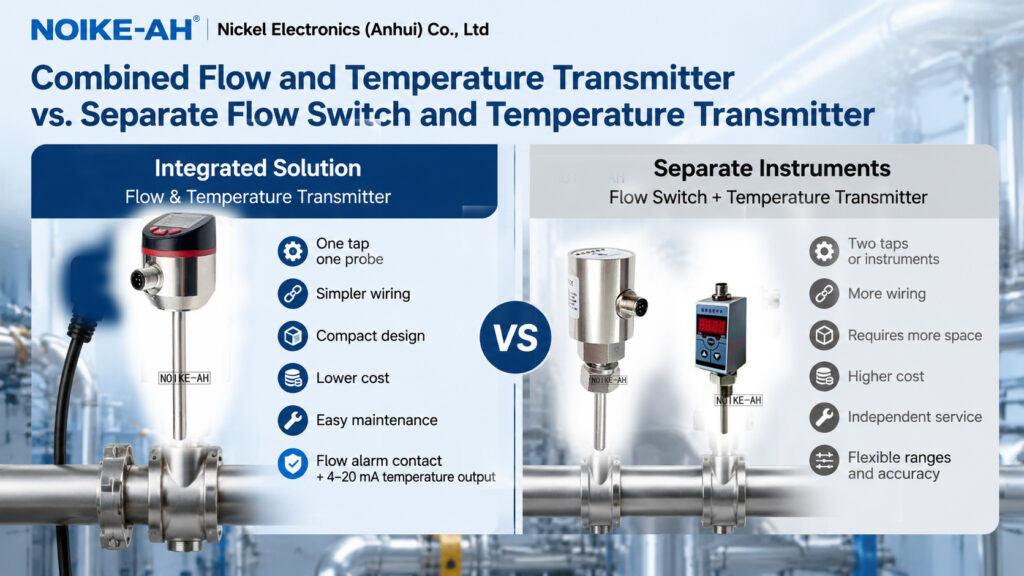
A combined flow and temperature transmitter monitors flow status and temperature using a single probe and housing. It provides a flow alarm switch contact and a 4–20 mA temperature output, often with an integrated LED display.
A separate arrangement uses two independent instruments: a flow switch for low-flow or no-flow alarms and a temperature transmitter for continuous temperature monitoring through a 4–20 mA signal.
The main difference is installation and measurement integration. An integrated transmitter is suitable when flow and temperature are monitored at the same location and the primary requirements are flow protection and temperature indication. Separate instruments are preferable when measurement points differ, independent measurement ranges or accuracy are required, or either instrument must be serviced without affecting the other.
2. What Are Integrated Flow and Temperature Transmitters and Separate Instruments?
2.1 Combined Flow and Temperature Transmitter
An integrated flow and temperature transmitter combines a thermal dispersion flow-sensing element and a temperature sensor in one probe housing. It provides a flow switch contact for threshold-based alarms and a temperature signal for monitoring.
This configuration reduces the number of installation points and simplifies wiring when both parameters are monitored at the same location.
2.2 Flow Switch
A flow switch detects whether flow has reached a configured threshold. It opens or closes an electrical contact when low-flow or no-flow conditions are detected, depending on the device’s switching configuration.
Flow switches are commonly used for equipment protection, interlocks, and alarm functions. They do not replace calibrated volumetric flow meters when precise flow measurement is required.
2.3 Temperature Transmitter (4–20 mA)
A temperature transmitter converts measured temperature into a 4–20 mA analog current signal. A PLC, SCADA system, or other compatible control system can use this signal for continuous temperature monitoring.
2.4 Single-Point Monitoring
Single-point monitoring means that flow status and temperature are measured at the same process location, using one installation point and probe position.
2.5 Thermal Dispersion Operating Principle
Thermal dispersion flow sensing uses heat transfer to detect fluid movement. Flow removes heat from a heated sensing element, and the resulting temperature difference or thermal response is used to determine flow status.
3. Integrated Flow and Temperature Transmitter vs. Separate Instruments
The following table summarizes the key differences between an integrated flow-temperature transmitter and a separate flow switch plus temperature transmitter.
| Comparison Factor | Integrated Flow and Temperature Transmitter | Separate Flow Switch + Temperature Transmitter |
|---|---|---|
| Installation points | One tap and probe | Typically two taps or installation points |
| Wiring | One device with shared housing and power arrangement | Two instruments with separate wiring and power arrangements |
| Installation space | Compact, single installation point | Requires more space for two devices |
| Cost | Generally lower for combined protection and indication | Generally higher because two instruments are required |
| Maintenance | One device to inspect and maintain | Independent servicing; one instrument can remain operational |
| Measurement ranges and accuracy | Shared housing; verify the temperature range and performance of the selected model | Each instrument can be selected for its own range and accuracy requirements |
| Best application | Same-point monitoring, flow alarms, and temperature indication | Different measurement locations or independent measurement requirements |
The most suitable configuration depends on measurement locations, control requirements, installation constraints, maintenance needs, and the specifications of the selected instruments.
4. When Should You Choose an Integrated Flow and Temperature Transmitter?
An integrated flow and temperature transmitter is suitable for applications where flow status and temperature need to be monitored at the same process location.
Typical selection conditions include:
- Cooling water monitoring: Detect low-flow or no-flow conditions while monitoring temperature in the same cooling-water line.
- Lubricating oil systems: Monitor flow status and temperature in a lubrication line.
- Pump protection circuits: Provide a flow alarm and temperature indication to support equipment protection.
- Limited installation space: Reduce the number of instruments and installation points.
- Reduced wiring requirements: Simplify installation by combining flow switching and temperature transmission in one device.
- Local indication and control: Use an LED display for local monitoring while transmitting temperature to a control system.
An integrated device is particularly appropriate when the objective is flow alarm protection plus temperature indication, rather than custody-transfer measurement, billing, or dedicated thermal energy measurement.
5. When Should You Choose a Separate Flow Switch and Temperature Transmitter?
Separate instruments are more suitable when flow and temperature monitoring have different requirements.
Consider a separate arrangement when:
- Measurement locations differ: Flow and temperature must be monitored at different positions, such as supply and return lines or a bearing and its associated fluid line.
- Independent measurement ranges are required: Each parameter requires a different operating range or performance specification.
- Different certifications are needed: Each instrument must meet its own certification or application requirements.
- Independent maintenance is important: One instrument may need to be removed or serviced while the other continues monitoring.
- Dedicated heat or energy calculation is required: The application needs appropriate temperature-difference and flow measurements rather than simple flow alarms and temperature indication.
- Independent calibration is necessary: Each instrument requires a separate calibration process to meet the application’s measurement requirements.
Selecting separate instruments provides greater flexibility when the two measurement functions cannot be adequately served by one integrated device.
6. Important Limitations of Integrated Flow and Temperature Transmitters
Before selecting an integrated flow and temperature transmitter, consider the following technical limitations.
6.1 It Is Not a Heat or Energy Meter
An integrated flow and temperature transmitter provides flow status and temperature indication. It does not replace a dedicated thermal energy measurement system.
Heat or energy calculation generally requires suitable flow measurement and the supply-return temperature difference (ΔT), together with the relevant fluid properties and calculation method.
6.2 Verify Model-Specific Specifications
Temperature range, measurement accuracy, power supply, probe material, and process compatibility depend on the selected model.
Confirm these specifications for the intended medium and operating conditions instead of assuming that all integrated devices share the same capabilities.
6.3 A Flow Switch Is Not a Calibrated Volumetric Flow Meter
A flow switch operates according to a configured threshold and provides a switching signal. It does not provide the same measurement function as a calibrated volumetric flow meter used for batch dispensing, quantitative flow measurement, or billing.
The instrument should therefore be selected according to whether the application requires flow-status detection or continuous, quantitative flow measurement.

7. NOIKE-AH NK500C Flow and Temperature Integrated Transmitter
The NOIKE-AH Flow & Temperature Integrated Transmitter NK500C combines thermal dispersion flow monitoring and temperature measurement in one compact device.
Its functions and available configurations include:
- Integrated flow and temperature monitoring: Combines both functions in one probe housing.
- LED display: Provides local indication of operating status and measured temperature, according to the model’s display configuration.
- Flow alarm switch output: Supports threshold-based flow alarms and equipment protection.
- 4–20 mA temperature output: Transmits temperature information to a compatible PLC, SCADA system, or other control equipment.
- Optional temperature switch output: Provides an additional temperature switching function when configured.
- Adjustable set point: Allows the switching threshold to be adjusted according to application requirements.
- Low pressure loss: Supports installation where minimizing process pressure loss is important.
- Waterproof housing: Provides protection against water ingress according to the specified model rating.
- Optional high-pressure version: Available in a version rated up to 600 bar.
- Optional corrosion-resistant version: Available for applications requiring enhanced resistance to the process medium.
The 600 bar pressure rating and corrosion-resistant configuration are optional versions, not standard specifications for every unit.
Before ordering, confirm the required temperature range, power supply, pressure rating, probe material, medium compatibility, and output configuration through a quotation.
Product Reference: NOIKE-AH Flow & Temperature Integrated Transmitter NK500C
8. Frequently Asked Questions About Integrated Flow and Temperature Transmitters
What is a combined flow and temperature transmitter?
A combined flow and temperature transmitter uses one probe housing to monitor flow status and temperature. It provides a flow alarm contact and a temperature output, such as a 4–20 mA analog signal.
Should I use an integrated transmitter or separate instruments for cooling water?
Choose an integrated transmitter when flow and temperature are monitored at the same point for flow alarms and temperature indication. Choose separate instruments when the measurement locations differ or when independent ranges, accuracy, certifications, or maintenance are required.
Does an integrated flow and temperature transmitter measure heat or thermal energy?
No. The device monitors flow status and indicates temperature. Thermal energy calculation requires suitable flow measurement, supply-return temperature difference (ΔT), and the necessary calculation parameters.
Can one device trigger a flow alarm and send temperature data to a PLC?
Yes. The flow switch contact can be connected to a compatible digital input for alarm or interlock functions, while the 4–20 mA temperature signal can be connected to an analog input for continuous monitoring.
The wiring, electrical ratings, and PLC input configuration must match the selected transmitter’s specifications.
Is the 600 bar pressure rating standard for every NK500C transmitter?
No. The 600 bar rating refers to an optional high-pressure version. Confirm the pressure rating and suitability of the selected configuration before ordering.
9. Related Articles and Product Information
For more information about flow switches, thermal dispersion sensing, and integrated flow-temperature monitoring, see the following resources:
- How Does a Thermal Flow Switch Work?
- Thermal Flow Switch: Working Principle and Applications
- Flow Meter vs. Flow Switch
- NOIKE-AH Flow & Temperature Integrated Transmitter NK500C
10. Technical References
The following manufacturers and product references provide additional information about integrated flow and temperature sensing:
Conclusion
An integrated flow and temperature transmitter combines flow alarm functionality and temperature monitoring in one compact device, making it suitable for single-point monitoring, equipment protection, and installations where space and wiring need to be reduced.
Separate flow switches and temperature transmitters offer greater flexibility when measurement locations, accuracy requirements, operating ranges, certifications, or maintenance needs differ.
For applications requiring both flow-status monitoring and temperature transmission, the NOIKE-AH NK500C provides an integrated option. Confirm the required specifications and optional configurations to ensure suitability for the actual operating conditions.