Integrated vs. Remote (Split) Electromagnetic Flow Meter: How to Choose the Right Type
1. Direct Answer: Integrated vs. Remote Electromagnetic Flow Meter
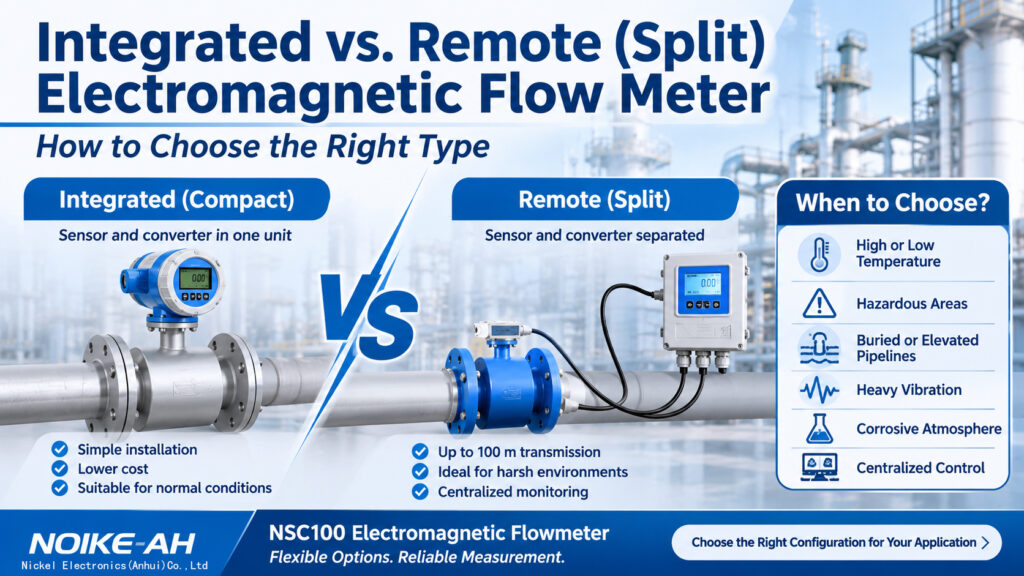
An integrated (compact) electromagnetic flow meter combines the sensor and converter into one unit mounted directly on the pipeline. It is suitable for normal operating conditions where ambient temperatures are moderate, vibration is low, and the display is easy to access.
A remote (split) electromagnetic flow meter separates the sensor installed on the pipeline from the converter and display, which can be mounted up to 100 m away, subject to the manufacturer’s specifications.
Choose a split electromagnetic flow meter when the measuring point is exposed to high or low ambient temperatures, located in a classified hazardous area, buried or elevated, difficult to access, subject to heavy vibration, or exposed to a corrosive atmosphere. It is also suitable when operators need centralized readings from multiple instruments in a control room.
Choose an integrated electromagnetic flow meter when the installation environment is moderate, the display is accessible, and lower cost and simpler installation are priorities.
2. What Is the Difference Between Integrated and Remote Electromagnetic Flow Meters?
Integrated and remote electromagnetic flow meters use the same basic electromagnetic flow measurement principle. The main difference is the physical arrangement of the sensor and converter.
2.1 Integrated Electromagnetic Flow Meter
An integrated, also called compact, electromagnetic flow meter combines the measuring sensor, converter, and display into one assembly mounted on the pipeline.
The flow reading can be checked directly at the installation point. Because there is no separate sensor-to-converter signal cable, the installation is generally simpler and more economical.
2.2 Remote (Split) Electromagnetic Flow Meter
A remote, or split, electromagnetic flow meter installs the sensor on the pipeline and connects it to a separate converter through a dedicated signal cable.
The converter and display can be positioned in a more convenient or suitable location, such as a control room or an area with more favorable ambient conditions. For the NOIKE-AH NSC100 split version, the transmission distance is up to 100 m, subject to the specified cable and installation requirements.
2.3 Key Components of an Electromagnetic Flow Meter
- Sensor: The measuring tube, electrodes, and excitation coils form the sensing assembly. The flow of a conductive liquid generates an induced voltage that is detected by the electrodes.
- Converter (transmitter): Processes the measurement signal, displays the flow reading, and provides outputs such as 4–20 mA, pulse, and digital communication signals.
- Signal cable: In a remote configuration, the dedicated cable connects the sensor and converter. Its type and length must comply with the manufacturer’s specifications.
- Separation distance: The distance between the sensor and converter must remain within the specified maximum transmission distance.
3. Integrated vs. Split Electromagnetic Flow Meter: Side-by-Side Comparison
| Comparison Aspect | Integrated (Compact) | Remote (Split) |
|---|---|---|
| Construction | Sensor and converter combined in one unit | Sensor and converter installed separately |
| Display location | Directly on the pipeline | At the remote converter location |
| Suitable environment | Moderate ambient conditions; accessible installation points | Hot or cold environments, hazardous areas, buried or elevated lines, and locations affected by vibration |
| Signal cable | No separate cable between sensor and converter | Dedicated shielded signal cable required |
| Installation cost | Generally lower | Generally higher due to additional wiring and setup |
| Installation complexity | Simpler | Requires cable routing and additional installation planning |
| Maintenance access | Access the complete unit at the measuring point | Read the display at a convenient remote location |
| Typical applications | Standard water and process pipelines | Control rooms, harsh environments, remote measuring points, and centralized monitoring |
4. When Should You Choose a Split Electromagnetic Flow Meter?
A remote or split electromagnetic flow meter is a suitable choice when the local installation conditions make an integrated converter difficult to operate, access, or maintain.
4.1 High or Low Ambient Temperature
If the converter cannot tolerate the ambient temperature or heat radiation around the pipeline, a split configuration allows the electronics to be installed in a more suitable environment.
Always verify the permitted ambient temperature range for the selected converter.
4.2 Classified Hazardous Areas
When the measuring point is in a classified hazardous area, the converter may need to be installed outside the classified zone according to the applicable certified equipment configuration and installation requirements.
A split design can help separate the converter from the measuring point, but the complete installation must still comply with the relevant hazardous-area requirements.
4.3 Buried, Underground, or Elevated Pipelines
For underground pipelines, inspection vaults, overhead installations, and other difficult-to-access locations, checking a display mounted directly on the pipe may be inconvenient.
A remote converter allows operators to read the measurement at a more accessible location.
4.4 Heavy Mechanical Vibration
Pumps and reciprocating equipment can generate mechanical vibration. When vibration makes an on-pipe converter or display installation unsuitable, separating the converter can help place the electronics in a more stable location.
The sensor installation and signal cable routing must still follow the manufacturer’s recommendations.
4.5 Corrosive Atmospheres
Chemical vapors, hydrogen sulfide (H₂S), chlorine, and other corrosive substances may attack converter housings or exposed electrical components, depending on the materials and environmental conditions.
A remote configuration allows the converter to be installed in a more suitable atmosphere. Confirm the housing protection and material compatibility for the actual application.
4.6 Centralized Monitoring in a Control Room
In facilities with multiple electromagnetic flow meters, operators may prefer to monitor readings from a centralized control room rather than visit each pipeline.
A remote configuration can support this arrangement when the selected converter and communication system meet the application’s requirements.

5. When Is an Integrated Electromagnetic Flow Meter the Better Choice?
An integrated electromagnetic flow meter is generally suitable when:
- Ambient temperature is within the instrument’s permitted operating range.
- The meter is installed in an accessible location.
- Mechanical vibration is low.
- The surrounding atmosphere is not corrosive to the converter housing.
- Operators can conveniently read the display at the pipeline.
- A lower-cost, simpler installation is preferred.
For ordinary water and process pipelines under suitable operating conditions, an integrated electromagnetic flow meter is often the straightforward choice.
Its main advantages are a compact structure, fewer installation connections, and no separate signal cable between the sensor and converter.
6. Split Electromagnetic Flow Meter Installation: Key Considerations
Correct installation is important for maintaining reliable signal transmission and convenient operation.
6.1 Use the Specified Signal Cable
Use the manufacturer’s dedicated shielded signal cable and keep the cable run within the permitted maximum separation distance.
Do not replace the specified cable with generic wiring unless the manufacturer explicitly permits it.
6.2 Route the Signal Cable Correctly
Keep the signal cable away from power cables and other potential sources of electrical interference where required. Follow the manufacturer’s grounding and shielding instructions.
6.3 Plan the Converter Location
Before installation, select a converter position that provides convenient reading, safe access, and suitable environmental conditions.
Consider ambient temperature, exposure to corrosive substances, maintenance requirements, and cable routing.
6.4 Verify Hazardous-Area Certification
For installations in classified hazardous areas, confirm the certification and approved equipment configuration for the selected model.
Moving the converter outside a hazardous zone does not, by itself, make the complete flow meter installation explosion-proof.

7. Limitations of Integrated and Remote Electromagnetic Flow Meters
Selecting an integrated or split configuration determines how the sensor and converter are installed. It does not independently determine all the instrument’s performance or environmental suitability.
Consider the following limitations before selection:
- Hazardous-area certification: A split configuration does not automatically certify the meter for use in a hazardous area. Verify the applicable certification and approved installation layout.
- Maximum cable length: Exceeding the specified sensor-to-converter distance or using an unsuitable cable may degrade signal quality.
- Temperature rating: Separating the converter does not automatically extend the rated operating temperature of the sensor or the complete instrument.
- Medium compatibility: The measuring tube lining and electrode materials must be selected according to the measured liquid.
- Pressure requirements: Confirm the pressure rating for the actual pipeline operating conditions.
- Installation conditions: The final selection must account for the medium, operating environment, cable requirements, and applicable certifications.
Therefore, compact-versus-split configuration should be considered alongside the medium characteristics, operating conditions, and instrument specifications.

8. NOIKE-AH NSC100 Electromagnetic Flow Meter: Integrated and Split Options
The NOIKE-AH NSC100 Electromagnetic Flowmeter is available in both integrated and split configurations.
The integrated version combines the sensor and converter for on-site display. The split version separates the sensor and converter, with a transmission distance of up to 100 m. The sensor and converter mounting directions are interchangeable according to the product’s published specifications.
Published Product Specifications
| Parameter | Published Specification |
|---|---|
| Model | NSC100 |
| Installation configuration | Integrated or split |
| Split transmission distance | Up to 100 m |
| Converter accuracy | Class 0.2 |
| Turndown ratio | Up to 1:150 |
| Sensor size | DN3–DN2800 |
| Flow velocity range | 0.01–12 m/s |
| Output signals | 4–20 mA, pulse, frequency |
| Communication options | Modbus (RS485), HART, or GPRS |
The final configuration should be selected according to the application requirements. Confirm the applicable cable specification, ambient temperature limits, communication options, and any hazardous-area certification when requesting a quotation.
For additional information, visit the NOIKE-AH NSC100 Electromagnetic Flowmeter product page.
9. Frequently Asked Questions (FAQ)
Q1. What is the difference between an integrated and a remote electromagnetic flow meter?
An integrated electromagnetic flow meter combines the sensor and converter in one unit mounted on the pipeline. A remote, or split, electromagnetic flow meter installs the sensor and converter separately and connects them with a dedicated signal cable.
Q2. When should I choose a split electromagnetic flow meter?
Choose a split configuration when the installation involves unsuitable ambient temperatures for the converter, a classified hazardous area, buried or elevated pipelines, difficult access, heavy vibration, a corrosive atmosphere, or centralized control-room monitoring.
Q3. How far can a remote electromagnetic flow meter converter be installed from the sensor?
The permitted distance depends on the manufacturer’s specifications and the cable used. For the NOIKE-AH NSC100 split version, the published transmission distance is up to 100 m. The specified signal cable must be used.
Q4. Does a split electromagnetic flow meter automatically become explosion-proof?
No. Separating the converter can help position the electronics outside a classified zone, but hazardous-area suitability depends on the applicable certification, equipment configuration, and installation requirements.
Q5. Which is more economical: an integrated or split electromagnetic flow meter?
An integrated model is generally less expensive and simpler to install because it does not require a separate sensor-to-converter signal cable. A split model adds wiring and installation requirements but can be more suitable for harsh, remote, or difficult-to-access measuring points.
Q6. Does choosing a split electromagnetic flow meter change its measurement principle?
No. Both integrated and split electromagnetic flow meters use the same basic electromagnetic measurement principle. The primary difference is the physical separation of the sensor and converter.
Q7. Can I choose the integrated or split version based only on pipeline size?
No. Pipeline size is only one selection factor. Ambient temperature, accessibility, vibration, corrosive exposure, cable distance, medium compatibility, pressure rating, and hazardous-area requirements must also be considered.
10. Related Reading
Explore these related resources to learn more about electromagnetic flow measurement and instrument selection:
- Electromagnetic Flowmeters for Wastewater
- Electromagnetic vs. Ultrasonic Flowmeter
- Electromagnetic Flowmeter Overview
- Electromagnetic Flowmeter NSC100
- Integrated vs split interference and decision tree
Conclusion
Choosing between an integrated and a remote electromagnetic flow meter depends primarily on the installation environment, display accessibility, wiring requirements, and maintenance needs.
An integrated electromagnetic flow meter is generally suitable for accessible pipelines with moderate ambient conditions and low vibration. A split electromagnetic flow meter is worth considering when the converter needs to be positioned away from high or low ambient temperatures, difficult-to-access measuring points, corrosive environments, or areas requiring a specific certified installation arrangement.
The NOIKE-AH NSC100 is available in both configurations, allowing the installation arrangement to be selected according to the application.
Contact the NOIKE-AH team for model selection, configuration recommendations, and a quotation based on your actual operating conditions.