
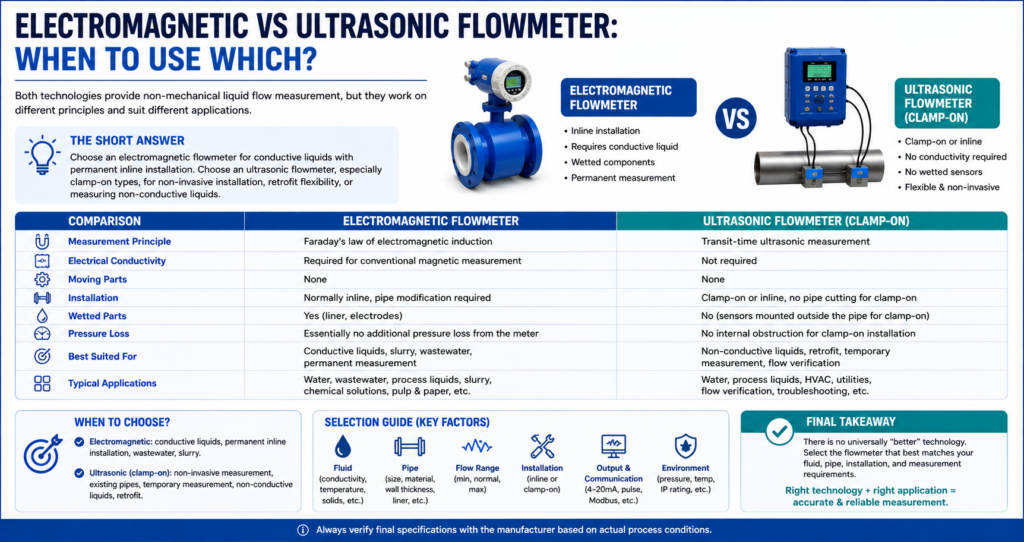
Electromagnetic vs ultrasonic flowmeters is a common comparison when selecting a flow measurement technology for industrial liquid applications. Both technologies can provide accurate, non-mechanical flow measurement, but they use fundamentally different measurement principles and have different application requirements.
The short answer is: choose an electromagnetic flowmeter when measuring a sufficiently conductive liquid and a permanent inline installation is acceptable. Choose an ultrasonic flowmeter, particularly a clamp-on design, when non-invasive installation, retrofit flexibility, or measurement of liquids unsuitable for electromagnetic measurement is important.
The final selection should always be based on the fluid properties, pipe characteristics, flow range, installation conditions, and required measurement performance.
Quick Answer: Electromagnetic vs Ultrasonic Flowmeter
| Factor | Electromagnetic Flowmeter | Ultrasonic Flowmeter |
|---|---|---|
| Measurement principle | Faraday’s law of electromagnetic induction | Measurement of ultrasonic propagation |
| Electrical conductivity | Required for conventional magnetic flow measurement | Not required |
| Moving parts | None | None |
| Installation | Normally inline | Inline or clamp-on, depending on design |
| Pipe modification | Normally required for inline installation | Clamp-on installation normally does not require pipe cutting |
| Wetted parts | Yes, for conventional inline designs | None for clamp-on sensors |
| Pressure loss | Essentially no additional pressure loss from the meter’s internal measurement principle | No internal obstruction for clamp-on installation |
| Water measurement | Excellent application | Excellent application |
| Wastewater | Common application | Application dependent |
| Conductive slurry | Often suitable with proper materials | Application dependent |
| Non-conductive liquids | Generally unsuitable for conventional magnetic measurement | Can be suitable, depending on acoustic conditions |
| Temporary measurement | Less convenient | Particularly suitable with portable clamp-on systems |
| Retrofit installation | May require pipe modification | Major advantage of clamp-on designs |
Key takeaway
Electromagnetic flowmeters are primarily selected according to liquid conductivity, while ultrasonic flowmeters are selected according to acoustic conditions and installation requirements.
1. What Is an Electromagnetic Flowmeter?
An electromagnetic flowmeter, also called a magnetic flowmeter or magmeter, measures the flow of electrically conductive liquids using the principle of electromagnetic induction.
According to Faraday’s law, when a conductive liquid moves through a magnetic field, an electrical voltage is induced. Electrodes installed in the measuring tube detect this voltage, and the transmitter processes the signal to determine the liquid flow velocity and volumetric flow rate.
In simplified form:
Induced voltage ∝ magnetic field strength × fluid velocity × electrode spacing
Because the measurement does not depend on mechanical rotation or displacement, conventional electromagnetic flowmeters have no moving parts in the measuring tube.
Typical electromagnetic flowmeter applications
Electromagnetic flowmeters are commonly considered for:
- Water
- Wastewater
- Cooling water
- Industrial process water
- Conductive chemical solutions
- Pulp and paper processes
- Conductive slurries
- Other electrically conductive liquids
The suitability of the specific meter depends on the manufacturer’s conductivity, temperature, pressure, liner and electrode specifications.
2. What Is an Ultrasonic Flowmeter?
An ultrasonic flowmeter uses ultrasonic sound waves to determine fluid velocity and flow rate.
Several ultrasonic measurement methods exist. For many industrial liquid applications, transit-time ultrasonic flowmeters are particularly important.
In a transit-time system, ultrasonic signals travel between transducers in different directions through the fluid. Because the fluid is moving, the propagation time differs depending on the direction of travel. The flowmeter uses this difference to determine flow velocity.
For a clamp-on ultrasonic flowmeter, the ultrasonic transducers are mounted on the outside of the pipe.
This means the pipe normally does not need to be cut or opened during installation.
Typical ultrasonic flowmeter applications
Depending on the instrument design and application conditions, ultrasonic flowmeters can be considered for:
- Water
- Process liquids
- Cooling water
- Industrial utilities
- Non-conductive liquids
- Existing pipelines
- Temporary flow measurement
- Flow verification and troubleshooting
However, ultrasonic flow measurement is not automatically suitable for every liquid. The fluid, pipe material, wall thickness, coating, installation arrangement and acoustic conditions must be evaluated.
3. Electromagnetic vs Ultrasonic Flowmeter: Main Technical Difference
The fundamental difference between these technologies is their measurement principle.
Electromagnetic flowmeter
The measurement depends on the interaction between:
Magnetic field + conductive liquid + fluid velocity
Therefore, electrical conductivity is a fundamental consideration.
Ultrasonic flowmeter
The measurement depends on:
Ultrasonic signal propagation + fluid movement + acoustic conditions
Electrical conductivity is not the measurement requirement.
This distinction provides a useful first-stage selection rule:
If the liquid is conductive, electromagnetic technology should be considered. If electrical conductivity is unsuitable or non-invasive installation is important, ultrasonic technology may be a better starting point.
This is only a preliminary selection rule. The actual application must still be checked against the manufacturer’s specifications.
4. When Should You Choose an Electromagnetic Flowmeter?
4.1 When the liquid is electrically conductive
This is the most important requirement.
Conventional electromagnetic flowmeters require the process liquid to have sufficient electrical conductivity for the selected instrument.
Typical applications include:
- Municipal water
- Wastewater
- Cooling water
- Process water
- Conductive chemical liquids
- Conductive slurry
The exact minimum conductivity is model-dependent. There is no single conductivity value that applies to every electromagnetic flowmeter.
Therefore, engineers should always check the manufacturer’s datasheet before making the final selection.
4.2 When measuring wastewater
Electromagnetic flowmeters are widely used in wastewater applications because wastewater is generally conductive.
Their non-mechanical measuring principle also makes them attractive for liquids containing suspended solids.
However, the actual application still requires evaluation of:
- Conductivity
- Solids concentration
- Particle characteristics
- Temperature
- Pressure
- Liner material
- Electrode material
Material selection is particularly important when the fluid is chemically aggressive or abrasive.
4.3 When measuring conductive slurry
Electromagnetic flowmeters can be suitable for conductive slurry applications.
Because the measuring tube does not rely on rotating mechanical components, there are no internal mechanical moving parts that directly measure the flow.
For slurry service, however, the selection of liner and electrode materials is critical.
The engineer should consider:
- Chemical compatibility
- Abrasion resistance
- Operating temperature
- Operating pressure
- Particle characteristics
- Solids concentration
A generic electromagnetic flowmeter specification should not automatically be applied to every slurry application.
4.4 When permanent inline installation is acceptable
An inline electromagnetic flowmeter is installed directly into the process pipeline.
This makes it suitable for permanent flow measurement systems where:
- The pipe can be modified during installation;
- Process shutdown is available;
- A dedicated flowmeter installation point exists;
- Continuous measurement is required.
For long-term process monitoring, this can provide a practical and robust measurement arrangement.
5. When Should You Choose an Ultrasonic Flowmeter?
5.1 When pipe modification should be avoided
This is one of the strongest advantages of clamp-on ultrasonic flowmeters.
Because the sensors are installed outside the pipe, the installation normally does not require:
- Cutting the pipe
- Welding a flowmeter body into the line
- Draining the pipeline
- Opening the process line
This can be particularly useful for existing operating systems.
Typical applications include:
- Existing water pipelines
- HVAC water systems
- Industrial utility lines
- Flow surveys
- Temporary measurement
- System commissioning
- Troubleshooting
5.2 When temporary measurement is required
Portable clamp-on ultrasonic flowmeters can be useful when the flowmeter does not need to remain permanently installed.
For example, an engineer may need to:
- Measure the flow of an existing pipeline.
- Verify the performance of an installed flowmeter.
- Investigate an unexpected flow condition.
- Perform an energy or system assessment.
- Collect temporary operating data.
After measurement, the sensors can be removed without permanently modifying the pipe.
5.3 When the liquid is electrically non-conductive
Unlike conventional electromagnetic flowmeters, ultrasonic flowmeters do not depend on electrical conductivity as the measurement principle.
Therefore, ultrasonic technology can be considered for some liquids that cannot be measured using conventional magnetic flowmeters.
However:
Non-conductive does not automatically mean ultrasonic-compatible.
The ultrasonic signal must be able to propagate through the pipe and fluid with sufficient quality.
Important factors include:
- Fluid composition
- Fluid temperature
- Pipe material
- Pipe wall thickness
- Pipe diameter
- Pipe coating or liner
- Sensor installation
- Acoustic coupling
6. Electromagnetic vs Ultrasonic Flowmeter: Installation Comparison
Installation is often the deciding factor between the two technologies.
Electromagnetic flowmeter installation
An inline electromagnetic flowmeter normally requires installation within the pipeline.
Important considerations include:
- Flow direction
- Pipe filling condition
- Grounding
- Electrode orientation
- Upstream and downstream piping
- Pipe size
- Liner compatibility
- Electrode compatibility
The manufacturer’s installation instructions should always be followed.
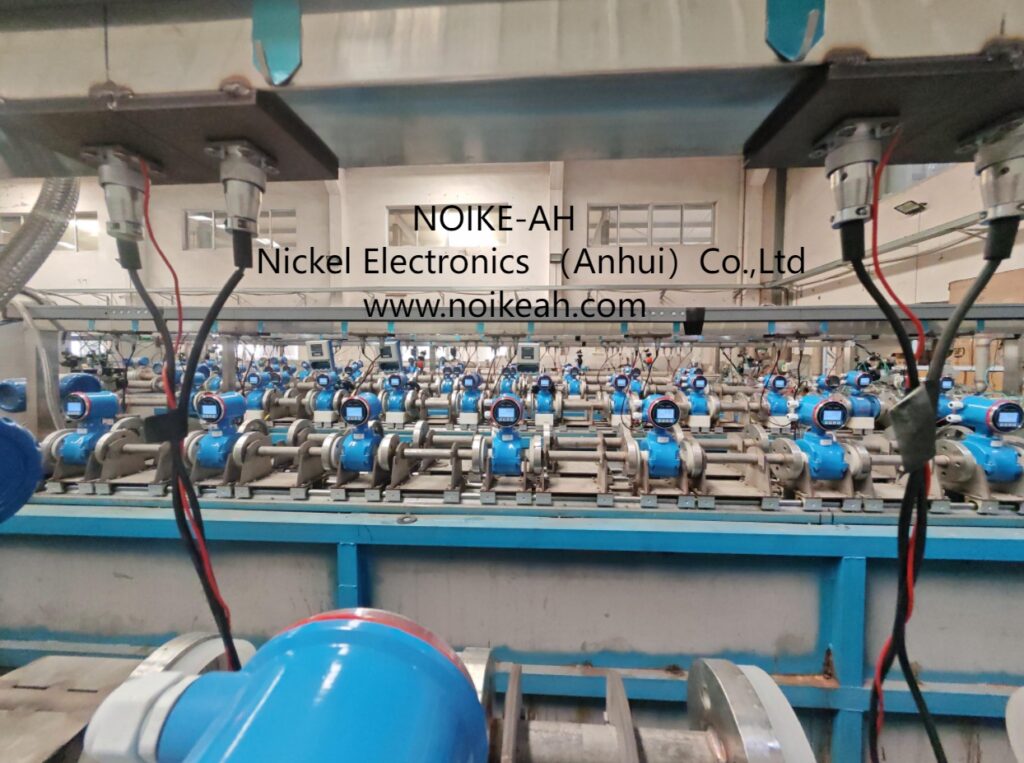
Clamp-on ultrasonic installation
A clamp-on ultrasonic flowmeter is installed externally.
Before installation, engineers typically need information such as:
- Pipe outside diameter
- Pipe wall thickness
- Pipe material
- Pipe liner or coating
- Fluid type
- Fluid temperature
- Approximate flow conditions
The sensor position and acoustic coupling are important because poor installation can result in weak or unstable ultrasonic signals.
7. Accuracy: Which Is More Accurate?
There is no technically correct universal answer that electromagnetic flowmeters are always more accurate than ultrasonic flowmeters, or vice versa.
Accuracy depends on the specific instrument and application.
Important variables include:
- Flow range
- Flow velocity
- Pipe diameter
- Flow profile
- Fluid properties
- Installation conditions
- Sensor configuration
- Calibration
- Temperature
- Signal quality
For this reason, comparing only the headline accuracy specification is not enough.
A better engineering question is:
Which flowmeter can meet the required accuracy under the actual operating conditions?
This approach avoids selecting a technology based only on a laboratory or datasheet number that may not represent the final installation.
8. Pressure Loss: Electromagnetic vs Ultrasonic
Both technologies can provide an important advantage over mechanical flowmeters because they do not need rotating mechanical elements to determine flow.
Electromagnetic flowmeter
The conventional electromagnetic measuring tube has no mechanical measuring element projecting into the flow path.
Therefore, the meter does not introduce the type of mechanical restriction associated with some mechanical flowmeter designs.
Clamp-on ultrasonic flowmeter
The sensors are mounted outside the pipe.
The internal pipe diameter is therefore unchanged by the measurement system, and the clamp-on installation does not introduce an internal flow obstruction.
9. Maintenance Comparison
Both technologies can provide relatively low-maintenance flow measurement because they do not use conventional moving mechanical measuring components.
However, the maintenance considerations are different.
Electromagnetic flowmeter
Potential considerations include:
- Electrode deposits
- Liner condition
- Grounding
- Electrical interference
- Pipe filling
- Material compatibility
Ultrasonic flowmeter
Potential considerations include:
- Sensor positioning
- Acoustic coupling
- Pipe parameter settings
- Pipe coating
- Fluid acoustic properties
- Signal quality
Therefore, low mechanical maintenance does not eliminate the need for correct installation and periodic system verification.
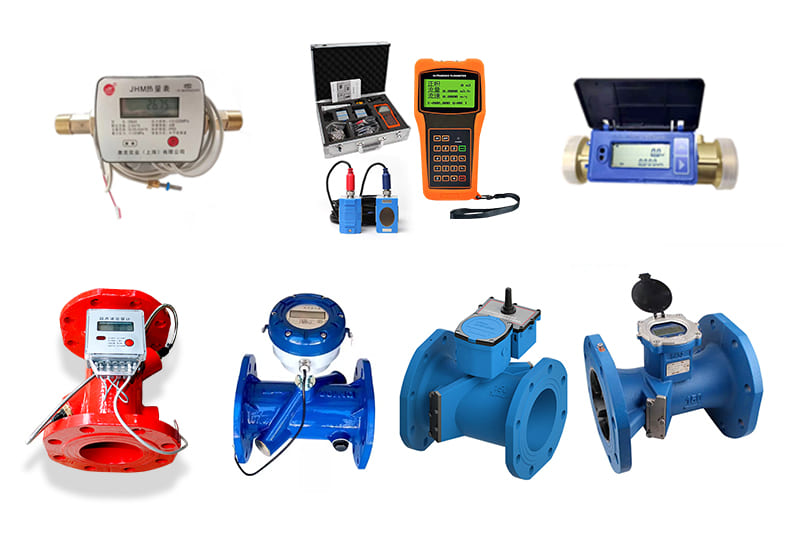
10. Electromagnetic vs Ultrasonic Flowmeter: Application Selection Guide
The following table can be used as a preliminary selection guide.
| Application Requirement | Preferred Starting Technology |
|---|---|
| Conductive water | Electromagnetic |
| Municipal wastewater | Electromagnetic |
| Conductive process liquid | Electromagnetic |
| Conductive slurry | Electromagnetic, application-specific |
| Existing pipeline cannot be cut | Clamp-on ultrasonic |
| Temporary flow measurement | Clamp-on ultrasonic |
| Flow verification | Clamp-on ultrasonic |
| Non-conductive liquid | Ultrasonic, subject to acoustic suitability |
| Permanent inline process measurement | Electromagnetic or ultrasonic |
| Retrofit without process interruption | Clamp-on ultrasonic may be advantageous |
| External/non-invasive measurement | Clamp-on ultrasonic |
Important: This table provides an initial technology selection only. The final flowmeter model must be selected according to the manufacturer’s specifications and the actual process conditions.
11. How to Select Between Electromagnetic and Ultrasonic Flowmeters
A practical flowmeter selection process should follow several steps.
Step 1: Identify the fluid
Determine:
- Fluid name
- Conductivity
- Viscosity
- Temperature
- Pressure
- Suspended solids
- Gas or air content
Step 2: Check the pipe
Record:
- Nominal pipe diameter
- Outside diameter
- Pipe material
- Wall thickness
- Internal liner
- External coating
- Existing fittings
Step 3: Determine the flow range
Define:
- Minimum flow
- Normal flow
- Maximum flow
The selected flowmeter should operate within its specified measurement range under actual process conditions.
Step 4: Determine installation requirements
Ask:
Can the pipe be cut?
If yes, an inline electromagnetic flowmeter may be a suitable option for conductive liquids.
If no, a clamp-on ultrasonic flowmeter may provide a practical alternative, provided the acoustic conditions are appropriate.
Step 5: Define the required outputs
Depending on the automation system, requirements may include:
- 4–20 mA
- Pulse output
- Relay output
- RS485
- Modbus RTU
- HART
- Digital communication
- Local display
The availability of each output depends on the selected instrument.
Step 6: Confirm environmental requirements
Consider:
- Ambient temperature
- Process temperature
- Humidity
- Outdoor installation
- Protection rating
- Vibration
- Hazardous-area requirements
- Electrical interference
Step 7: Confirm the manufacturer’s specifications
Before placing an order, verify:
- Measurement range
- Accuracy
- Repeatability
- Pressure rating
- Temperature rating
- Conductivity requirement
- Pipe size
- Wetted materials
- Installation requirements
- Output signals
- Communication protocols
- Certification requirements
This final verification step is essential because specifications vary between manufacturers and models.
12. Electromagnetic vs Ultrasonic Flowmeter for Common Industries
Water Treatment
Electromagnetic flowmeters are widely considered for conductive water and wastewater measurement.
Typical applications include:
- Raw water
- Treated water
- Wastewater
- Sludge-related applications
- Process water
HVAC and Building Services
Both technologies can be considered for chilled-water and cooling-water measurement.
An electromagnetic flowmeter can be a strong option for permanent conductive-water measurement.
A clamp-on ultrasonic flowmeter can be particularly useful when an existing HVAC pipeline needs to be measured without major pipe modification.
Chemical Processing
The choice depends strongly on the chemical properties.
For conductive chemicals, electromagnetic measurement may be appropriate when the liner and electrode materials are compatible.
For non-conductive liquids, ultrasonic measurement may be considered if the acoustic conditions are suitable.
Material compatibility should always be confirmed before selection.
Industrial Utilities
Industrial utility systems often contain existing pipelines where shutdown and pipe modification are undesirable.
In these situations, clamp-on ultrasonic flow measurement can provide significant installation flexibility.
For permanent installations, both technologies may be considered depending on the fluid and system design.
13. Common Flowmeter Selection Mistakes
Mistake 1: Selecting only by pipe size
Pipe size is important, but it is not enough.
A correct selection also requires information about:
- Fluid
- Conductivity
- Flow range
- Temperature
- Pressure
- Installation conditions
Mistake 2: Assuming ultrasonic means “universal”
Ultrasonic flowmeters are flexible, but they still have application limitations.
Poor acoustic conditions can affect signal quality and measurement performance.
Mistake 3: Assuming electromagnetic works for all liquids
It does not.
Conventional electromagnetic flowmeters require a sufficiently conductive liquid.
Many electrically insulating liquids are therefore unsuitable.
Mistake 4: Comparing accuracy numbers without considering installation
A flowmeter’s specified accuracy does not guarantee the same performance in every installation.
Installation conditions and process parameters matter.
Mistake 5: Ignoring material compatibility
For chemical or abrasive applications, the liner and electrode materials of an electromagnetic flowmeter must be compatible with the process fluid.
For ultrasonic systems, pipe material, liner and acoustic characteristics must also be considered.
14. Frequently Asked Questions
Is an electromagnetic flowmeter better than an ultrasonic flowmeter?
Not universally.
An electromagnetic flowmeter is often a strong choice for conductive liquids and permanent inline installations. An ultrasonic flowmeter can be advantageous when non-invasive installation, retrofit flexibility or temporary measurement is required.
What is the main difference between electromagnetic and ultrasonic flowmeters?
An electromagnetic flowmeter measures the flow of conductive liquids using electromagnetic induction.
An ultrasonic flowmeter measures flow using ultrasonic signal propagation.
Therefore, electromagnetic measurement depends on electrical conductivity, while ultrasonic measurement depends primarily on suitable acoustic conditions.
Can ultrasonic flowmeters measure non-conductive liquids?
Yes, depending on the measurement method, fluid and pipe conditions.
Unlike electromagnetic flowmeters, ultrasonic flowmeters do not require the liquid to be electrically conductive. However, acoustic compatibility must still be confirmed.
Can electromagnetic flowmeters measure wastewater?
Yes. Electromagnetic flowmeters are commonly used for conductive wastewater applications.
The exact meter should be selected according to conductivity, solids, temperature, pressure, liner and electrode requirements.
Which flowmeter is easier to install?
For existing pipelines, a clamp-on ultrasonic flowmeter is generally easier to install because the sensors are mounted externally and the pipe normally does not need to be cut.
Which flowmeter has moving parts?
Conventional electromagnetic and ultrasonic flowmeters do not rely on mechanical moving parts to measure flow.
Which is better for permanent installation?
For conductive liquids, an inline electromagnetic flowmeter is often a strong choice for permanent installations.
However, ultrasonic flowmeters can also be used for permanent applications when their measurement and installation requirements are satisfied.
15. Final Selection: Electromagnetic or Ultrasonic?
The choice between an electromagnetic and ultrasonic flowmeter should be based on the actual application rather than on a simple “which technology is better” comparison.
Choose an electromagnetic flowmeter when:
- The liquid is electrically conductive.
- Permanent inline installation is acceptable.
- Water, wastewater or conductive process liquids are being measured.
- Conductive slurry measurement is required and suitable materials are available.
- A robust, non-mechanical measurement principle is preferred.
Choose an ultrasonic flowmeter when:
- Non-invasive measurement is important.
- The existing pipe should not be cut.
- Temporary or portable measurement is required.
- Retrofit installation needs to be simple.
- The liquid is not suitable for conventional electromagnetic measurement.
- The pipe and fluid provide suitable acoustic conditions.
Final Takeaway
Electromagnetic vs ultrasonic flowmeter selection is ultimately an application-engineering decision.
The most important parameters are not simply price or advertised accuracy. Engineers should evaluate:
Fluid → Conductivity → Flow Range → Pipe → Installation → Temperature → Pressure → Materials → Accuracy → Outputs
For a permanent installation involving conductive water or wastewater, an electromagnetic flowmeter is often an excellent starting point.
For an existing pipeline where pipe modification is difficult, or when temporary/non-invasive measurement is required, a clamp-on ultrasonic flowmeter may provide a more practical solution.
The correct technology is the one that matches the actual process conditions and installation requirements and whose published specifications can be verified for the intended application.



