How to Choose a Flow Meter for High-Viscosity Liquids
Direct Answer
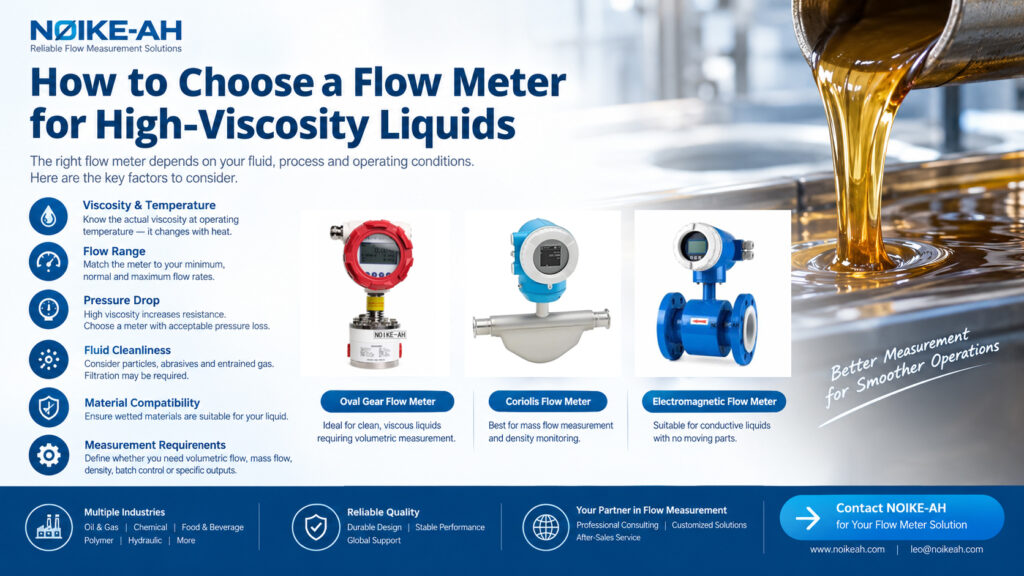
Selecting a flow meter for high-viscosity liquids requires evaluating the fluid’s viscosity at its actual operating temperature, the required flow range, allowable pressure drop, fluid cleanliness, and measurement accuracy.
Positive displacement flow meters, particularly oval gear flow meters, are often suitable for clean, viscous liquids when volumetric flow measurement is required. Coriolis mass flow meters are worth considering when direct mass flow measurement or density measurement is needed. However, the appropriate technology depends on the specific fluid properties and operating conditions.
Choosing a meter based only on pipe diameter or nominal flow rate can result in excessive pressure loss, unstable operation, or measurement errors. The selection process should begin with the actual process conditions rather than the meter’s nominal specifications.
Key Takeaways
- Check viscosity at operating temperature: Many liquids become significantly more viscous as their temperature decreases.
- Consider positive displacement technology: Oval gear flow meters are a common option for measuring clean oils, resins, syrups, and other viscous liquids.
- Evaluate pressure drop: High viscosity can increase the pressure required to drive liquid through the meter, particularly at higher flow rates.
- Match the meter to the fluid: Suspended solids, abrasive particles, entrained gas, and chemical compatibility can affect suitability and service life.
- Define the measurement objective: Volumetric flow, mass flow, density, and batch quantity are different requirements that may favor different technologies.
1. What Is a High-Viscosity Liquid?
Viscosity is a measure of a fluid’s resistance to flow. A high-viscosity liquid generally flows less readily than a low-viscosity liquid under comparable conditions.
Common examples of high-viscosity industrial liquids include:
- Heavy lubricating oils and fuel oils
- Hydraulic oils under certain temperature conditions
- Resins and adhesives
- Polymer liquids
- Syrups, molasses, and other viscous food-processing liquids
- Greases and other thick process materials, depending on their rheological behavior
These materials do not all behave in the same way. Some liquids are approximately Newtonian, meaning their viscosity remains relatively constant at a given temperature and pressure. Others are non-Newtonian, meaning their apparent viscosity changes with shear rate or other process conditions.
This distinction matters because a meter suitable for a stable, viscous oil may not perform equivalently with a shear-thinning polymer or a grease that requires a particular pumping arrangement.
1.1 Why Does Viscosity Matter in Flow Measurement?
High viscosity can affect the measurement system in several ways.
Pressure drop: A viscous liquid generally requires more pressure to move through a restrictive flow path. The actual pressure drop depends on the meter design, flow rate, fluid properties, and operating conditions.
Flow profile: At a given pipe diameter and flow rate, higher viscosity tends to reduce the Reynolds number. The resulting flow may be laminar rather than turbulent, affecting technologies that infer flow from fluid velocity or differential pressure.
Mechanical loading: In positive displacement meters, viscous fluid can increase resistance to the movement of internal components. The allowable flow range may therefore be lower than the nominal range specified for less viscous liquids.
Temperature sensitivity: If viscosity changes substantially with temperature, the meter may experience different hydraulic conditions during startup, normal operation, and shutdown.
For these reasons, high-viscosity flow measurement should be treated as a system-selection problem, not simply an instrument-purchasing decision.
2. Which Flow Meter Is Best for High-Viscosity Liquids?
There is no single flow meter that is best for every high-viscosity application. The following comparison identifies the principal considerations for common technologies.
| Flow meter type | Potential advantages | Main considerations |
|---|---|---|
| Oval gear flow meter | Direct volumetric measurement; well suited to many clean, viscous liquids | Moving parts, fluid cleanliness, wear, and pressure drop |
| Other positive displacement flow meters | Direct volumetric measurement; some designs suit viscous fluids and batching | Performance depends on the design, viscosity range, and maintenance requirements |
| Coriolis mass flow meter | Direct mass flow measurement; can also measure liquid density | Initial cost, pressure drop, sizing, and installation constraints |
| Electromagnetic flow meter | No moving parts; useful for electrically conductive liquids | The liquid must have sufficient electrical conductivity; viscosity and flow conditions still require evaluation |
| Turbine flow meter | Compact design and useful performance in suitable clean-fluid applications | High viscosity can increase drag and alter rotor response; verify the manufacturer’s viscosity limits |
| Differential pressure flow meter | Established technology with a wide range of industrial applications | Requires differential-pressure measurement and appropriate compensation or calibration; pressure loss and viscosity effects must be evaluated |
This table is a preliminary screening guide, not a universal performance ranking. Exact suitability depends on the selected model and the actual operating conditions.

2.1 Oval Gear Flow Meter: A Common Choice for Viscous Liquids
An oval gear flow meter is a type of positive displacement flow meter. It measures liquid volume by repeatedly trapping and transferring defined volumes inside a measuring chamber.
As the liquid moves through the meter, the gears rotate. The rotation is converted into a pulse signal or another output, allowing the system to calculate volumetric flow and accumulated volume.
Why it is often suitable:
- It measures displaced liquid volume rather than calculating flow solely from fluid velocity.
- It is commonly used for clean, viscous liquids such as oils, resins, and certain chemical or food-processing liquids.
- It can be suitable for low-flow dosing and batch measurement when the required range and accuracy are within the manufacturer’s specifications.
- Its performance can be less sensitive to changes in viscosity than that of some velocity-based technologies, within the meter’s rated operating range.
However, an oval gear meter is not automatically suitable for every thick liquid. Abrasive particles can cause wear, large particles can obstruct the measuring chamber, and excessive viscosity can create unacceptable pressure drop or mechanical loading.
The selected model must be checked against the actual viscosity range, minimum and maximum flow rates, operating pressure, temperature, and fluid compatibility.
2.2 Coriolis Flow Meter: When Mass Flow Is Important
A Coriolis flow meter measures mass flow by detecting changes in the vibration of its measuring tubes as fluid passes through them.
Depending on the model, it can also provide density and temperature measurements.
It may be appropriate when a process requires:
- Direct mass flow measurement rather than only volumetric flow
- Density measurement for process control or product monitoring
- Accurate batching based on mass
- A measurement solution for liquids whose density changes during operation
High viscosity still matters. It can increase pressure drop through the measuring tubes, and the meter must be sized for the actual operating fluid and flow range.
The correct choice should therefore be based on the manufacturer’s pressure-drop data and performance specifications for the intended service, rather than on the Coriolis principle alone.
2.3 Electromagnetic Flow Meter: Check Conductivity First
An electromagnetic flow meter measures flow using the voltage induced when an electrically conductive liquid moves through a magnetic field.
Because it has no moving parts in the flow path, it can be attractive for some demanding industrial applications.
However, electrical conductivity is a fundamental selection requirement. An electromagnetic meter is not suitable for electrically nonconductive liquids such as many oils and hydrocarbon-based fluids.
For viscous conductive liquids, confirm the meter’s minimum conductivity requirement, lining compatibility, electrode material, operating temperature, and expected flow conditions.
2.4 Why Turbine Flow Meters Require Careful Evaluation
Turbine flow meters infer flow from the rotation of a rotor driven by the moving liquid.
In high-viscosity service, increased viscous drag can affect rotor response and measurement performance. The effect depends on the meter’s geometry, calibration, fluid properties, and operating range.
A turbine meter should not be selected for thick oil or resin merely because its nominal flow range matches the pipeline. Confirm that the manufacturer permits the actual viscosity and specifies suitable performance under those conditions.
3. How to Select a Flow Meter for High-Viscosity Liquids
A reliable selection process starts with the process data and then narrows down the available measurement technologies.
Step 1: Determine the Actual Operating Viscosity
Record the liquid’s viscosity at the actual operating temperature.
Dynamic viscosity is commonly expressed in mPa·s or cP. Kinematic viscosity is commonly expressed in mm²/s or cSt.
The two are related by:
Where:
- = dynamic viscosity
- = fluid density
- = kinematic viscosity
Use consistent units when applying this relationship.
If viscosity is provided in cSt, density is needed to calculate dynamic viscosity. Do not assume that a viscosity value measured at room temperature represents the conditions inside a heated or cooled process line.
For applications with large temperature variations, provide viscosity at the minimum, normal, and maximum operating temperatures whenever possible.
Step 2: Define the Minimum, Normal, and Maximum Flow Rates
Determine the actual process flow range rather than using pipe capacity as the design flow rate.
The required information includes:
- Minimum continuous flow rate
- Normal operating flow rate
- Maximum expected flow rate
- Startup or intermittent flow conditions
- Required turndown ratio
The selected meter must operate within its specified range at the actual fluid viscosity.
For positive displacement meters, a thick liquid may increase the pressure required to turn the measuring elements. The maximum allowable flow rate may therefore differ from the value listed for a reference fluid.
For Coriolis and other meter technologies, verify the manufacturer’s sizing criteria for the required operating envelope.
Step 3: Evaluate Pressure Drop
Pressure drop is one of the most important selection criteria for high-viscosity liquids.
A meter creates resistance to flow. The resulting pressure loss can affect pump selection, process stability, energy consumption, and the ability to achieve the required flow rate.
The pressure-drop assessment should consider:
- Actual fluid viscosity
- Minimum, normal, and maximum flow
- Meter size and internal geometry
- Available upstream pressure
- Downstream pressure requirements
- Pump capacity and the rest of the piping system
Do not assume that a larger meter is always the best solution. Oversizing may introduce other performance limitations, including operation below the meter’s recommended minimum flow rate.
The correct meter size is the one that meets the required measurement performance while keeping pressure drop and operating conditions within acceptable limits.
Step 4: Confirm the Operating Temperature
Temperature affects both the fluid and the instrument.
For many oils, resins, and similar materials, increasing temperature reduces viscosity. This may improve flowability but can also change the pressure-drop characteristics and the operating range required from the meter.
At the same time, the instrument’s body, seals, bearings, electronics, and process connections must remain within their rated temperature limits.
For heated liquids, verify:
- Minimum and maximum process temperatures
- Startup temperature and viscosity
- Wetted-material compatibility
- Seal and bearing temperature ratings
- Whether heat tracing or insulation is required
- Whether the meter needs a special high-temperature configuration
A meter selected only for steady-state temperature may not be suitable for cold startup or cleaning cycles.
Step 5: Check Fluid Cleanliness and Particle Content
Fluid cleanliness is particularly important for positive displacement meters with moving components.
Oval gear meters typically require fluid that is sufficiently clean to prevent particles from jamming the gears or accelerating wear. A suitable upstream strainer may be necessary, provided its mesh size and pressure drop are appropriate for the process.
However, filtration should not be specified automatically without evaluating the liquid. A fine strainer can create excessive pressure loss when used with very viscous fluids.
For fluids containing abrasive particles, evaluate particle size, concentration, hardness, and the potential for erosion or blockage.
If the process contains solids, compare the available meter technologies and obtain manufacturer confirmation of suitability.
Step 6: Select Wetted Materials
All parts exposed to the liquid must be compatible with the medium under the actual process conditions.
Consider the following components:
- Meter body
- Measuring elements
- Shafts, bearings, or other internal components
- Seals and gaskets
- Electrodes and liner, where applicable
- Process connections
Material selection should account for chemical composition, concentration, temperature, pressure, and cleaning chemicals.
Stainless steel is not universally compatible with every chemical, and seal compatibility can be as important as the body material. Confirm the complete wetted-material specification rather than selecting by body material alone.
Step 7: Define the Required Measurement Output
The measurement requirement determines which meter and transmitter configuration is appropriate.
Common requirements include:
- Instantaneous volumetric flow
- Accumulated volume
- Mass flow
- Batch quantity
- Local display
- Pulse output
- 4–20 mA output
- Communication with a PLC or other control system
Confirm the output signal, supply voltage, electrical connection, enclosure protection, and communication protocol before ordering.
The required measurement performance should also be specified clearly. Accuracy, repeatability, resolution, and long-term stability are different characteristics and should not be treated as interchangeable.
4. Installation Considerations for High-Viscosity Flow Meters
Even a correctly selected flow meter can perform poorly if the installation does not match the manufacturer’s requirements.
4.1 Ensure Adequate Pressure and Pumping Capacity
The pump must supply enough pressure to overcome the resistance of the meter, piping, valves, filters, and other equipment.
Check the complete system pressure balance at the maximum required flow and highest expected viscosity.
Do not increase pump pressure beyond the allowable working pressure of the meter or other system components.
4.2 Consider Cold Startup Conditions
A liquid that flows readily after heating may become much more difficult to move during a cold start.
If the process involves heating, allow for the highest expected startup viscosity and confirm that the pump, piping, and meter can operate under those conditions.
Where necessary, consider an approved heating or temperature-maintenance arrangement.
4.3 Prevent Air Entrapment
Entrained air can affect flow measurement, especially when the instrument assumes that the measuring section contains liquid.
Air pockets may cause unstable readings, inconsistent batch quantities, or interruptions in liquid flow.
Review the piping layout, filling procedure, venting arrangements, and pump suction conditions. Where gas entrainment is possible, determine whether an air eliminator or a different measurement arrangement is needed.
4.4 Follow the Meter’s Installation Requirements
Positive displacement meters and Coriolis meters have different installation requirements.
For an oval gear meter, follow the manufacturer’s guidance on orientation, filtration, mechanical support, and flow direction.
For a Coriolis meter, follow the manufacturer’s instructions for support, pipe stress, vibration, orientation, and ensuring that the measuring tubes remain properly filled when required.
Do not apply a universal straight-pipe requirement to all meter types. Use the installation instructions for the exact model.
5. Common Problems When Measuring High-Viscosity Liquids
Problem 1: The Flow Rate Is Lower Than Expected
Possible causes:
- Actual viscosity is higher than the design value.
- The meter creates excessive pressure drop.
- The pump cannot supply the required differential pressure.
- A strainer or pipe section is partially blocked.
- The meter is operating outside its specified flow range.
Recommended checks:
Measure upstream and downstream pressure where practical, verify the actual operating temperature and viscosity, and compare the measured flow with the manufacturer’s sizing data.
Problem 2: Flow Readings Are Unstable
Possible causes:
- Entrained air or incomplete filling
- Pulsating flow from the pump
- Operation near the meter’s minimum measurable flow
- Mechanical wear or contamination
- Electrical interference or an unsuitable signal configuration
Recommended checks:
Inspect the process conditions first, then examine the meter installation, internal condition, signal wiring, and output configuration.
Problem 3: The Meter Requires Frequent Maintenance
Possible causes:
- Abrasive particles in the liquid
- Incompatible wetted materials
- Operation beyond the rated pressure, temperature, or flow range
- Excessive mechanical loading
- Inadequate filtration where filtration is required
Recommended checks:
Review the fluid specification and operating history, inspect the wetted components, and confirm that the selected configuration matches the actual service.
Problem 4: Measurement Accuracy Changes with Temperature
Possible causes:
- Viscosity changes substantially with temperature.
- The meter’s operating conditions differ from its calibration conditions.
- The liquid’s density changes, affecting conversions between mass and volume.
- Thermal expansion or material changes affect the measurement system.
Recommended checks:
Record operating temperature alongside the flow reading, verify the manufacturer’s performance data over the operating range, and determine whether temperature or density compensation is required.
6. Industrial Applications of High-Viscosity Flow Meters
Different industries use viscous-liquid flow measurement for process control, dosing, transfer, and inventory management.
| Industry | Typical media | Selection priorities |
|---|---|---|
| Lubrication systems | Lubricating oils and heavy oils | Viscosity range, flow range, pressure drop, and cleanliness |
| Hydraulic equipment | Hydraulic oils | Flow range, pressure rating, temperature, and compatibility |
| Chemical processing | Resins, adhesives, and viscous chemicals | Chemical compatibility, viscosity, and required measurement output |
| Polymer processing | Polymer liquids and process additives | Temperature-dependent viscosity, pressure drop, and process conditions |
| Food processing | Syrups, molasses, and similar products | Product compatibility, cleaning requirements, and sanitary construction where required |
| Fuel and oil transfer | Heavy fuel oils and other suitable petroleum liquids | Operating viscosity, transfer rate, pressure loss, and measurement purpose |
These are application examples rather than guarantees of suitability. The selected meter must be validated against the specific fluid composition and operating conditions.
7. Recommended Flow Meter Selection Approach
For many industrial applications involving clean, viscous liquids, an oval gear flow meter is a sensible starting point when the main requirement is volumetric measurement.
A Coriolis mass flow meter should also be evaluated when direct mass measurement or density information is important, or when the process requirements justify its cost and installation considerations.
An electromagnetic flow meter may be suitable for a conductive liquid, but it is not appropriate for nonconductive oils simply because they have a high viscosity.
The final selection should be based on a documented comparison of measurement performance, pressure drop, fluid compatibility, maintenance requirements, and total operating cost.
Quick Selection Guide
- Clean, viscous oil with volumetric measurement requirements: Evaluate an oval gear flow meter.
- Viscous liquid requiring direct mass flow or density measurement: Evaluate a suitably sized Coriolis flow meter.
- Electrically conductive viscous liquid with no moving parts desired: Consider an electromagnetic flow meter after confirming conductivity and other requirements.
- Liquid containing abrasive solids: Assess particle characteristics and compare technologies designed for the actual medium.
- Liquid with large temperature-related viscosity changes: Size and validate the meter across the full operating temperature range.
- Very high viscosity or limited available pressure: Obtain a model-specific pressure-drop assessment before confirming the meter size.
8. Frequently Asked Questions
Q1: Which flow meter is best for high-viscosity liquids?
An oval gear flow meter is often a good option for clean, viscous liquids when volumetric flow measurement is required. A Coriolis flow meter may be preferable when direct mass flow or density measurement is needed. The final choice depends on viscosity, flow range, pressure drop, temperature, fluid cleanliness, and required measurement performance.
Q2: Can an oval gear flow meter measure very thick oil?
Yes, provided that the oil’s viscosity and operating conditions fall within the selected model’s specifications. Very thick oil can increase pressure drop and mechanical loading, so the meter’s allowable flow range must be checked at the actual operating viscosity.
Q3: Does higher viscosity improve oval gear flow meter accuracy?
Higher viscosity can reduce internal slip between the measuring elements and the meter chamber in some operating ranges. However, this does not mean that accuracy always improves as viscosity increases. Excessive viscosity can raise pressure drop, increase mechanical resistance, and restrict the allowable flow range. The manufacturer’s performance data should be used for selection.
Q4: How does temperature affect high-viscosity flow measurement?
Temperature can substantially change the viscosity of oils, resins, and other liquids. This affects the pressure required to maintain flow and can change the performance of some meter technologies. Both fluid viscosity and instrument temperature ratings must be checked across the operating range.
Q5: Can a flow meter be used for both low- and high-viscosity liquids?
Some meters can handle a broad viscosity range, but the complete operating envelope must be verified. Changes in viscosity may affect pressure drop, minimum measurable flow, calibration performance, and the maximum allowable flow rate. If the process uses different liquids, provide the properties of each liquid during selection.
Q6: Is a Coriolis flow meter always more accurate than an oval gear flow meter?
No universal ranking applies to every application. Accuracy depends on the specific model, operating range, fluid conditions, installation, and calibration. Compare the manufacturer’s specified accuracy under the intended service conditions rather than assuming that one technology is always more accurate.
Q7: What information is needed to select a high-viscosity flow meter?
Provide the following information:
- Liquid name and composition, where relevant
- Dynamic or kinematic viscosity and the temperature at which it was measured
- Minimum, normal, and maximum operating temperatures
- Minimum, normal, and maximum flow rates
- Operating pressure and allowable pressure drop
- Pipe size and process connection
- Density, where available
- Presence of suspended solids, abrasives, or entrained gas
- Required accuracy and measurement type
- Required output signal and power supply
This information allows the supplier to evaluate the measurement principle, meter size, wetted materials, and configuration more reliably.
Conclusion
Choosing a flow meter for high-viscosity liquids requires more than matching the meter to the pipeline diameter. Viscosity at operating temperature, flow range, pressure drop, fluid cleanliness, material compatibility, and measurement requirements all influence the final selection.
Oval gear flow meters are commonly used for clean, viscous liquids requiring volumetric measurement. Coriolis meters provide an alternative when mass flow or density measurement is important, while electromagnetic meters require sufficient electrical conductivity.
The most reliable approach is to compare suitable technologies using the actual process data and verify the selected model’s performance with the manufacturer before installation.
Request a Flow Meter Recommendation from NOIKE-AH
Need help selecting a flow meter for heavy oil, resin, adhesive, or another high-viscosity liquid?
NOIKE-AH provides industrial flow measurement solutions for different process requirements. Share your liquid properties and operating conditions so that the appropriate technology and configuration can be evaluated.
To support your selection, please provide:
- Medium and viscosity at operating temperature
- Minimum and maximum flow rates
- Operating pressure and temperature
- Pipe size and connection type
- Required accuracy and output signal
- Any special requirements for materials, installation, or process control
Contact NOIKE-AH to discuss your high-viscosity liquid flow measurement application.