
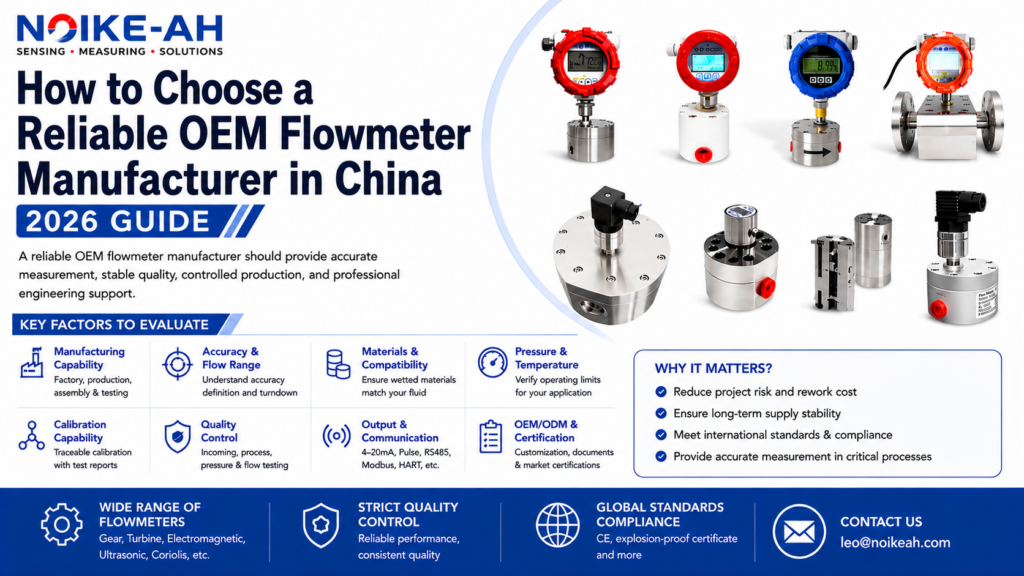
Choosing a reliable OEM flowmeter manufacturer in China requires more than comparing unit prices. Industrial buyers should evaluate the manufacturer’s flow measurement technology, manufacturing capability, calibration process, quality control, technical documentation, OEM/ODM capability, certifications, and after-sales support.
A reliable OEM flowmeter manufacturer should be able to provide a flowmeter that matches the actual application—including fluid type, flow range, viscosity, pressure, temperature, pipe size, accuracy requirements, output signal, installation conditions, and applicable market requirements.
This guide explains how to evaluate an OEM flowmeter manufacturer in China from both a technical and commercial perspective, helping engineers, distributors, system integrators, and industrial buyers reduce supplier-selection risks.
Quick Answer: How Do You Choose a Reliable OEM Flowmeter Manufacturer in China?
To choose a reliable OEM flowmeter manufacturer, evaluate these 10 areas:
- Manufacturing capability – Confirm whether the supplier controls production, assembly, testing, and calibration.
- Flowmeter technology – Verify that the measurement principle matches your fluid and operating conditions.
- Flow range and accuracy – Check minimum, normal, and maximum flow and understand how accuracy is defined.
- Material compatibility – Confirm wetted materials, seals, and compatibility with the measured medium.
- Pressure and temperature ratings – Verify operating limits for the actual application.
- Calibration capability – Ask how flowmeters are calibrated and what reference standards are used.
- Quality control – Review incoming, process, pressure, electrical, flow, and final inspection procedures where applicable.
- OEM/ODM capability – Confirm customization of branding, electronics, mechanical interfaces, documentation, and packaging.
- Certifications and standards – Verify that certificates apply to the exact product and configuration.
- Technical support – Evaluate the manufacturer’s ability to provide engineering support before and after the sale.
The best OEM flowmeter manufacturer is not necessarily the lowest-cost supplier. The better choice is the supplier that can consistently meet the agreed technical specifications and provide controlled production, testing, documentation, and support.
1. Start With the Flow Measurement Application
Before comparing Chinese flowmeter manufacturers, define the actual application.
A flowmeter should be selected according to the process conditions, not simply according to pipe size or purchase price.
Important parameters include:
- Fluid type
- Liquid or gas
- Minimum flow rate
- Normal flow rate
- Maximum flow rate
- Fluid viscosity
- Fluid temperature
- Operating pressure
- Pipe size
- Fluid conductivity, where applicable
- Fluid cleanliness and particle content
- Required accuracy
- Required output signal
- Installation orientation
- Environmental conditions
- Required certifications
For example, a positive displacement gear flowmeter can be suitable for relatively clean liquids and applications requiring accurate measurement of relatively small flow rates.
An electromagnetic flowmeter is generally intended for electrically conductive liquids and is not suitable for non-conductive liquids.
Thermal flowmeters use heat-transfer characteristics and are commonly selected for gas or air measurement.
Ultrasonic, Coriolis, turbine, vortex, and differential-pressure flowmeters each have different operating principles and application limitations.
What Should a Reliable Manufacturer Ask?
A technically competent OEM supplier should normally ask for application information before recommending a flowmeter.
At minimum, the supplier should understand:
Medium + Flow Range + Pressure + Temperature + Pipe Size + Accuracy + Output
If a supplier immediately provides a quotation without confirming these basic conditions, additional technical verification is recommended.
2. Verify the Supplier Is Actually an OEM Flowmeter Manufacturer
One of the most important steps when sourcing flowmeters from China is distinguishing a genuine manufacturer from a trading company.
A trading company may still provide useful sourcing services, but direct access to the manufacturer can be particularly important when you require:
- OEM production
- ODM development
- Product customization
- Stable quality
- Engineering support
- Long-term supply
- Customized documentation
What Should You Check?
Ask the supplier for evidence of manufacturing capability, such as:
- Factory information
- Production equipment
- Assembly area
- Testing equipment
- Calibration equipment
- Engineering team
- Product drawings
- Technical datasheets
- Quality-control procedures
- Sample test reports
- Production photographs or factory video
- Existing OEM/ODM experience
Do not rely only on descriptions such as “factory,” “manufacturer,” or “OEM supplier.”
A more useful question is:
Which parts of the flowmeter are manufactured and tested in your own facility?
This helps determine whether the supplier actually controls critical processes such as machining, assembly, electronics, calibration, and final inspection.
3. Evaluate the Manufacturer’s Flowmeter Technology
A reliable flowmeter manufacturer should be able to explain why a particular flow measurement principle is appropriate for your application.
Positive Displacement Flowmeters
Positive displacement flowmeters measure fluid by repeatedly trapping and transferring known volumes of fluid.
Gear flowmeters are one type of positive displacement flowmeter and can be used where relatively low flow rates, repeatability, and compact construction are important.
Micro gear flowmeters can be designed for very low liquid flow measurement. However, specifications such as minimum measurable flow, accuracy, viscosity range, pressure rating, and temperature range must be confirmed for the specific model.
The specifications of one gear flowmeter should not automatically be applied to another model.
Electromagnetic Flowmeters
Electromagnetic flowmeters operate according to Faraday’s law of electromagnetic induction and require an electrically conductive fluid.
They are widely used for water, wastewater, and other conductive liquid applications.
When evaluating an OEM manufacturer, ask about:
- Minimum conductivity requirement
- Liner material
- Electrode material
- Accuracy specification
- Flow velocity range
- Grounding requirements
- Empty-pipe detection
- Output options
Turbine Flowmeters
Turbine flowmeters use a rotor that rotates as fluid passes through the measuring section.
The output is related to rotor speed and therefore to flow.
They can provide pulse or frequency output and are used in various liquid and gas applications.
However, viscosity, fluid cleanliness, rotor condition, flow profile, and installation conditions can affect performance.
Ultrasonic Flowmeters
Ultrasonic flowmeters determine flow using ultrasonic signals.
Depending on the design, they may be installed inline or externally mounted.
The manufacturer should clearly specify the measurement principle and applicable fluid and pipe conditions.
For example, buyers should determine whether the product uses transit-time, Doppler, or another ultrasonic measurement method.
Coriolis Flowmeters
Coriolis flowmeters measure mass flow using the Coriolis effect and, depending on the design, can also provide density-related measurements.
They are generally more complex and expensive than many conventional flowmeters.
Therefore, they should be selected according to the actual process requirements rather than based solely on an advertised accuracy number.
4. Understand What Flowmeter Accuracy Really Means
One of the most common mistakes when comparing flowmeter manufacturers is comparing accuracy numbers without checking their reference.
For example:
“Accuracy: ±0.5%”
does not provide enough information by itself.
The specification could refer to:
- Percentage of reading
- Percentage of full scale
- Percentage of calibrated range
- Accuracy under specified test conditions
For example, ±0.5% FS means the error specification is referenced to full scale. It should not automatically be interpreted as ±0.5% of the measured reading.
Questions to Ask the Manufacturer
Ask the supplier to specify:
- Accuracy definition
- Test conditions
- Flow range
- Reference medium
- Temperature conditions
- Repeatability
- Linearity
- Hysteresis, where applicable
- Zero stability
- Temperature influence
- Pressure influence
- Viscosity influence
A technically credible datasheet should clearly define the conditions behind its performance specifications.
5. Verify the Actual Flow Range
Flow range is just as important as accuracy.
Do not select a flowmeter simply because its connection size matches the pipeline.
Provide the manufacturer with:
Minimum Flow → Normal Flow → Maximum Flow
The manufacturer can then determine whether the selected model operates within its specified measuring range.
For applications with a large difference between minimum and maximum flow, the turndown ratio is also important.
The manufacturer should be able to explain the relationship between:
- Qmin
- Normal operating flow
- Qmax
- Specified accuracy range
For regulated applications, additional requirements may apply.
For example, OIML R 117:2019 covers dynamic measuring systems for liquids other than water and defines requirements applicable to these systems. Buyers should determine whether the specific application falls within its scope.
6. Check Fluid Compatibility and Wetted Materials
Material compatibility is a critical consideration when selecting an OEM flowmeter.
Ask the manufacturer to identify the materials used for the wetted components.
Depending on the flowmeter design, these may include:
- Stainless steel
- Carbon steel
- Aluminum
- PTFE
- FKM
- EPDM
- Ceramic
- Engineering plastics
- Other application-specific materials
Compatibility depends on:
Fluid + Concentration + Temperature + Pressure + Operating Conditions
For example, simply describing a product as a “stainless steel flowmeter“ is not sufficient.
The buyer should determine:
- Which stainless-steel grade is used
- Which components contact the fluid
- Which seal material is used
- Whether the materials are compatible with the measured medium
For chemical, pharmaceutical, food, high-temperature, or aggressive-fluid applications, material selection requires particular attention.
7. Verify Pressure and Temperature Ratings
Pressure and temperature ratings should always be evaluated against the actual process conditions.
Ask the manufacturer to distinguish between:
- Operating pressure
- Maximum allowable pressure
- Proof pressure, if applicable
- Operating temperature
- Ambient temperature
- Maximum medium temperature
- Pressure-temperature limitations
A flowmeter’s allowable pressure can depend on temperature, materials, and construction.
Similarly, the stated medium-temperature range may not be identical to the allowable temperature for the electronics.
For high-temperature applications, ask whether the following have separate temperature limitations:
- Sensor
- Transmitter
- Display
- Cable
- Seals
- Electronic components
8. Evaluate Flowmeter Calibration Capability
Calibration capability is an important indicator of a flowmeter manufacturer’s technical competence.
Ask:
- What reference instrument is used?
- What calibration medium is used?
- What flow range is calibrated?
- How is the reference standard maintained?
- Is calibration traceable?
- Is a calibration report supplied?
- What measurement uncertainty applies to the calibration system?
ISO/IEC 17025:2017 specifies requirements for the competence, impartiality, and consistent operation of testing and calibration laboratories.
However:
ISO 9001 certification and ISO/IEC 17025 accreditation are not the same thing.
ISO 9001 concerns an organization’s quality-management system, while ISO/IEC 17025 addresses the competence of testing and calibration laboratories.
Therefore, do not treat the statement “ISO certified” as sufficient evidence of calibration capability.
Ask exactly:
What certification or accreditation do you have, and what is its scope?
9. Examine the Manufacturer’s Quality-Control Process
A professional OEM flowmeter manufacturer should have a defined inspection process.
Depending on the product, this may include:
Incoming Inspection
Critical raw materials and components should be checked against purchasing specifications.
Process Inspection
Important manufacturing processes should be controlled rather than relying only on final inspection.
Pressure Testing
Pressure-containing flowmeter bodies may require appropriate pressure testing according to the product design and applicable requirements.
Electrical Testing
Electronic flowmeters may be checked for:
- Supply voltage
- Current consumption
- Output signal
- Communication interface
- Insulation
- Wiring
- Display operation
Flow Calibration
Finished flowmeters should be tested against a suitable reference system according to the manufacturer’s calibration procedure.
Final Inspection
Final inspection may verify:
- Product configuration
- Dimensions
- Labeling
- Connections
- Output
- Appearance
- Customer-specific requirements
For OEM projects, the inspection requirements should ideally be agreed before mass production.
10. Verify Output Signals and Communication Interfaces
An OEM flowmeter must be electrically compatible with the customer’s control system.
Common industrial outputs include:F
- Pulse output
- Frequency output
- Switch output
- 4–20 mA
- RS485
- Modbus RTU
- HART, where supported by the specific product
Do not assume that a flowmeter with a 4–20 mA output automatically supports HART or Modbus.
These are different functions and must be confirmed for the exact electronics configuration.
For 4–20 mA Flowmeters
Confirm:
- Two-wire or four-wire configuration
- Supply voltage
- Maximum load resistance
- Current output range
- Fault behavior
- Electrical isolation, if required
For RS485/Modbus Flowmeters
Confirm:
- RS485 interface
- Modbus RTU support
- Communication parameters
- Device address
- Register map
- Supported function codes
A reliable OEM manufacturer should provide a wiring diagram and communication documentation for the actual configuration.
11. Check Mechanical Dimensions and Installation Requirements
Mechanical compatibility is essential before approving an OEM flowmeter.
Verify:
- Nominal pipe size
- Connection type
- Thread specification
- Flange standard
- Face-to-face dimension
- Installation orientation
- Flow direction
- Straight pipe requirements
- Electrical connection
- Cable entry
- Display orientation
Two flowmeters with the same nominal pipe size are not necessarily mechanically interchangeable.
Thread standards, flange standards, face-to-face dimensions, and installation requirements can differ.
Installation conditions may also influence measurement performance.
Depending on the measurement principle, elbows, valves, pumps, reducers, and other components can disturb the flow profile.
A professional manufacturer should provide installation requirements for the specific meter.
12. Verify IP Protection Ratings
If a manufacturer claims an IP rating such as IP65 or IP67, verify what standard the rating is based on and whether it applies to the complete assembled product.
IEC 60529 defines the classification of degrees of protection provided by enclosures using the IP Code.
The actual protection of a flowmeter can depend on:
- Housing construction
- Connector design
- Cable gland
- Cover sealing
- Display window
- Assembly process
Therefore, an IP rating should be treated as a defined product specification rather than simply a marketing statement.
13. Evaluate OEM and ODM Customization Capability
OEM and ODM are not identical.
OEM generally involves manufacturing according to customer requirements, branding, configuration, or specifications.
ODM generally involves a greater degree of product design and development by the manufacturer.
For OEM flowmeter projects, ask whether the supplier can customize:
- Customer logo
- Nameplate
- Housing
- Cable
- Connector
- Output configuration
- Display
- Firmware
- Packaging
- User manuals
- Technical drawings
- Flow ranges
- Connection dimensions
- Materials
For more advanced projects, you may require:
- Customized electronics
- Communication protocol modifications
- Special calibration procedures
- New mechanical structures
- Prototype development
- Engineering validation
The supplier should clearly distinguish between standard configurations and genuine engineering customization.
14. Review the Technical Documentation
Before placing a large OEM order, request a complete technical documentation package.
Depending on the product, this may include:
- Product datasheet
- Installation manual
- Wiring diagram
- Dimensional drawing
- Material information
- Calibration information
- Test report, where applicable
- Communication protocol documentation
- Product labeling specification
- Packaging specification
For customized products, the approved drawing should become part of the controlled technical documentation.
This helps reduce the risk of receiving a product that differs from the approved sample in:
- Dimensions
- Connector
- Material
- Output
- Electronics
- Labeling
15. Do Not Select an OEM Manufacturer Based Only on Price
The lowest quotation is not necessarily the lowest total cost.
For industrial flow measurement, consider:
Total Cost = Purchase Price + Engineering Cost + Testing Cost + Rework + Shipping + Failure Cost + After-Sales Cost
Inconsistent measurement performance can cost more than the difference between two supplier quotations.
OEM customers may face additional costs from:
- Repeated sampling
- Engineering modifications
- Failed validation
- Incorrect documentation
- Product returns
- Field replacement
- Customer complaints
- Delayed projects
A slightly higher unit price may provide better overall value if it results in stable quality, accurate documentation, technical support, and lower failure risk.
16. Request and Test Samples Before Mass Production
A sample should not be evaluated only for appearance.
Mechanical Verification
Check:
- Dimensions
- Connection
- Materials
- Mounting
- Labeling
Electrical Verification
Check:
- Supply voltage
- Output signal
- Wiring
- Connector
- Communication
Measurement Verification
Check:
- Flow range
- Accuracy
- Repeatability
- Response
- Zero behavior
Documentation Verification
Check:
- Datasheet
- Calibration report
- Wiring diagram
- User manual
Where possible, test the sample under conditions close to the actual application.
For an OEM project, identifying a problem during sample validation is much less costly than discovering it after mass production.
17. Verify Certifications for the Target Market
Certification requirements depend on:
- Product type
- Application
- Destination market
- Operating environment
- Applicable regulations
Do not simply ask:
“Do you have CE?”
Instead, ask:
- Which product is covered?
- Which model?
- Which configuration?
- Which directive or regulation?
- Which standards were applied?
- Is the certificate valid for the customized version?
- Who issued the certificate?
- Is there a corresponding test report?
The same principle applies to other certifications and approvals.
For legal metrology applications, additional requirements may apply. For example, OIML R 117:2019 covers dynamic measuring systems for liquids other than water.
However, not every industrial flowmeter requires OIML approval. The applicable requirements depend on the specific application and regulations of the target market.
18. Evaluate Technical Communication and Engineering Support
A reliable OEM flowmeter manufacturer should be able to communicate with both purchasing teams and engineers.
A competent technical supplier should be able to explain:
- Why a particular flowmeter was selected
- The actual measuring range
- How accuracy is defined
- Minimum flow limitations
- Maximum pressure
- Wetted materials
- Output configuration
- Installation requirements
- Calibration method
- Effects of viscosity changes
- Performance below the specified measuring range
If the supplier cannot answer basic technical questions without repeatedly referring everything to another party, additional technical verification may be necessary.
19. OEM Flowmeter Manufacturer Evaluation Checklist
Use the following criteria to compare potential suppliers.
| Evaluation Item | What to Verify |
|---|---|
| Manufacturing capability | Factory, equipment, assembly and testing |
| Flowmeter technology | Measurement principle and application suitability |
| Accuracy | Reference condition and definition |
| Flow range | Minimum, normal and maximum flow |
| Fluid compatibility | Wetted materials and seals |
| Pressure rating | Operating and maximum allowable pressure |
| Temperature | Medium and ambient limits |
| Calibration | Method, reference standards and reports |
| Quality system | Documented quality-control process |
| Testing | Flow, pressure and electrical testing where applicable |
| Output | Pulse, 4–20 mA, RS485/Modbus, etc. |
| Mechanical interface | Threads, flanges and dimensions |
| IP protection | Applicable enclosure protection specification |
| OEM capability | Branding, configuration and customization |
| Documentation | Drawings, manuals and test documents |
| Certification | Exact model and applicable market |
| Sample testing | Engineering validation before mass production |
| Lead time | Sample and production lead times |
| After-sales support | Technical response and replacement process |
20. Red Flags When Choosing a Chinese Flowmeter Supplier
Be cautious when a supplier:
- Provides specifications without test conditions
- Claims unusually high accuracy without supporting information
- Uses identical specifications for substantially different measurement technologies
- Cannot provide dimensional drawings
- Cannot explain its calibration procedure
- Cannot identify wetted materials
- Cannot provide wiring information before ordering
- Claims certifications without identifying the applicable model
- Changes specifications after sample approval
- Offers an unusually low price without explaining the configuration
- Cannot provide consistent technical documentation
One issue alone does not necessarily mean that a supplier is unreliable. However, several of these signs together should trigger additional verification.
21. What Makes a Reliable OEM Flowmeter Manufacturer?
A dependable OEM flowmeter manufacturer should demonstrate a combination of:
Technical Capability
The manufacturer understands different flow measurement principles and their application limitations.
Manufacturing Control
The supplier controls important production and assembly processes.
Calibration Capability
The manufacturer has an appropriate method for verifying flowmeter performance.
Quality Management
The supplier has defined inspection and quality-control procedures.
Technical Documentation
Drawings, datasheets, manuals, wiring information, and test documents are controlled and consistent.
OEM/ODM Capability
The supplier can support the required level of product customization.
Technical Support
Engineers can communicate with customers before, during, and after production.
Long-Term Supply Capability
The supplier can maintain consistent specifications and quality across production batches.
Conclusion: How to Select the Right OEM Flowmeter Manufacturer in China
Choosing an OEM flowmeter manufacturer in China should be approached as a technical supplier evaluation, not simply a price comparison.
The recommended process is:
Application → Measurement Principle → Technical Specification → Supplier Verification → Sample → Testing → Approval → Mass Production → Quality Control
rather than:
Price → Order → Troubleshoot Later
Before selecting a manufacturer, confirm the actual flow range, fluid properties, accuracy definition, pressure and temperature limits, wetted materials, output signals, installation requirements, calibration process, testing procedures, certifications, and OEM customization capability.
For regulated applications, standards such as OIML R 117 should be considered where applicable. For calibration and testing laboratories, ISO/IEC 17025 provides a framework for laboratory competence. For enclosure protection, IEC 60529 defines the IP Code.
Most importantly, technical parameters should be verified against the specific model and configuration. An accuracy value, pressure rating, temperature range, viscosity range, or IP rating should never be treated as universally applicable to every flowmeter from a manufacturer.
The right OEM flowmeter manufacturer is not simply the supplier offering the lowest price. It is the manufacturer that can consistently deliver the required measurement performance, controlled production, reliable calibration, accurate documentation, customization capability, and long-term technical support.
FAQ: OEM Flowmeter Manufacturer in China
What should I look for in an OEM flowmeter manufacturer?
Look for manufacturing capability, suitable flow measurement technology, calibration capability, quality control, technical documentation, OEM customization capability, applicable certifications, and responsive engineering support.
How can I verify whether a Chinese flowmeter supplier is a real manufacturer?
Request information about the production facility, manufacturing equipment, assembly processes, testing equipment, calibration capability, engineering team, product drawings, and quality-control procedures. Factory verification or an independent audit can provide additional evidence when appropriate.
What information should I provide when requesting an OEM flowmeter quotation?
At minimum, provide the fluid type, minimum/normal/maximum flow, viscosity where relevant, operating pressure, temperature, pipe size, required accuracy, output signal, connection type, installation conditions, and destination-market requirements.
Is the cheapest OEM flowmeter supplier the best choice?
Not necessarily. For industrial applications, total cost also includes engineering, testing, rework, returns, field failures, shipping, and after-sales support. Technical compatibility and quality consistency should be evaluated before price.
What is the difference between OEM and ODM flowmeter manufacturing?
OEM generally means manufacturing according to the customer’s specified requirements, branding, or configuration. ODM generally involves a greater degree of product design and development by the manufacturer.
Should I test samples before placing a bulk OEM order?
Yes. Sample validation can confirm mechanical dimensions, electrical interfaces, output signals, measurement performance, documentation, and customization requirements before mass production.
Does every industrial flowmeter need OIML certification?
No. OIML requirements depend on the application and applicable regulations. OIML R 117:2019 specifically addresses dynamic measuring systems for liquids other than water. Buyers should determine whether their particular application falls within the applicable regulatory scope.
What is the most important parameter when selecting a flowmeter?
There is no single parameter that is always the most important. The correct selection depends on the complete application, including fluid, flow range, pressure, temperature, viscosity, measurement accuracy, installation conditions, materials, and required output.
Final Takeaway
A reliable OEM flowmeter manufacturer should be able to prove its technical capability—not simply claim it.
When comparing Chinese suppliers, evaluate the complete chain:
Application → Design → Manufacturing → Calibration → Testing → Documentation → OEM Customization → After-Sales Support
This approach provides a much stronger basis for selecting a long-term OEM flowmeter partner and reducing technical risk in industrial flow measurement projects.



