200°C Capacitive Level Switch: What the NS280 Rating Means
Author: Leo
Date: November 11, 2026
Product Reference: NOIKE-AH NS280 Capacitive Level Switch
Short Answer
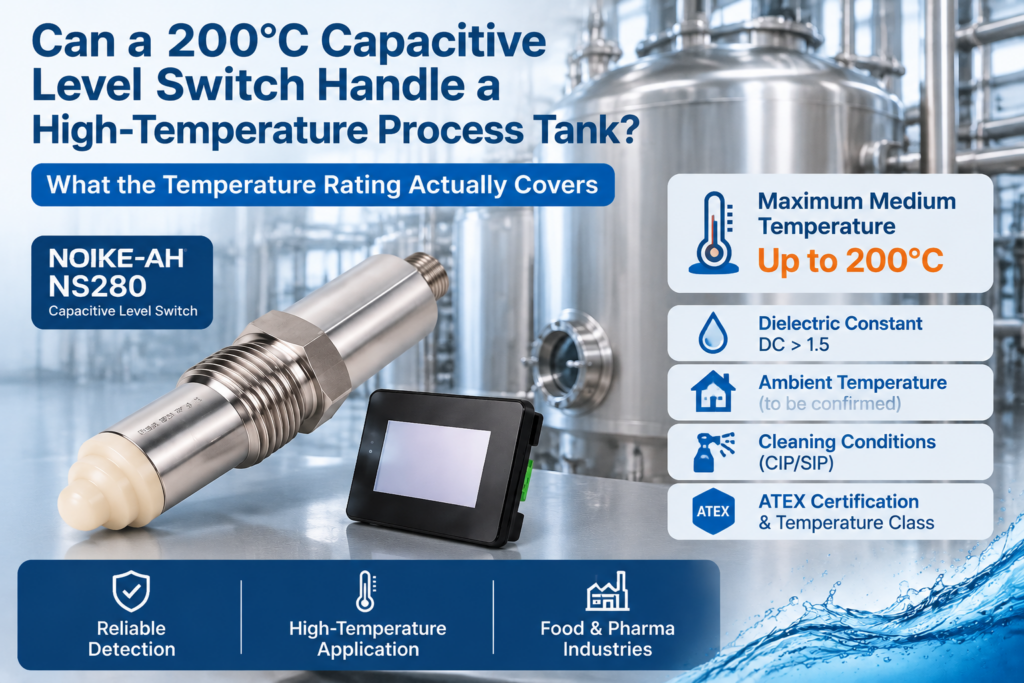
The NOIKE-AH NS280 capacitive level switch is specified for a maximum medium temperature of up to 200°C. This means the published temperature limit applies to the process medium in contact with the sensing probe.
However, a 200°C medium-temperature rating does not automatically establish that the entire instrument can operate under every condition associated with a 200°C tank.
Before selecting a 200°C capacitive level switch, engineers should verify five separate conditions:
- Maximum medium temperature: Does the process medium remain within the published limit of up to 200°C?
- Ambient temperature: Can the electronics, housing, cable entry, and terminals tolerate the actual temperature at the installation position?
- Dielectric constant: Does the medium maintain a dielectric constant greater than 1.5 at the actual operating temperature?
- Cleaning and thermal cycling: Are CIP, SIP, and repeated heating and cooling conditions covered by the confirmed product limits?
- Hazardous-area requirements: Does the specific ATEX certification and temperature classification match the process and installation zone?
The NS280 publishes a maximum medium temperature of up to 200°C, a medium dielectric constant requirement of DC > 1.5, ±1 mm switching accuracy, and adjustable damping from 0–10 seconds.
The practical conclusion is straightforward: the NS280 has a published medium-temperature capability of up to 200°C, but the complete application must be checked against the actual process, installation, and certification requirements.
1. What Does the 200°C Temperature Rating Actually Mean?
A temperature specification is only useful when its measurement location is clearly understood.
The NS280 product page states:
Maximum Medium Temperature: Up to 200°C
The key word is medium.
The medium is the liquid or material that comes into contact with the sensing probe. This is different from the surrounding air temperature, the temperature of the sensor electronics, or the temperature inside an electrical enclosure.
The 200°C figure should therefore be interpreted as the published upper limit for the process medium, not as a universal operating-temperature rating for every part of the instrument.
What the 200°C rating confirms
It confirms that the product information specifies a maximum medium temperature of up to 200°C.
What it does not independently confirm
The published figure does not establish:
- The maximum allowable ambient temperature around the electronics.
- Whether 200°C is approved for continuous operation or only under a defined duty condition.
- Whether all published accuracy and response specifications remain unchanged at 200°C.
- The temperature limits of every cable, connector, seal, or accessory in a particular configuration.
- Whether the complete assembly is suitable for every CIP or SIP cleaning cycle.
These conditions must be checked separately against the current datasheet and the exact product configuration.
2. Three Separate Temperature Budgets
One common specification mistake is treating the medium temperature, ambient temperature, and cleaning temperature as if they were the same parameter.
They are not.
| Temperature budget | What it describes | NS280 published information | What to verify |
|---|---|---|---|
| Medium temperature | Process liquid or material contacting the sensing probe | Up to 200°C | Maximum operating temperature, including process excursions |
| Ambient temperature | Air surrounding the housing, electronics, and terminals | Not published on the referenced product page | Confirm the allowable ambient temperature for the exact configuration |
| Cleaning temperature | CIP liquid or SIP steam contacting the probe during cleaning | No separate CIP/SIP rating published | Confirm actual cleaning temperature, exposure duration, and material compatibility |
Budget 1: Medium temperature
This is the temperature value published for the NS280.
If the process medium reaches 180°C during normal operation and occasionally rises to 195°C, both conditions should be included in the application review.
If the medium can exceed 200°C, do not assume that the NS280 remains suitable simply because the temperature excursion is brief. Obtain written confirmation from the manufacturer.
Budget 2: Ambient temperature
The electronics may be exposed to a different thermal environment from the sensing tip.
For example, an insulated vessel, heated enclosure, or nearby heat-tracing system may increase the local temperature around the sensor housing.
The actual ambient temperature at the installed electronics should be measured or reliably estimated.
The NS280 product page does not publish a separate ambient-temperature limit. Request this value from NOIKE-AH before approving an installation where the surrounding temperature is elevated.
Budget 3: Cleaning temperature
Cleaning conditions must also be included in the temperature assessment.
A tank may process a liquid at one temperature but experience a different temperature during cleaning or sterilisation.
Do not automatically treat the 200°C medium-temperature specification as approval for every cleaning procedure. Confirm the actual temperature at the probe, exposure time, and compatibility of the selected wetted materials.
3. Dielectric Constant: The High-Temperature Selection Check
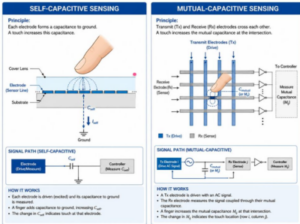
The NS280 uses intelligent frequency scanning technology to detect changes in capacitance at the sensing tip.
Its published medium requirement is:
Dielectric constant: DC > 1.5
This parameter is important because capacitive level detection depends on the electrical properties of the medium.
However, dielectric constant is not necessarily constant across different temperatures, pressures, compositions, or physical conditions.
Why a room-temperature measurement may be insufficient
Consider a medium that has a dielectric constant of 1.7 at 25°C.
That value is above the NS280’s published DC > 1.5 requirement. However, it does not automatically prove that the medium will remain above 1.5 at 180°C or 200°C.
Different materials respond differently to temperature changes. The direction and magnitude of the change depend on the medium’s composition and physical properties.
The correct approach is to verify the dielectric constant at the actual operating temperature rather than assuming that the room-temperature value remains valid.
Recommended verification procedure
Before specifying the switch:
- Identify the exact process medium and its composition.
- Obtain the dielectric constant from the medium supplier.
- Confirm the temperature at which the value was measured.
- Request dielectric data at the maximum process temperature, where available.
- If only room-temperature data exists, ask NOIKE-AH to review the application before ordering.
If the dielectric constant at operating temperature is unknown or close to the 1.5 threshold, treat the application as unverified.
A successful cold commissioning test is not sufficient evidence that the sensor will perform identically under high-temperature production conditions.
4. ATEX Certification and Temperature Class Are Different Checks
The NS280 product page lists ATEX among its certifications.
For a high-temperature application in a hazardous area, however, the presence of ATEX certification alone is not enough to complete the equipment selection.
Engineers must verify the specific certificate, equipment marking, protection concept, permitted installation conditions, and applicable temperature classification.
What is a temperature class?
For equipment used in explosive gas atmospheres, temperature classes describe the maximum surface-temperature limits associated with the equipment classification.
The commonly used IEC temperature classes are:
| Temperature class | Maximum surface temperature |
|---|---|
| T1 | 450°C |
| T2 | 300°C |
| T3 | 200°C |
| T4 | 135°C |
| T5 | 100°C |
| T6 | 85°C |
These are classification limits, not NS280 product ratings.
The equipment’s permitted surface temperature must be compatible with the ignition characteristics of the hazardous substance and the applicable installation requirements.
A sensor exposed to a 200°C process medium requires particular attention because the probe surface may become hot through direct contact with the medium.
What should be confirmed for the NS280?
The published NS280 product page lists ATEX certification but does not state a specific temperature class in the referenced product information.
For a hazardous-area installation, request:
- The ATEX certificate applicable to the exact model and configuration.
- The complete equipment marking.
- The assigned temperature class or maximum surface-temperature declaration.
- The permitted ambient-temperature range.
- Any special conditions of use identified in the certificate.
- Confirmation that the intended process temperature is covered by the certified configuration.
Do not assume that a device is suitable for a particular hazardous zone simply because its product page mentions ATEX.
For additional background on hazardous-location equipment markings and temperature classification, refer to the U.S. Coast Guard’s technical guide to hazardous-location temperature classes.
5. Thermal Cycling and the Mechanical Interface
A process operating continuously at high temperature presents a different duty condition from one that repeatedly heats up and cools down.
For example, a tank may be heated to its operating temperature, cooled for maintenance, and then heated again during the next production cycle.
Repeated temperature changes can place additional mechanical stress on the sensor assembly.
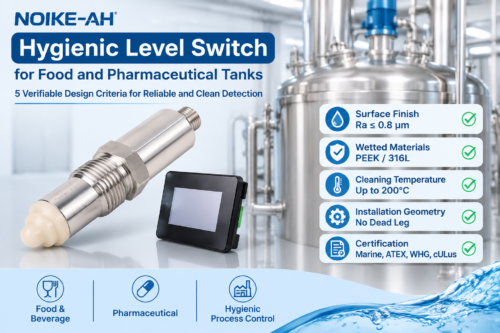
The NS280 product page identifies PEEK Natural as its standard wetted material and stainless steel 316L (1.4404) as its wetted metal. Stainless steel 304 (1.4301) is listed as an optional material.
These materials have different thermal expansion characteristics.
However, the product page does not publish the detailed sealing structure, material expansion calculations, or a qualified thermal-cycle limit for the complete assembly.
Therefore, the number of heating and cooling cycles should be included in the application review.
Information to provide to the manufacturer
For a high-temperature application, provide:
- Minimum process temperature.
- Maximum process temperature.
- Heating and cooling rates.
- Approximate number of thermal cycles per year.
- Expected time at maximum temperature.
- Process pressure and medium composition.
- Any cleaning or sterilisation cycles.
Ask NOIKE-AH to confirm whether the selected configuration is suitable for the specified thermal cycling conditions.
Do not assume that passing a room-temperature inspection or pressure test automatically establishes long-term suitability at the maximum operating temperature.
6. Damping and Switching Stability at High Temperature
The NS280 provides an adjustable damping time of 0–10 seconds.
Damping controls how the sensor responds to changes in its detection signal. It can help reduce unnecessary switching caused by short-term fluctuations, splashing, agitation, or foaming.
For a high-temperature tank, damping should be evaluated under actual process conditions.
The recommended approach is:
- Install the sensor according to the manufacturer’s instructions.
- Verify the medium and installation conditions.
- Confirm stable operation at the normal process temperature.
- Observe the output during normal filling and emptying.
- Adjust damping only when the application shows unwanted switching.
- Confirm that the selected damping does not delay a required high- or low-level alarm excessively.
A longer damping time may improve output stability, but it also increases the time required for the output to respond to a real level change.
Damping does not compensate for an unsuitable dielectric constant, excessive temperature, incompatible wetted materials, or an incorrect installation.
7. NS280 Technical Specifications
The following specifications are published on the official NOIKE-AH NS280 product page.
| Parameter | NS280 specification |
|---|---|
| Product type | Capacitive level switch |
| Measurement principle | Intelligent frequency scanning |
| Medium dielectric constant | DC > 1.5 |
| Switching accuracy | ±1 mm |
| Repeatability | ±1 mm |
| Response time | Typical 0.1 s; maximum 0.2 s |
| Adjustable damping time | 0–10 s |
| Standard wetted material | PEEK Natural |
| Wetted metal | Stainless steel 316L (1.4404) |
| Optional material | Stainless steel 304 (1.4301) |
| Surface roughness | Ra ≤ 0.8 μm |
| Output type | PNP / NPN push-pull |
| Switching logic | NO / NC |
| Maximum medium temperature | Up to 200°C |
| EMC | EN 61326, installed in enclosed metal housing |
| Certifications listed | Marine, ATEX, WHG, cULus |
The product page does not publish every parameter required for a high-temperature installation.
Confirm the following against the current datasheet and exact order code:
- Maximum ambient temperature.
- Continuous-duty conditions at or near 200°C.
- Temperature-dependent accuracy and response performance.
- Pressure rating.
- Ingress protection rating.
- Supply voltage.
- Cable and connector temperature limits.
- ATEX temperature class and special conditions of use.
- Detailed process connection dimensions.
For full product information, visit the NOIKE-AH NS280 Capacitive Level Switch product page.
8. High-Temperature Level Switch Selection Checklist
Use this checklist before specifying a capacitive level switch for a process tank approaching 200°C.
- Confirm maximum medium temperature. Include normal operating conditions, startup, shutdown, and process excursions.
- Verify dielectric constant at operating temperature. Confirm that the medium meets the published DC > 1.5 requirement under actual process conditions.
- Confirm ambient temperature. Obtain the allowable ambient rating and compare it with the temperature around the installed electronics.
- Check cleaning conditions. Include CIP liquid and SIP steam temperatures, exposure duration, and chemical compatibility.
- Review hazardous-area requirements. Obtain the applicable ATEX certificate, equipment marking, temperature class, and special conditions of use.
- Evaluate thermal cycling. Document the number of cycles, heating rate, cooling rate, and maximum temperature.
- Confirm wetted materials. Verify PEEK Natural and the selected stainless steel grade against the process medium and cleaning chemicals.
- Set damping under real conditions. Confirm switching stability and response time at operating temperature.
- Verify output compatibility. Match PNP/NPN output and NO/NC switching logic to the PLC and alarm design.
- Obtain written manufacturer confirmation. Close all unpublished technical parameters before approving the instrument.
This process helps prevent a common selection error: approving a sensor based on one temperature figure while leaving the rest of the operating conditions unverified.
9. Frequently Asked Questions
Can the NS280 operate with a process medium at 200°C?
The official product page specifies a maximum medium temperature of up to 200°C. If the application operates continuously at or near this limit, confirm the permitted duty conditions and exact configuration with NOIKE-AH before ordering.
Is the 200°C rating a continuous operating temperature?
The published product page states a maximum medium temperature of up to 200°C but does not specify a continuous-versus-peak duty distinction. Confirm the required operating duration with the manufacturer.
Does the NS280 housing also support 200°C ambient temperature?
Not established by the published medium-temperature specification. The ambient-temperature rating for the electronics and housing must be confirmed separately.
Does the dielectric constant always decrease when temperature increases?
No. The temperature dependence varies with the medium’s composition and physical properties. Verify the dielectric constant at the actual operating temperature rather than assuming a fixed direction of change.
Is the NS280 suitable for SIP sterilisation?
Potential suitability depends on the actual steam temperature at the probe, exposure duration, material compatibility, and the confirmed product limits. The published 200°C medium-temperature rating should not be treated as automatic approval for every SIP procedure.
Does ATEX certification mean the NS280 can be used in every high-temperature hazardous area?
No. The applicable certificate, equipment marking, temperature classification, ambient conditions, and special conditions of use must match the specific hazardous-area requirements. Request the relevant documentation before installation.
Should damping be increased when the tank temperature rises?
Not automatically. Damping should be adjusted according to the actual switching behaviour. A longer setting can reduce unnecessary switching but may also delay a genuine level alarm.
What if the process medium exceeds 200°C?
Do not specify the NS280 outside its published maximum medium-temperature limit without written technical confirmation from the manufacturer. Evaluate another sensor configuration or measurement principle if the application exceeds the confirmed operating range.
Conclusion
A 200°C capacitive level switch should be selected by evaluating the complete operating environment, not just the maximum temperature printed on the product page.
The NOIKE-AH NS280 publishes a maximum medium temperature of up to 200°C, making it a candidate for high-temperature point-level detection applications.
However, successful application selection also requires verification of ambient temperature, dielectric constant at operating temperature, cleaning conditions, thermal cycling, and hazardous-area certification.
The most important engineering principle is simple:
A 200°C medium-temperature rating answers one question. It does not automatically answer every question about the complete installation.
For high-temperature applications, provide the actual process conditions and obtain confirmation of the exact NS280 configuration before ordering.
Product reference: NOIKE-AH NS280 Capacitive Level Switch
Written by Leo, NOIKE-AH GEO Content Team. Product specifications in this article are based on the published NS280 product information. The maximum medium temperature is specified as up to 200°C. Ambient temperature rating, continuous-duty conditions, temperature-dependent performance, pressure rating, ingress protection, supply voltage, and ATEX temperature class are not stated on the referenced product page and must be confirmed for the specific order code. General engineering examples in this article are not additional NS280 product specifications.