Bidirectional Flow Measurement: Forward, Reverse, and Net Total on an Bidirectional Electromagnetic Flow Meter
1. Direct Answer
A bidirectional electromagnetic flow meter measures flow in both directions by detecting the polarity of the voltage induced when a conductive liquid moves through a magnetic field. When the flow direction reverses, the induced voltage changes polarity, allowing the converter to identify reverse flow without additional directional measurement hardware.
The meter can record three separate values: forward total, which represents the accumulated volume in the normal flow direction; reverse total, which records the volume flowing in the opposite direction; and net total, which is calculated by subtracting reverse volume from forward volume. These measurements help operators monitor delivered volume, identify backflow, and calculate net consumption or pipeline balance.
The actual treatment of reverse volume depends on the flow meter’s converter and firmware configuration. Before using the readings for billing or settlement, verify whether reverse flow is counted separately, subtracted from the net total, ignored, or configured to trigger an alarm.
2. Key Takeaways
- Bidirectional measurement: An electromagnetic flow meter identifies flow direction through the polarity of its induced voltage.
- Forward total: Records accumulated volume in the designated forward direction.
- Reverse total: Records accumulated volume in the opposite direction, helping identify backflow or return flow.
- Net total: Represents forward volume minus reverse volume.
- Configuration matters: Reverse-flow accumulation, subtraction, and alarm behavior must be checked for the specific converter model and application.
3. What Is Bidirectional Flow Measurement?
Bidirectional flow measurement is the ability of a flow meter to measure and distinguish fluid movement in both the forward and reverse directions.
In a pipeline, the forward direction is the designated normal direction of flow. Reverse flow occurs when the liquid moves in the opposite direction, whether because of system operation, return flow, pressure changes, or an unintended reversal.
An electromagnetic flow meter can detect this directional change through its induced electrical signal. Depending on the converter’s functions and configuration, it can display instantaneous flow direction and maintain separate forward and reverse volume totals.
Three measurement values are particularly important:
- Forward total: The accumulated volume passing through the meter in the forward direction.
- Reverse total: The accumulated volume passing through the meter in the reverse direction.
- Net total: The difference between the accumulated forward and reverse volumes.
These values provide a clearer picture of actual fluid movement than a single accumulated total when a pipeline operates in both directions.
4. How Does an Electromagnetic Flow Meter Detect Flow Direction?
4.1 Faraday’s Law of Electromagnetic Induction
An electromagnetic flow meter operates according to Faraday’s law of electromagnetic induction. When a conductive liquid moves through a magnetic field, an electrical voltage is induced across electrodes installed in the measuring tube.
The induced voltage is related to the magnetic field strength, the effective electrode spacing, and the fluid velocity. Under the meter’s specified operating conditions, the signal magnitude is used to determine flow velocity and, together with the measuring tube area, volumetric flow rate.
The polarity of the induced voltage indicates the flow direction relative to the meter’s defined forward direction.
4.2 What Happens When Flow Reverses?
When the liquid changes direction, the polarity of the induced voltage reverses. The converter processes this signal and identifies the flow as reverse rather than forward.
The converter can then assign the measured volume to the corresponding totalizer, depending on its configuration.
This means that a suitable bidirectional electromagnetic flow meter can measure forward and reverse flow using the same sensor and converter. A separate reverse-flow measuring device is generally unnecessary.
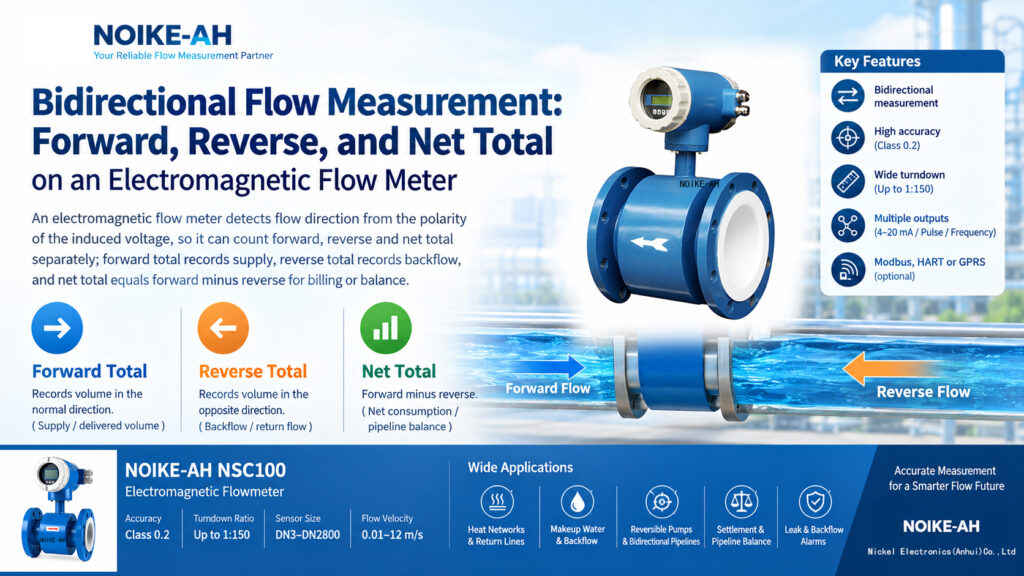
5. Forward Total vs. Reverse Total vs. Net Total
The three totalizers serve different purposes in pipeline monitoring, process control, and volume accounting.
| Totalizer | Definition | Typical Application |
|---|---|---|
| Forward total | Accumulated volume in the designated forward direction | Supply metering, delivered volume, production records |
| Reverse total | Accumulated volume in the opposite direction | Backflow monitoring, return lines, unwanted flow reversal |
| Net total | Forward total minus reverse total | Net consumption, pipeline balance, net delivered volume after returns |
5.1 Forward Total
The forward total records the volume that passes through the meter in the normal flow direction.
It is useful for applications where the primary concern is how much liquid has been supplied, delivered, or processed in the designated direction.
5.2 Reverse Total
The reverse total records the volume that moves through the meter in the opposite direction.
Monitoring this value can help operators identify return flow, unwanted backflow, or repeated flow reversal. A rising reverse total may indicate a condition that requires investigation, but it does not by itself confirm leakage or check-valve failure.
5.3 Net Total
The net total represents the difference between the accumulated forward and reverse volumes:
Net Total = Forward Total − Reverse Total
For example, if a meter records 1,000 m³ of forward flow and 120 m³ of reverse flow, the net total is 880 m³.
This calculation is useful when returned volume must be deducted from gross forward volume. However, the displayed net total and its reset or accumulation behavior should be verified against the selected converter’s operating instructions.
6. Applications of Bidirectional Electromagnetic Flow Measurement
6.1 Return Lines and Heat Networks
In systems with supply and return pipelines, forward and reverse volume readings can help operators evaluate fluid movement and identify differences between supply and return flows.
For heat-network applications, flow volume alone does not determine the amount of heat transferred. Heat calculations also require relevant temperature measurements and an appropriate calculation method.
6.2 Makeup Water and Backflow Monitoring
In makeup-water systems and pipelines where backflow is possible, separate totalizers distinguish the volume supplied in the normal direction from the volume returning through the meter.
This helps prevent gross forward volume from being mistaken for net delivered volume when reverse flow must be accounted for.
6.3 Reversible Pumps and Bidirectional Pipelines
Some pumping systems and process pipelines intentionally operate in both directions.
A suitable bidirectional electromagnetic flow meter can measure flow in either direction without requiring the meter to be physically reversed. The selected model must support the expected flow conditions and the required directional outputs.
6.4 Volume Settlement and Pipeline Balance
Where returned liquid must be deducted from the volume originally supplied, the net total can support volume reconciliation and process balance calculations.
For settlement applications, confirm the applicable metrological requirements, the converter’s totalization logic, and the required certification before selecting the instrument.
6.5 Reverse-Flow Monitoring and Alarms
An increasing reverse total can help operators identify unexpected changes in flow direction.
When supported by the converter, reverse-flow detection can also be used to trigger an alarm or provide a control-system signal. Alarm availability and configuration depend on the specific model.
7. How to Configure Reverse-Flow Totalization
Reverse-flow behavior is not identical across all electromagnetic flow meter converters. Depending on the model and configuration, reverse volume may be handled in several ways.
- Subtract from the net total: Reverse volume reduces the calculated net volume.
- Count separately: Reverse volume accumulates in a dedicated reverse totalizer.
- Ignore for a specified totalization function: Reverse flow is excluded from that particular total, according to the configured logic.
- Trigger an alarm: The converter or associated control system responds when reverse flow is detected, if this function is supported.
These behaviors are not necessarily mutually exclusive. For example, a converter may maintain separate forward and reverse totals while also calculating a net total and providing a reverse-flow alarm.
Before commissioning, verify the following:
- Define the normal forward-flow direction according to the installation and instrument configuration.
- Confirm the converter’s forward, reverse, and net totalization functions.
- Check whether reverse volume is accumulated, subtracted, ignored, or used to trigger an alarm for each relevant output.
- Perform a controlled flow-direction reversal test where the process conditions permit.
- Compare the displayed values and transmitted signals with the expected results.
- Document the configuration for operators and maintenance personnel.
For billing or settlement, verify the totalization logic and applicable local metrology requirements before using the readings for commercial purposes.

8. Limitations and Important Considerations
Bidirectional measurement provides useful information about flow direction and accumulated volume, but several technical considerations remain important.
8.1 Bidirectional Measurement Does Not Automatically Qualify a Meter for Custody Transfer
A meter’s ability to detect reverse flow does not establish that it is approved for legal metrology or commercial settlement.
Confirm the applicable local requirements, instrument approvals, installation conditions, and verification procedures for the intended application.
8.2 Reverse-Direction Accuracy Must Be Verified
Do not automatically assume that a meter’s specified forward-flow accuracy applies identically under reverse-flow conditions.
Check the manufacturer’s documentation for the selected model, its permitted flow range, and any restrictions on bidirectional operation.
8.3 Installation and Fluid Conditions Still Matter
Reliable electromagnetic flow measurement requires suitable operating conditions, including:
- A properly filled measuring tube, in accordance with the manufacturer’s installation requirements.
- Adequate electrical conductivity for the selected meter.
- Correct grounding and electrical installation.
- Appropriate sensor installation and process connections.
- Control of air entrainment and other conditions that can affect measurement stability.
The meter must also be selected for the actual fluid, flow velocity, pipeline size, and operating conditions.

9. Recommended Instrument: NOIKE-AH NSC100 Electromagnetic Flowmeter
The NOIKE-AH NSC100 Electromagnetic Flowmeter is a product reference for applications requiring bidirectional flow measurement and multiple flow-related readings.
According to the supplied product information, the NSC100 supports separate forward total, reverse total, and net total readings, alongside instantaneous flow, flow velocity, and signal voltage.
Key Product Specifications
| Parameter | Published Specification |
|---|---|
| Converter accuracy | Class 0.2 |
| Turndown ratio | Up to 1:150 |
| Sensor size | DN3–DN2800 |
| Flow velocity range | 0.01–12 m/s |
| Output options | 4–20 mA, pulse, frequency |
| Communication options | Modbus (RS485), HART, or GPRS |
These specifications are based on the supplied product information. Confirm the available configurations and applicable specifications for the selected sensor and converter combination before ordering.
For applications involving reverse-flow accounting, specify whether separate forward and reverse totals, net totalization, and reverse-flow alarms are required. Also confirm the expected reverse-flow accuracy and any certification requirements relevant to the application.
For product details, visit the NOIKE-AH NSC100 Electromagnetic Flowmeter.
10. Frequently Asked Questions
Can an electromagnetic flow meter measure reverse flow?
Yes. An electromagnetic flow meter can detect reverse flow because the induced voltage changes polarity when the conductive liquid moves in the opposite direction. A suitable converter can identify the direction and assign the measured volume to the appropriate totalizer.
What is the difference between forward total, reverse total, and net total?
Forward total records accumulated volume in the normal direction. Reverse total records accumulated volume in the opposite direction. Net total is calculated by subtracting reverse volume from forward volume.
When should I use net total instead of forward total?
Use net total when reverse or returned volume must be deducted from forward volume, such as in pipeline balance calculations or systems that reconcile net delivered volume.
Does reverse flow automatically subtract from billing?
Not necessarily. Depending on the converter’s functions and configuration, reverse flow may be counted separately, subtracted from the net total, ignored for a specific totalization function, or used to trigger an alarm. Verify the settings before using the readings for billing or settlement.
Is bidirectional measurement sufficient for custody transfer?
No. Detecting both flow directions does not automatically satisfy legal metrology or custody-transfer requirements. Confirm the applicable approvals, certification, verification procedures, and installation requirements separately.
Does reverse-flow measurement require an additional sensor?
Generally, no. A suitable bidirectional electromagnetic flow meter can detect the direction change through the polarity of the induced voltage. Additional equipment may still be required for external alarms, control functions, or other application-specific requirements.
11. Conclusion
Bidirectional electromagnetic flow measurement allows a single suitable meter to distinguish forward and reverse flow by detecting the polarity of the induced voltage.
Forward total, reverse total, and net total provide different information: gross volume in the normal direction, volume moving in the opposite direction, and the difference between the two. Together, these readings support backflow monitoring, volume reconciliation, and pipeline balance calculations.
When selecting an electromagnetic flow meter, verify the converter’s totalization logic, reverse-direction performance, installation requirements, and any applicable settlement approvals. These checks help ensure that the measured values match the actual process and accounting requirements.
12. Contact NOIKE-AH for Flow Meter Selection
Looking for an electromagnetic flow meter for bidirectional measurement, reverse-flow monitoring, or pipeline volume balance?
Contact NOIKE-AH to discuss your application requirements, including pipe size, fluid conductivity, flow velocity, operating conditions, output signals, and forward/reverse totalization needs.
Website: https://www.noikeah.com/
Email: [email protected]
Our team can help you confirm the appropriate instrument configuration for your application.
13. Related Reading
- Electromagnetic Flowmeters for Wastewater
- Electromagnetic vs. Ultrasonic Flowmeter
- Electromagnetic Flowmeter Overview
- Electromagnetic Flowmeter NSC100