Direct Answer
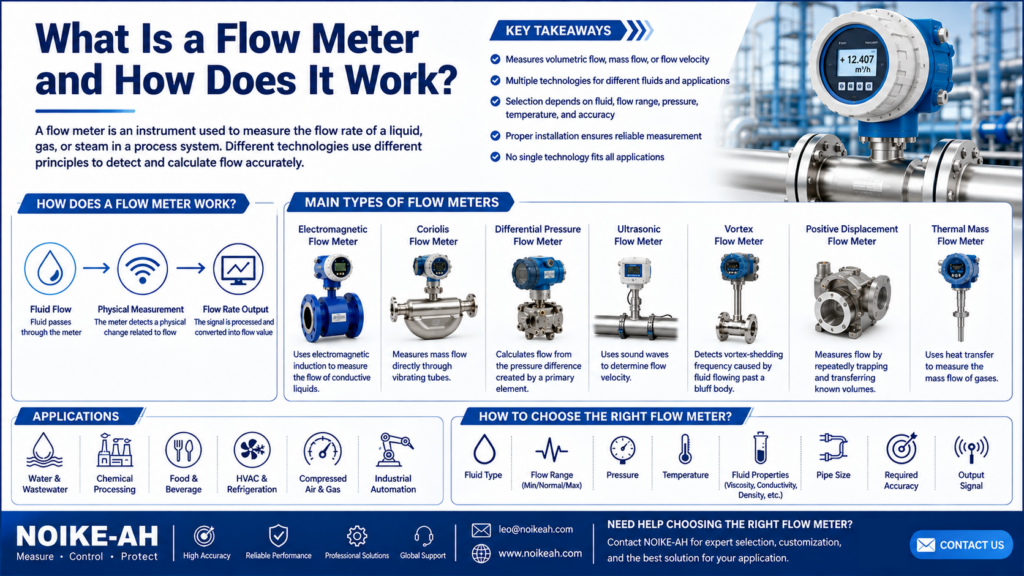
A flow meter is an instrument used to measure the flow of a liquid, gas, or steam through a pipe or process system. Depending on its measurement principle, a flow meter can determine volumetric flow rate, mass flow rate, or fluid velocity.
Different flow meters work in different ways. Electromagnetic flow meters use electromagnetic induction, Coriolis meters measure mass flow through vibrating tubes, vortex meters detect vortex-shedding frequency, ultrasonic meters use sound waves, differential-pressure meters calculate flow from pressure difference, and positive-displacement meters measure known volumes of fluid. The correct technology depends on the fluid, flow range, pressure, temperature, pipe size, required accuracy, and installation conditions.
Key Takeaways
- A flow meter measures the movement of fluid through a defined measurement point.
- Flow meters may measure or derive volumetric flow, mass flow, or flow velocity, depending on the technology.
- Common technologies include electromagnetic, Coriolis, differential pressure, ultrasonic, vortex, turbine, positive displacement, and thermal mass.
- The best flow meter is determined by fluid properties and process conditions, not simply by pipe size.
- Proper sizing, installation, configuration, and calibration are essential for reliable flow measurement.
- No single flow meter technology is ideal for every liquid, gas, or steam application.
What Is a Flow Meter?
A flow meter is a measuring instrument that determines how much fluid moves through a piping system over a given period.
In industrial applications, flow measurement is commonly expressed as either:
Volumetric Flow Rate
Volumetric flow describes the volume of fluid passing through the measurement point per unit of time.
Common units include:
- m³/h
- L/min
- L/h
- ft³/min
- gal/min
The basic relationship is:
Q = A × v
Where:
- Q = volumetric flow rate
- A = pipe cross-sectional area
- v = average fluid velocity
Mass Flow Rate
Mass flow describes the mass of fluid passing through the measurement point per unit of time.
Typical units include:
- kg/h
- kg/min
- t/h
- lb/h
Mass flow is particularly important when the process depends on the actual amount of material rather than its volume.
Flow Velocity
Flow velocity describes how quickly the fluid moves through the pipe, commonly expressed in:
- m/s
- ft/s
Some flow meters primarily detect a variable related to velocity and then calculate or convert it into a flow-rate value.
The distinction between mass flow, volumetric flow, and velocity is important because different flow-meter technologies measure different physical quantities.
How Does a Flow Meter Work?
A flow meter does not have one universal operating principle. Instead, each technology uses a physical effect that changes when fluid flows.
The measurement process can generally be understood in three stages:
Fluid Flow → Physical Measurement → Flow-Rate Output
For example:
- A magnetic flow meter detects an induced electrical voltage.
- A vortex meter detects vortex frequency.
- A Coriolis meter detects changes in vibrating tubes.
- A DP flow meter measures pressure difference.
- An ultrasonic meter measures sound-wave behavior.
- A positive-displacement meter measures repeated known volumes.
The transmitter or electronic system then processes the sensor signal and provides a flow-rate indication or output.
What Are the Main Types of Flow Meters?
Different applications require different measurement technologies. The following are some of the major flow-meter principles used in industrial systems.
1. Electromagnetic Flow Meter
An electromagnetic flow meter, also called a magnetic flow meter, uses electromagnetic induction to measure the velocity of a conductive liquid.
The measuring tube generates a magnetic field. When a conductive liquid passes through this field, a voltage is induced across the liquid. The induced voltage is related to the average flow velocity and can therefore be converted into volumetric flow rate.
Typical applications
- Water
- Wastewater
- Process liquids
- Conductive chemicals
- Slurries, when the meter is designed for the application
Key consideration
The liquid must have adequate electrical conductivity for the measurement principle to function correctly.
Because there are generally no moving parts inside the measuring tube, electromagnetic flow meters can be attractive for applications where mechanical wear is undesirable.
2. Coriolis Flow Meter
A Coriolis flow meter measures mass flow directly using vibrating measuring tubes.
As fluid moves through the vibrating tubes, the movement of the fluid causes a measurable change in the tube’s vibration behavior. The resulting phase shift is related to mass flow.
Depending on the meter design, Coriolis instruments can also provide density and temperature information.
Typical applications
- Chemical processing
- Batching
- Dosing
- Oil and gas
- Food and beverage
- Pharmaceutical processing
- Applications requiring direct mass-flow measurement
Coriolis flow measurement is standardized by ISO 10790, which provides guidance on selection, installation, calibration, performance, and operation of Coriolis flow meters.
3. Differential Pressure Flow Meter
A differential-pressure flow meter determines flow from the pressure difference created by a primary element installed in the pipe.
Common primary elements include:
- Orifice plates
- Venturi tubes
- Nozzles
- Cone meters
- Wedge meters
The basic relationship is commonly expressed as:
Q ∝ √ΔP
where ΔP is the differential pressure.
The actual flow calculation involves additional factors, including fluid properties and the geometry of the primary device.
Important standard
ISO 5167-1:2022 establishes general principles and requirements for measuring flow using differential-pressure devices inserted into full circular conduits. It covers devices including orifice plates, nozzles, Venturi tubes, cone meters, and wedge meters.
ISO 5167 also specifies installation and uncertainty-related requirements for its applicable measurement methods. Its scope is not a universal specification for every flow meter. For example, the standard applies to full conduits with single-phase flow under its specified conditions and does not cover pulsating flow.
Typical applications
- Steam
- Compressed gases
- Process gases
- Liquids
- Utility systems
4. Ultrasonic Flow Meter
An ultrasonic flow meter uses sound waves to determine flow-related information.
One common method is transit-time measurement. The meter compares the travel time of ultrasonic signals moving with and against the flow. The difference is related to fluid velocity.
Some ultrasonic meters are installed inline, while clamp-on ultrasonic meters can measure from outside the pipe without inserting a wetted sensor into the process.
Typical applications
- Water
- Process liquids
- Large pipelines
- Temporary measurements
- Applications where non-intrusive measurement is desirable
The suitability of ultrasonic measurement depends on the pipe, fluid, flow conditions, acoustic properties, and specific meter design.
5. Vortex Flow Meter
A vortex flow meter places a bluff body in the fluid path.
As fluid flows around the bluff body, alternating vortices are generated downstream. The frequency of these vortices is related to flow velocity.
The instrument detects the vortex frequency and converts it into a flow-rate value.
Typical applications
- Steam
- Compressed air
- Industrial gases
- Clean liquids
- Process utilities
Vortex technology is particularly associated with industrial steam and clean-gas measurement, although suitability depends on the actual process conditions.
6. Turbine Flow Meter
A turbine flow meter contains a rotor positioned in the fluid stream.
As fluid passes through the meter, the rotor rotates. Within the meter’s specified operating range, rotor speed is related to fluid flow.
Advantages
- Relatively simple measurement principle
- Can provide pulse or frequency output
- Suitable for certain clean-liquid applications
Considerations
The rotor and bearings are mechanical components. Therefore, fluid cleanliness, viscosity, operating range, pressure, temperature, and mechanical wear should be considered during selection.
A turbine meter should not automatically be treated as suitable for dirty or highly viscous fluids.
7. Positive Displacement Flow Meter
A positive-displacement (PD) flow meter measures flow by repeatedly trapping and transferring defined volumes of fluid.
Examples include:
- Oval gear meters
- Gear flow meters
- Rotary piston meters
- Other displacement-based designs
Instead of relying primarily on fluid velocity, the instrument measures a series of known or calibrated displacement events.
Typical applications
Positive-displacement technology can be useful for:
- Low liquid flow
- Dosing
- Batching
- Lubricating oils
- Hydraulic fluids
- Higher-viscosity liquids
The actual suitability depends on the meter’s flow range, viscosity range, pressure rating, temperature rating, material compatibility, and required accuracy.
8. Thermal Mass Flow Meter
A thermal mass flow meter uses heat transfer to determine gas mass flow.
A sensing element is heated, and flowing gas removes heat from the element. The relationship between heat transfer and gas flow is used to determine the mass-flow rate.
Typical applications
- Compressed air
- Industrial gases
- Process gas
- Gas utility monitoring
Because the measurement depends on thermal properties, the gas composition and operating conditions must be appropriate for the instrument’s configuration.
Key Parameters for Flow Meter Selection
Selecting a flow meter requires more than knowing the pipe diameter.
1. Fluid Type
First identify whether the medium is:
- Water
- Oil
- Chemical liquid
- Slurry
- Compressed air
- Natural gas
- Other gas
- Steam
Also determine whether the flow is single-phase or contains gas, solids, or other phases.
2. Minimum, Normal and Maximum Flow
Always provide:
- Minimum flow
- Normal operating flow
- Maximum flow
This information is essential for selecting an appropriate meter range.
A meter should not be selected only from the maximum possible process flow.
3. Pressure
Specify:
- Normal operating pressure
- Maximum operating pressure
- Pressure fluctuations
Pressure affects both the mechanical rating and, for some applications, the fluid properties used in the measurement.
4. Temperature
Specify:
- Minimum process temperature
- Normal process temperature
- Maximum process temperature
The sensor, seals, electronics, process connection, and installation configuration must all be suitable for the expected temperature.
5. Fluid Properties
Depending on the measurement technology, important properties may include:
- Density
- Viscosity
- Electrical conductivity
- Compressibility
- Gas composition
- Solids concentration
For example, conductivity is a fundamental consideration for electromagnetic flow meters, while viscosity can significantly influence some turbine and positive-displacement applications.
6. Pipe Size
Pipe size is important, but pipe size alone does not determine meter size.
The final selection should consider:
Pipe Size + Flow Range + Fluid Properties + Allowable Pressure Loss + Meter Operating Range
This prevents the common mistake of selecting a meter solely because its connection matches the existing pipe.
7. Required Accuracy
Accuracy must always be evaluated together with its reference basis.
For example:
- ±1% of reading
- ±1% of full scale
are not equivalent specifications.
Repeatability is also important because a meter may repeatedly produce similar results even when its absolute accuracy is limited.
8. Output Signal
Determine what the control system requires.
Common outputs include:
- Pulse
- Frequency
- 4–20 mA
- Relay
- Digital communication
The available output depends on the specific meter and transmitter configuration.
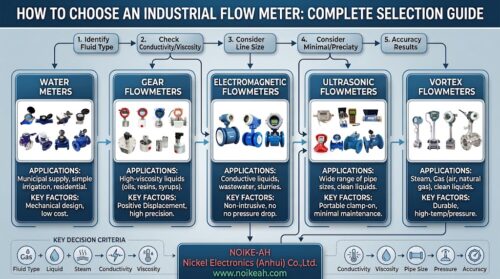
How to Choose the Right Flow Meter?
The following table provides a practical starting point.
| Application Requirement | Flow Meter Technology to Consider |
|---|---|
| Conductive water or liquid | Electromagnetic |
| Direct mass-flow measurement | Coriolis |
| Steam measurement | Vortex / Differential Pressure |
| Clean gas | Vortex / Ultrasonic / DP |
| Compressed air | Thermal Mass / Vortex / Ultrasonic / DP |
| Low liquid flow | Positive Displacement / Gear |
| Viscous liquid | Positive Displacement / Coriolis |
| Non-intrusive measurement | Clamp-on Ultrasonic |
| Large pipeline measurement | Ultrasonic, depending on application |
| Process liquid with solids | Electromagnetic, when suitable for the application |
This is a technology-selection guide rather than a universal rule. Final selection should always be based on actual process data.
Flow Meter Installation
Correct installation is critical to measurement performance.
Maintain Appropriate Flow Conditions
Many flow meters require suitable upstream and downstream piping conditions.
Elbows, valves, reducers, pumps, and other disturbances can alter the velocity profile entering the meter.
However, there is no universal straight-pipe requirement for all flow meters.
The required installation distance depends on the meter technology and manufacturer specifications.
For differential-pressure devices covered by ISO 5167, installation conditions form part of the measurement requirements.
Keep Liquid Measuring Pipes Properly Filled
For many liquid applications, the meter should operate with the measuring section properly filled.
Air or gas entering a liquid measurement system can affect the reading depending on the measurement technology.
Installation should therefore consider:
- Pipe elevation
- Air accumulation
- Pump location
- Drainage
- Pipe orientation
Consider Flow Direction
The meter must be installed according to its specified flow direction.
Incorrect orientation can result in:
- Incorrect output
- Unstable readings
- Measurement errors
- Mechanical problems for some meter types
Avoid Excessive Vibration
Vibration can affect sensitive measurement systems and mechanical meters.
Where vibration is present, consider:
- Pipe supports
- Equipment isolation
- Installation location
- Manufacturer recommendations
Consider Maintenance Access
A flow meter should be installed where technicians can access:
- Display
- Wiring terminals
- Sensors
- Process connections
- Isolation valves
- Calibration or verification points
Good accessibility can reduce maintenance time and improve long-term system reliability.
Common Flow Meter Problems
Why Is the Flow Reading Inaccurate?
Possible causes include:
- Incorrect sizing
- Incorrect configuration
- Fluid properties different from expected
- Installation problems
- Flow disturbance
- Air in liquid service
- Sensor contamination
- Operation outside the specified range
- Calibration issues
The meter should be checked systematically before replacement.
Why Is the Flow Signal Unstable?
Potential causes include:
- Pulsating flow
- Gas bubbles
- Process fluctuations
- Excessive vibration
- Electrical interference
- Flow below the effective operating range
- Incorrect installation
An unstable signal does not automatically mean the sensor is defective.
Why Does a Flow Meter Show a Low Reading?
Possible causes include:
- Actual flow is lower than expected
- Incorrect meter configuration
- Partial pipe conditions
- Gas entrainment
- Incorrect pipe-size information
- Sensor contamination
- Installation disturbance
- Operation outside the specified measurement range
The actual process conditions should be verified before changing the instrument.
What Are Flow Meters Used For?
Flow meters are used wherever controlling or monitoring fluid movement is important.
Water and Wastewater
Flow measurement is commonly used for:
- Water supply
- Wastewater treatment
- Pumping systems
- Process water
- Cooling water
Electromagnetic and ultrasonic technologies are common options depending on the application.
HVAC and Refrigeration
Flow measurement can be used for:
- Chilled water
- Condenser water
- Heating water
- Cooling systems
- Heat-pump systems
The meter technology should be selected according to fluid properties, pipe size, temperature, pressure, and required measurement performance.
Chemical Processing
Flow measurement can support:
- Chemical dosing
- Process control
- Material transfer
- Batch production
- Solvent measurement
Material compatibility is especially important when selecting wetted components.
Food and Beverage
Flow meters may be used for:
- Ingredient transfer
- Liquid processing
- Batching
- Cleaning systems
- Utility monitoring
Hygienic requirements may apply depending on the process.
Compressed Air and Gas
Flow measurement can be used to:
- Monitor compressed-air consumption
- Measure process gases
- Monitor utility consumption
- Support process control
Thermal mass, vortex, ultrasonic, and differential-pressure technologies may be considered depending on the gas and operating conditions.
Industrial Automation
Flow meters can provide measurement data to:
- PLC
- DCS
- SCADA
- Batching systems
- Alarm systems
- Process-control systems
The required communication interface should be specified during selection.
Recommended Instrument by Application
For a practical first selection:
Conductive Liquid
Consider an electromagnetic flow meter.
It is particularly suitable when the liquid has sufficient electrical conductivity and the process requires volumetric flow measurement.
Steam
Consider a vortex or differential-pressure flow meter.
The final choice depends on pressure, temperature, flow range, pipe size, installation, and required accuracy.
Direct Mass Flow
Consider a Coriolis flow meter.
Coriolis technology is designed for direct mass-flow measurement and can also provide additional process variables depending on the instrument.
Ultra-Low Liquid Flow
Consider a positive-displacement or precision gear flow meter.
This approach can be advantageous when the process requires accurate displacement-based measurement at low liquid flow rates, provided the fluid viscosity and meter operating range are compatible.
Non-Intrusive Measurement
Consider a clamp-on ultrasonic flow meter.
This can be useful when cutting the pipe or inserting a wetted sensor is undesirable, provided the pipe and fluid conditions are suitable.
FAQ
What is a flow meter?
A flow meter is an instrument used to measure the flow rate of a liquid, gas, or other compatible fluid through a process system. Depending on the technology, it can measure or determine volumetric flow, mass flow, or flow velocity.
How does a flow meter work?
A flow meter detects a physical effect associated with fluid movement and converts that measurement into a flow-rate value. The physical principle depends on the technology, such as electromagnetic induction, differential pressure, Coriolis force, ultrasonic signals, vortex shedding, turbine rotation, thermal transfer, or positive displacement.
What are the main types of flow meters?
Common types include electromagnetic, Coriolis, differential-pressure, ultrasonic, vortex, turbine, positive-displacement, and thermal mass flow meters.
Which flow meter is best for water?
There is no single best flow meter for all water applications. Electromagnetic flow meters are commonly considered for conductive water, while ultrasonic technology can be suitable for certain inline or non-intrusive applications. The final selection depends on flow range, pipe size, temperature, pressure, installation, and accuracy requirements.
Which flow meter is suitable for steam?
Vortex and differential-pressure technologies are commonly used for steam measurement. The appropriate technology depends on the steam conditions, flow range, pressure, temperature, pipe size, installation requirements, and accuracy target.
Which flow meter is suitable for low liquid flow?
Positive-displacement and precision gear flow meters can be considered for low liquid flow applications. The meter’s minimum measurable flow, viscosity range, pressure, temperature, and required accuracy should be verified before selection.
Can a flow meter measure both liquid and gas?
Some measurement technologies can be used for both liquids and gases, but a particular flow meter model is not automatically suitable for both. The sensor design and calibration must match the intended medium and operating conditions.
Does pipe size determine flow meter size?
No. Pipe size is an important selection parameter, but it is not the only one. Minimum, normal, and maximum flow rates, allowable velocity, pressure loss, fluid properties, and the meter’s specified operating range must also be considered.
Does every flow meter require straight pipe?
No. Installation requirements vary by technology and meter design. Some flow meters are more sensitive to upstream disturbances than others. Always follow the specific manufacturer’s installation requirements.
What output signals are available from flow meters?
Depending on the model, flow meters may provide pulse, frequency, 4–20 mA, relay, or digital communication outputs. The available interfaces should be confirmed for the specific instrument.
What information should I provide when requesting a flow meter quotation?
For a technical quotation, provide:
- Fluid name
- Minimum flow
- Normal flow
- Maximum flow
- Pipe size
- Operating pressure
- Operating temperature
- Fluid density or viscosity, when relevant
- Conductivity for electromagnetic applications
- Required accuracy
- Process connection
- Required output signal
- Installation conditions
Providing these parameters allows the manufacturer to evaluate the application rather than recommending a meter based only on pipe size.
Conclusion
A flow meter is a process instrument that measures or determines the rate at which fluid moves through a system. Different technologies use different physical principles, including electromagnetic induction, differential pressure, Coriolis vibration, ultrasonic signals, vortex shedding, turbine rotation, thermal transfer, and positive displacement.
The right flow meter should be selected according to the fluid, flow range, pressure, temperature, pipe size, fluid properties, accuracy requirements, pressure loss, installation conditions, and output requirements.
For reliable measurement, correct technology selection is only the first step. Proper sizing, installation, configuration, commissioning, and maintenance are equally important.
For example, a magnetic flow meter may be a strong candidate for conductive water, while a vortex meter may be appropriate for many steam applications, a Coriolis meter for direct mass-flow measurement, and a positive-displacement or gear meter for certain low-flow liquid applications.
The goal is not to find the “best flow meter” in general. The goal is to find the right flow meter for a specific process.
RFQ CTA — Need Help Choosing the Right Flow Meter?
Choosing the correct flow meter starts with accurate process information.
Send NOIKE-AH the following parameters for a technical evaluation:
- Medium / Fluid:
- Minimum Flow:
- Normal Flow:
- Maximum Flow:
- Pipe Size:
- Pressure:
- Temperature:
- Viscosity / Density:
- Conductivity, if applicable:
- Required Accuracy:
- Process Connection:
- Output Signal:
- Installation Conditions:
NOIKE-AH provides flow measurement solutions for industrial applications, including flow meters, flow switches, and customized OEM/ODM instrumentation.
Contact NOIKE-AH for flow meter selection, technical consultation, OEM/ODM customization, and quotation.