
How to Choose an Industrial Flow Meter: Complete Selection Guide Direct Answer
Choosing an industrial flow meter starts with understanding the measured medium, flow range, pressure, temperature, pipe size, required accuracy, and installation conditions. Different technologies—including electromagnetic, vortex, ultrasonic, turbine, thermal mass, Coriolis, and mechanical flow meters—are designed for different fluids and operating conditions.
The correct flow meter is not necessarily the most accurate or most expensive option. The best choice is the instrument that provides reliable measurement under the actual process conditions while balancing accuracy, pressure loss, maintenance, installation requirements, and total cost of ownership.
Key Takeaways
- Identify the fluid type and physical properties before selecting a flow meter.
- Check minimum, normal, and maximum flow rates, rather than selecting based only on normal flow.
- Match the meter technology to the application: liquid, gas, steam, conductive fluid, clean fluid, or fluid containing solids.
- Consider pipe size, pressure, temperature, straight-pipe requirements, installation orientation, and maintenance access.
- Select output and communication functions according to the control system, such as 4–20 mA, pulse, relay, HART, RS485/Modbus, or other available protocols.
What Is an Industrial Flow Meter?
An industrial flow meter is an instrument used to measure the flow rate of liquids, gases, or steam in industrial pipelines and process systems.
Depending on the technology, a flow meter can measure:
- Volumetric flow rate, such as m³/h, L/min, or GPM
- Mass flow rate, such as kg/h or t/h
- Velocity, which can be converted into flow rate when the pipe cross-sectional area is known
Common industrial flow meter technologies include:
| Flow Meter Type | Typical Measurement Principle | Common Applications |
|---|---|---|
| Electromagnetic Flow Meter | Faraday’s law of electromagnetic induction | Water, wastewater, conductive liquids |
| Vortex Flow Meter | Vortex shedding behind a bluff body | Steam, gas, compressed air, liquids |
| Ultrasonic Flow Meter | Transit-time or Doppler ultrasonic measurement | Water, clean liquids, some industrial fluids |
| Turbine Flow Meter | Rotor rotation caused by fluid flow | Clean liquids and gases |
| Coriolis Flow Meter | Coriolis effect | High-accuracy mass flow measurement |
| Thermal Mass Flow Meter | Heat transfer from a heated sensor | Air, gases, compressed air |
| Mechanical Flow Meter | Mechanical movement caused by flow | Water and relatively simple applications |
No single flow meter technology is ideal for every process.
How Does It Work?
Different flow meter technologies determine flow in different ways.
Electromagnetic Flow Meter
An electromagnetic flow meter generates a magnetic field around the measuring tube. When a conductive liquid passes through the magnetic field, a voltage is induced. The voltage is proportional to the average flow velocity, allowing the instrument to calculate volumetric flow.
Electromagnetic flow meters have no moving parts in the measuring tube, which makes them suitable for many water, wastewater, chemical, and process-liquid applications.
However, the medium must have sufficient electrical conductivity, so electromagnetic flow meters are generally unsuitable for non-conductive liquids such as most hydrocarbons.
Vortex Flow Meter
A vortex flow meter places a bluff body in the flow path. As fluid passes the bluff body, alternating vortices are generated. The vortex shedding frequency is related to flow velocity.
Vortex meters are widely used for steam, compressed air, natural gas, and industrial liquids, provided the operating conditions are suitable.
Ultrasonic Flow Meter
Ultrasonic flow meters use sound waves to determine fluid velocity. Transit-time ultrasonic meters compare the travel time of ultrasonic signals moving with and against the flow.
Clamp-on ultrasonic flow meters can measure flow without cutting into the pipeline, which can be useful for temporary measurement, system verification, or applications where process shutdown is difficult.
Coriolis Flow Meter
Coriolis flow meters measure mass flow through the interaction between fluid movement and oscillating measuring tubes. They can also provide density and temperature information depending on the instrument configuration.
They are particularly valuable when direct mass-flow measurement and high accuracy are important.
Key Parameters
Before choosing an industrial flow meter, collect the following process information.
1. Medium
Identify exactly what is being measured:
- Water
- Wastewater
- Oil
- Chemicals
- Compressed air
- Natural gas
- Steam
- Fuel
- Slurry
- Other process fluids
Also consider viscosity, density, conductivity, corrosiveness, suspended solids, gas content, and other relevant physical properties.
2. Flow Range
Provide at least:
- Minimum flow
- Normal flow
- Maximum flow
For example, a pipeline may operate at 10–80 m³/h rather than simply “50 m³/h.”
The meter should be selected so that the normal operating point is within an appropriate portion of its measurement range while still covering the required minimum and maximum flow.
3. Pipe Size
Record the actual pipeline diameter and connection requirements.
Common connection types include:
- Flanged
- Threaded
- Wafer
- Tri-clamp
- Insertion
- Clamp-on
The meter size does not always have to be identical to the process pipe size. In some applications, reducing or expanding the meter size can improve measurement performance, but this must be evaluated according to the meter’s allowable velocity range and installation requirements.
4. Pressure
Provide:
- Normal operating pressure
- Minimum pressure
- Maximum pressure
- Design pressure
Pressure is important for selecting the appropriate pressure rating and mechanical construction.
5. Temperature
Specify both:
- Process temperature
- Ambient temperature
High-temperature steam, hot water, cryogenic fluids, and outdoor installations may require different sensor and electronics configurations.
6. Accuracy
Determine the actual accuracy requirement.
For a utility-water monitoring application, an extremely high-accuracy meter may not be economically justified. For custody transfer, batching, dosing, or process control, a higher level of accuracy may be required.
7. Output and Communication
Common options include:
- 4–20 mA
- Pulse output
- Frequency output
- Relay output
- RS485 / Modbus
- HART
- Other industrial communication interfaces
The output should be compatible with the PLC, DCS, SCADA, flow totalizer, or other control equipment.
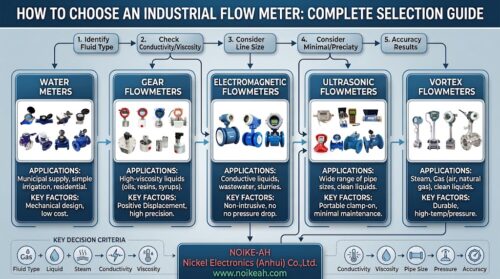
How to Choose
The most practical way to select a flow meter is to work through the application step by step.
Step 1: Identify the Medium
Start with the fluid.
Ask:
Is it a liquid, gas, or steam?
Then determine whether it is conductive, corrosive, viscous, clean, or contains suspended particles.
Step 2: Determine the Flow Range
Do not provide only the average flow.
Record:
Minimum → Normal → Maximum
This is one of the most important inputs for flow meter sizing.
Step 3: Check Operating Pressure and Temperature
The flow meter must withstand the actual process conditions, including possible pressure and temperature fluctuations.
Step 4: Select the Measurement Technology
A simplified selection approach is:
- Conductive liquids → Electromagnetic flow meter
- Steam → Vortex flow meter
- Compressed air and gases → Thermal mass or vortex flow meter, depending on the application
- Clean liquids → Ultrasonic, electromagnetic, turbine, or other suitable technologies
- High-accuracy mass measurement → Coriolis flow meter
- Temporary/non-invasive measurement → Clamp-on ultrasonic flow meter
- Simple water applications → Mechanical or electromagnetic flow meter
This is a starting point rather than a substitute for engineering selection.
Step 5: Check Installation Conditions
Confirm:
- Available straight pipe length
- Pipe orientation
- Upstream disturbances
- Downstream disturbances
- Valves and pumps nearby
- Pipeline vibration
- Accessibility for maintenance
- Electrical installation conditions
Step 6: Confirm Meter Size
Meter sizing should consider the expected flow velocity, measuring range, pressure loss, and manufacturer’s specified operating limits.
Avoid selecting a meter solely because its nominal diameter matches the pipeline.
Step 7: Confirm Outputs and Materials
Finally, select:
- Wetted materials
- Electrode or sensor materials where applicable
- Liner materials where applicable
- Connection type
- Enclosure protection
- Power supply
- Display
- Communication interface
- Output configuration
Installation
Correct installation is essential for reliable flow measurement.
Straight Pipe Requirements
Many flow meters require relatively undisturbed flow conditions.
Elbows, valves, reducers, pumps, tees, and other disturbances can create turbulence or asymmetric velocity profiles.
Follow the manufacturer’s specified upstream and downstream straight-pipe requirements rather than applying one universal number to every flow meter.
Pipeline Must Remain Full When Required
For many liquid flow meter applications, the measuring pipe should remain completely filled.
Avoid installation locations where the pipeline can partially drain, especially at high points, open discharge sections, or locations downstream of unsuitable control arrangements.
Avoid Unnecessary Vibration
Strong mechanical vibration can affect measurement stability and electronics.
Where vibration is unavoidable, evaluate the installation design and the manufacturer’s allowable vibration conditions.
Consider Maintenance Access
The meter should remain accessible for:
- Inspection
- Wiring
- Configuration
- Calibration or verification
- Cleaning where applicable
- Replacement
A technically correct meter installed in an inaccessible location can still create significant maintenance problems.
Common Problems
Unstable Flow Readings
Possible causes include:
- Turbulent flow
- Insufficient straight pipe
- Two-phase flow
- Partially filled pipeline
- Air bubbles
- Condensate in steam systems
- Incorrect meter sizing
- Electrical interference
The first step should be to check the actual process and installation conditions rather than immediately assuming that the flow meter is defective.
Flow Reading Is Too High or Too Low
Potential causes include:
- Incorrect meter sizing
- Incorrect calibration parameters
- Incorrect pipe diameter settings
- Installation problems
- Fluid conditions outside the specified range
- Incorrect sensor orientation
- Inappropriate meter technology
No Flow Signal
Check:
- Power supply
- Wiring
- Output configuration
- Sensor connection
- Pipeline condition
- Actual flow
- Alarm or diagnostic information
Pressure Loss Is Too High
Some flow meter technologies introduce a flow obstruction.
If pressure loss is critical, compare the meter’s internal construction and pressure-drop characteristics before selecting the final model.
Application
Industrial flow meters are used across many industries.
Water and Wastewater
Typical applications include:
- Raw water
- Process water
- Cooling water
- Wastewater
- Water treatment
- Pumping systems
- Water distribution
Electromagnetic and ultrasonic technologies are commonly considered for these applications, depending on the fluid and installation conditions.
Chemical Processing
Flow measurement may be required for:
- Chemical feed
- Process liquids
- Corrosive liquids
- Cooling systems
- Mixing processes
Material compatibility is particularly important.
Oil and Gas
Depending on the process, applications may involve:
- Hydrocarbon liquids
- Natural gas
- Fuel
- Produced water
- Process utilities
The appropriate technology depends on fluid properties, pressure, temperature, accuracy requirements, and applicable industry requirements.
Steam and Energy Management
Vortex flow meters are commonly used for steam measurement.
For steam applications, engineers should consider:
- Saturated or superheated steam
- Pressure
- Temperature
- Flow range
- Pipeline configuration
- Condensate management
Compressed Air
Compressed-air flow measurement is used for:
- Energy management
- Leakage monitoring
- Production-line monitoring
- Plant utility management
Thermal mass and vortex technologies may be considered depending on the required measurement method and operating conditions.
Recommended Instrument
For general industrial liquid-flow applications, an electromagnetic flow meter is often a practical choice when the medium is electrically conductive.
For steam applications, a vortex flow meter is generally a more appropriate technology.
For non-invasive measurement or temporary verification, a clamp-on ultrasonic flow meter can be considered.
For applications requiring direct mass-flow measurement and high accuracy, a Coriolis flow meter may be appropriate.
For gas-flow measurement, particularly compressed air, a thermal mass flow meter can be considered when its measurement range and installation conditions match the application.
The final selection should always be based on the actual process parameters and the manufacturer’s technical specifications.
FAQ
What is the best industrial flow meter?
There is no single best flow meter for every application. The best choice depends on the medium, flow range, pressure, temperature, pipe size, accuracy requirement, installation conditions, and required outputs.
Which flow meter is best for water?
Electromagnetic and ultrasonic flow meters are commonly considered for industrial water applications. Mechanical flow meters can also be suitable for simpler applications.
Which flow meter is best for steam?
Vortex flow meters are widely used for industrial steam measurement. The selection should consider whether the steam is saturated or superheated and the actual pressure, temperature, and flow range.
Can one flow meter measure different fluids?
Some flow meter technologies can measure different fluids, but their suitability depends on the physical properties of each medium. A meter selected for water should not automatically be assumed suitable for steam, oil, gas, or corrosive chemicals.
Does pipe size determine flow meter size?
Not necessarily. The flow meter should be sized according to the required flow range and the manufacturer’s recommended velocity and operating range. In some installations, the meter diameter can differ from the pipeline diameter.
What information should I provide when requesting a flow meter quotation?
At minimum, provide:
- Medium
- Minimum/normal/maximum flow
- Pipe diameter
- Operating pressure
- Operating temperature
- Required accuracy
- Process connection
- Power supply
- Output or communication requirements
- Installation conditions
Providing these parameters allows the manufacturer to recommend a more appropriate model.
Conclusion
Selecting an industrial flow meter is a process-engineering decision, not simply a product-size decision.
The most important factors are the fluid, flow range, pressure, temperature, pipe size, accuracy, installation conditions, and communication requirements. Once these parameters are established, the appropriate measurement technology can be selected and the meter can be correctly sized.
A well-selected flow meter should provide stable measurement, appropriate accuracy, acceptable pressure loss, reliable operation, and manageable maintenance throughout its service life.
RFQ CTA
Need Help Choosing the Right Industrial Flow Meter?
Not sure which flow meter technology is suitable for your application?
Send us your medium, flow range, pipe size, pressure, temperature, and application details. Our technical team can help evaluate the operating conditions and recommend a suitable flow measurement solution.
Request a Flow Meter Recommendation / RFQ
NOIKE-AH — Professional Manufacturer of Flow, Pressure, Level and Temperature Instrumentation & Sensors



