
Direct Answer
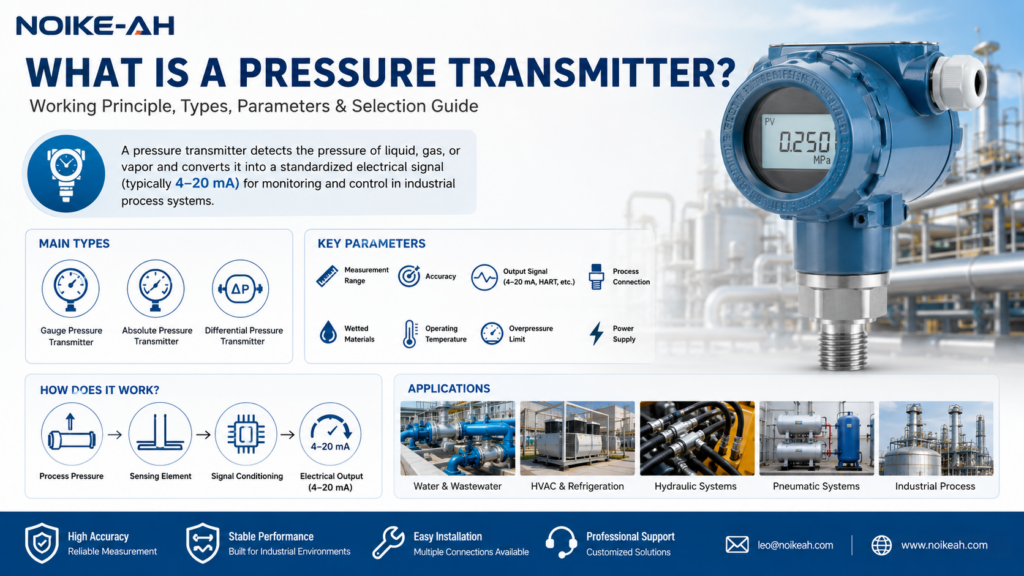
A pressure transmitter is an industrial measuring instrument that detects the pressure of a liquid, gas, or other process medium and converts the measured pressure into a standardized electrical signal for monitoring, control, or automation systems. Common output signals include 4–20 mA, while some pressure transmitters also support digital communication such as HART or other industrial communication interfaces.
A pressure transmitter typically consists of a pressure-sensing element, signal-conditioning electronics, and an electrical output interface. The correct transmitter should be selected according to the pressure range, medium, temperature, connection, accuracy, output signal, and installation environment.
Key Takeaways
- A pressure transmitter converts process pressure into an electrical output signal for industrial measurement and control.
- 4–20 mA is one of the most widely used analog output signals in industrial instrumentation.
- Pressure transmitters can be designed for gauge, absolute, differential, or other pressure measurement requirements.
- Correct selection depends on pressure range, overpressure conditions, process medium, temperature, accuracy, electrical output, and process connection.
- Installation conditions can significantly affect measurement stability and accuracy.
- A transmitter should be selected based on the actual process conditions, not simply the nominal pipe pressure.
What Is a Pressure Transmitter?
A pressure transmitter is a type of industrial pressure instrument used to measure the pressure of a process medium and transmit the measurement to another device, such as a PLC, DCS, data acquisition system, display instrument, or control system.
Unlike a simple mechanical pressure gauge, which normally provides a local visual indication, a pressure transmitter converts pressure into an electrical signal that can be transmitted over a distance.
For example, a typical 4–20 mA pressure transmitter may use:
- 4 mA to represent the lower calibrated range
- 20 mA to represent the upper calibrated range
The receiving control system can then convert the current signal into a pressure value based on the configured measurement range.
Pressure Transmitter vs. Pressure Sensor
The terms pressure sensor and pressure transmitter are sometimes used interchangeably, but they are not necessarily identical.
A pressure sensor generally refers to the sensing element or device that detects pressure.
A pressure transmitter normally includes the sensing element plus electronic circuitry that conditions the signal and provides a standardized output suitable for industrial control or monitoring.
In practical industrial applications, a pressure transmitter is therefore usually considered a more complete measurement device.
How Does a Pressure Transmitter Work?
The basic operating process can be simplified into four stages:
Process Pressure → Sensing Element → Signal Conditioning → Electrical Output
1. Pressure Is Applied to the Sensing Element
The process medium applies pressure to a sensing diaphragm or other pressure-sensitive structure.
Depending on the transmitter design, the sensing technology may include piezoresistive, capacitive, strain-gauge, or other pressure-sensing principles.
2. Pressure Causes a Physical Change
The applied pressure produces a measurable mechanical or electrical change in the sensing element.
For example, pressure may cause a diaphragm to deflect. The sensing electronics detect the corresponding change.
3. Electronic Circuitry Processes the Signal
The raw sensor signal is generally relatively small and may require amplification, compensation, linearization, and other signal processing.
The transmitter electronics convert the sensor response into a usable measurement signal.
4. The Transmitter Produces an Output
The processed signal is transmitted to a control or monitoring system.
A common industrial configuration is:
Pressure → 4–20 mA → PLC/DCS → Display or Control
For applications requiring additional communication or configuration functions, digital communication may also be available depending on the transmitter model.
What Are the Main Types of Pressure Transmitters?
Pressure transmitters can be classified according to the pressure reference used for measurement.
1. Gauge Pressure Transmitter
A gauge pressure transmitter measures pressure relative to the surrounding atmospheric pressure.
It is commonly used for applications such as:
- Pump discharge pressure
- Water pressure
- Air pressure
- Hydraulic systems
- Process pipeline pressure
- Compressor systems
For example, if a transmitter measures 0.5 MPa gauge pressure, the measurement represents approximately 0.5 MPa above the local atmospheric pressure.
2. Absolute Pressure Transmitter
An absolute pressure transmitter measures pressure relative to an absolute vacuum reference.
It is useful when atmospheric pressure variations must not directly affect the measurement.
Typical applications can include:
- Vacuum systems
- Pressure monitoring where atmospheric variation matters
- Certain process and laboratory applications
- Gas and steam-related processes
3. Differential Pressure Transmitter
A differential pressure transmitter measures the difference between two pressure ports.
The basic relationship is:
ΔP = P₁ − P₂
where:
- P₁ = pressure at the high-pressure side
- P₂ = pressure at the low-pressure side
- ΔP = differential pressure
Differential pressure transmitters are widely used for:
- Filter monitoring
- Flow measurement using differential pressure
- Liquid-level measurement in certain tank configurations
- Pressure-drop monitoring
- Process equipment monitoring
What Are the Key Pressure Transmitter Parameters?
Selecting a pressure transmitter requires more than looking at its pressure range. Several technical parameters should be evaluated.
1. Measurement Range
The measurement range defines the pressure interval that the transmitter is designed to measure.
For example:
0–1 MPa
means the calibrated measurement range extends from 0 MPa to 1 MPa.
The range should be selected according to the actual operating pressure while allowing appropriate margin for process fluctuations.
Choosing an unnecessarily large range can reduce the usefulness of the available measurement span, while selecting a range that is too small may expose the transmitter to excessive pressure.
2. Overpressure Limit
The overpressure limit describes how much pressure the sensing element can withstand without permanent damage, according to the manufacturer’s specification.
This is different from the normal measurement range.
For example:
Measurement range: 0–1 MPa
does not mean the transmitter should continuously operate above 1 MPa.
The allowable overpressure must always be checked against the manufacturer’s datasheet.
3. Accuracy
Accuracy indicates how closely the transmitter’s output corresponds to the actual pressure under specified conditions.
A commonly used specification is expressed as a percentage of full scale or calibrated span.
For example:
±0.5% FS
means the stated accuracy limit is based on the full-scale value.
However, when comparing transmitters, engineers should check the complete accuracy definition because manufacturers may specify accuracy differently, including reference conditions, temperature effects, linearity, hysteresis, and repeatability.
4. Output Signal
Common pressure transmitter output configurations include:
4–20 mA
The 4–20 mA signal is widely used in industrial automation because current transmission is suitable for long-distance signal transmission and is relatively resistant to voltage drop in the signal wiring.
HART
HART communication can be used together with an analog current signal to provide digital communication and configuration capabilities, depending on the transmitter.
Other Digital Outputs
Some transmitters may provide digital communication interfaces depending on the application and product design.
Always confirm the actual supported output protocol before integrating a transmitter into a control system.
5. Power Supply
The required power supply depends on the transmitter design.
Industrial transmitters may use DC power supplies, and a two-wire 4–20 mA transmitter is commonly powered through the same loop used for signal transmission.
The actual supply voltage range should always be checked against the product datasheet.
6. Process Connection
The process connection determines how the transmitter is mechanically connected to the process.
Common configurations include threaded connections and other specialized process interfaces.
The connection should match:
- Process piping
- Existing equipment
- Pressure rating
- Sealing requirements
- Installation method
- Process medium
A mechanically incompatible connection can cause leakage or prevent correct installation.
7. Wetted Materials
The materials exposed to the process medium are particularly important.
For corrosive or chemically aggressive media, the wetted materials must have appropriate chemical compatibility.
Common stainless-steel materials are widely used in industrial pressure instrumentation, but stainless steel is not automatically compatible with every chemical medium.
The actual medium composition, concentration, temperature, and pressure should be considered when selecting materials.
How to Choose a Pressure Transmitter?
A reliable selection process should begin with the process conditions.
Step 1: Determine the Pressure Type
First determine whether you need:
- Gauge pressure
- Absolute pressure
- Differential pressure
This is one of the most fundamental selection decisions.
Step 2: Determine the Normal Operating Pressure
Identify the normal operating pressure and its possible fluctuations.
Do not select the transmitter based only on the maximum value shown on the equipment nameplate.
Consider:
Normal pressure + process fluctuation + possible pressure surge
The selected measurement range must remain within the transmitter’s specified operating limits.
Step 3: Check the Medium
Identify what the transmitter will measure:
- Water
- Air
- Hydraulic oil
- Gas
- Steam
- Chemical liquids
- Other process fluids
Then evaluate chemical compatibility and wetted materials.
Step 4: Check Temperature
Both the process temperature and ambient temperature can affect transmitter performance.
If the process temperature exceeds the transmitter’s allowable limits, a suitable installation arrangement or specialized configuration may be required.
Do not assume that a transmitter suitable for a particular pressure is automatically suitable for the same pressure at a higher temperature.
Step 5: Determine Required Accuracy
Higher accuracy is not always necessary.
For basic pressure monitoring, a moderate accuracy specification may be sufficient.
For precision process control, testing, calibration, or measurement applications, a higher accuracy transmitter may be appropriate.
The key is to match the transmitter accuracy with the actual measurement requirement.
Step 6: Select the Output
Confirm what the receiving system requires:
- 4–20 mA
- 4–20 mA + HART
- Other supported digital communication
The transmitter output and PLC/DCS input must be compatible.
Step 7: Select the Electrical and Process Connections
The transmitter must physically match the installation.
Check:
- Process thread
- Electrical connection
- Cable or connector requirements
- Installation space
- Housing protection requirements
Pressure Transmitter Installation Guide
Correct installation is essential for obtaining stable pressure measurements.
1. Verify the Pressure Range
Before installation, confirm that the transmitter’s measurement range and pressure rating are appropriate for the actual system.
Do not install a transmitter simply because its process connection fits the pipe.
2. Check the Process Connection
Make sure the thread or flange specification matches the process connection.
Use an appropriate sealing method according to the connection design and manufacturer’s instructions.
Avoid applying excessive mechanical force to the transmitter housing.
3. Consider the Installation Position
The installation position should minimize:
- Mechanical vibration
- Excessive heat
- Direct impact
- Severe environmental exposure
- Unnecessary pressure pulsation
For applications with significant vibration or pressure fluctuation, additional installation measures may be necessary.
4. Consider Temperature
If the process temperature is high, the transmitter should be installed in a configuration that keeps the transmitter within its specified temperature limits.
For steam and high-temperature processes, the pressure connection arrangement is especially important because the temperature at the transmitter must remain within the manufacturer’s permitted range.
5. Electrical Wiring
For a typical two-wire 4–20 mA transmitter, the basic signal path is:
DC Power Supply → Transmitter → PLC/DCS Analog Input → Power Supply
The exact wiring must follow the transmitter’s wiring diagram.
Never assume that all 4–20 mA transmitters have identical terminal assignments.
Common Pressure Transmitter Problems and Troubleshooting
Pressure transmitters can develop measurement problems because of the instrument itself, installation, wiring, process conditions, or the receiving control system.
Problem 1: Output Remains at 4 mA or Near Zero
Possible causes include:
- Actual process pressure is near the lower range
- Incorrect wiring
- Insufficient loop power
- Signal circuit problem
- Sensor or electronics fault
- Incorrect transmitter configuration
Recommended checks
Start with the simplest checks:
Process pressure → Wiring → Power supply → Loop current → Transmitter configuration → Instrument condition
Avoid immediately replacing the transmitter before confirming the actual loop conditions.
Problem 2: Output Remains Near 20 mA
Possible causes include:
- Actual pressure is close to the upper measurement limit
- Pressure exceeds the configured range
- Incorrect range configuration
- Pressure port or sensing system problem
- Electrical or sensor fault
First verify the actual pressure using an independent reference instrument where appropriate.
Problem 3: Pressure Reading Fluctuates
Possible causes include:
- Actual process pressure fluctuation
- Pump pulsation
- Compressor pulsation
- Mechanical vibration
- Electrical interference
- Improper installation
- Gas bubbles or liquid-column effects
- Inadequate damping for the application
The first question should be:
Is the pressure itself fluctuating, or is only the transmitter output fluctuating?
This distinction can significantly reduce troubleshooting time.
Problem 4: Reading Is Consistently Incorrect
Possible causes include:
- Incorrect pressure range
- Zero shift
- Calibration issue
- Temperature effects
- Incorrect pressure reference
- Installation-related pressure effects
- Process connection problems
Compare the transmitter against a suitable calibrated reference under controlled conditions before concluding that the sensor has failed.
Problem 5: No Output Signal
Check:
- Power supply
- Wiring polarity
- Terminal connections
- Loop resistance
- PLC/DCS input
- Transmitter electronics
A transmitter failure should only be suspected after the external circuit has been checked.
Where Are Pressure Transmitters Used?
Pressure transmitters are used across many industrial measurement and control applications.
Water and Wastewater
Typical applications include:
- Pump pressure monitoring
- Pipeline pressure measurement
- Water treatment systems
- Water supply systems
HVAC and Refrigeration
Pressure transmitters can be used for monitoring pressure in refrigeration and HVAC systems when the transmitter’s pressure range, temperature rating, and wetted materials are suitable for the refrigerant and operating conditions.
Hydraulic Systems
Pressure transmitters are commonly used to monitor hydraulic system pressure and provide signals to control or monitoring systems.
Pneumatic Systems
Applications include:
- Compressed-air systems
- Pneumatic equipment
- Air pressure monitoring
- Compressor systems
Industrial Process Systems
Pressure transmitters can be integrated into process automation systems for monitoring and controlling process pressure.
Recommended Instrument: NOIKE-AH Pressure Transmitters
For industrial pressure measurement, NOIKE-AH pressure transmitters can be selected according to the actual application requirements, including measurement range, pressure type, output signal, process connection, accuracy, and environmental conditions.
For example, the NT3051 pressure transmitter specifications previously provided for your product materials include:
- Measurement range: 0–100 kPa to 10 MPa
- Overload pressure: 150% FS
- Supply voltage: DC 16–30 V
- Analog signal accuracy: ≤ ±0.1% FS
For applications requiring different pressure ranges, output configurations, materials, or process connections, the specific model and configuration should be confirmed from the applicable product datasheet.
Important: Product specifications should always be verified against the latest official technical documentation before being used for engineering selection or procurement.
FAQ
What is a pressure transmitter used for?
A pressure transmitter measures process pressure and converts it into an electrical signal that can be transmitted to a PLC, DCS, display, monitoring system, or other industrial control equipment.
What is the difference between a pressure sensor and a pressure transmitter?
A pressure sensor generally refers to the pressure-sensing component or device. A pressure transmitter normally combines pressure sensing with signal conditioning and a standardized output interface for industrial measurement and control.
What is the most common pressure transmitter output?
4–20 mA is one of the most widely used analog output signals in industrial instrumentation. Other output and communication options may be available depending on the transmitter design.
What is the difference between gauge and absolute pressure?
Gauge pressure is referenced to atmospheric pressure, while absolute pressure is referenced to an absolute vacuum.
What is a differential pressure transmitter?
A differential pressure transmitter measures the pressure difference between two pressure inputs rather than measuring pressure relative to atmospheric pressure or vacuum.
How do I select a pressure transmitter?
Start with the pressure type, normal and maximum operating pressure, medium, temperature, required accuracy, output signal, process connection, electrical connection, and environmental conditions.
Can a pressure transmitter measure water pressure?
Yes. Pressure transmitters are widely used for water-pressure measurement, provided that the selected transmitter has a suitable pressure range, wetted materials, temperature rating, process connection, and output configuration.
Can a pressure transmitter measure hydraulic oil?
Yes, provided that the transmitter’s wetted materials and pressure/temperature ratings are compatible with the hydraulic oil and system operating conditions.
Why does a pressure transmitter give an unstable reading?
The cause may be actual process fluctuation, pump or compressor pulsation, vibration, electrical interference, installation conditions, or a transmitter problem. Troubleshooting should distinguish between actual pressure fluctuation and measurement-system fluctuation.
Conclusion
A pressure transmitter converts process pressure into a standardized electrical signal for industrial monitoring and control. Its performance depends not only on the sensing element but also on the pressure reference, measurement range, accuracy, output signal, process connection, materials, temperature, and installation conditions.
For reliable selection, engineers should first define the actual process conditions and then match the transmitter specifications to those requirements.
The most important principle is simple:
Do not select a pressure transmitter by pressure range alone. Select it according to the complete process, electrical, mechanical, and environmental requirements.
RFQ CTA
Need the Right Pressure Transmitter for Your Application?
NOIKE-AH provides industrial pressure measurement solutions for applications involving water, air, hydraulic systems, HVAC & refrigeration, and industrial process measurement.
Send us your application parameters and we can help identify a suitable pressure transmitter configuration.
Please provide:
- Medium
- Normal operating pressure
- Maximum pressure
- Required measurement range
- Medium temperature
- Ambient temperature
- Output signal
- Process connection
- Required accuracy
- Quantity
NOIKE-AH — Professional Industrial Pressure & Flow Instrument Manufacturer
Email: [email protected]
Website: www.noikeah.com



