Integrated Flow and Temperature Switch: One Device for Two Alarms
Author: Leo
SEO Title: Integrated Flow and Temperature Switch | NK210
Meta Description: Discover how an integrated flow and temperature switch monitors flow and temperature at one point. Compare NK210 and NK500C, applications, outputs and selection criteria.
Suggested URL Slug: /integrated-flow-temperature-switch/
Direct Answer
An integrated flow and temperature switch combines flow monitoring and temperature monitoring in one probe and housing. Using the thermal dispersion principle, it detects flow conditions while monitoring the temperature of the process medium, allowing both conditions to be monitored at essentially the same location.
This design is useful for cooling-water circuits, cutting-fluid systems, lubrication equipment and pump dry-run protection where flow and temperature alarms are required. The NOIKE-AH NK210 is a switch-type integrated thermal sensor, while the NK500C is an option to consider when an integrated flow and temperature device with analog temperature output is required. The appropriate choice depends on the required outputs, temperature accuracy, flow measurement needs and process conditions.
Key Takeaways
- Two monitoring functions in one device: Monitor flow condition and medium temperature at the same installation point.
- Simplified installation: One process connection can reduce the number of instrument penetrations, cables and installation tasks.
- Designed for equipment protection: Suitable applications include cooling-water monitoring, cutting-fluid circulation, lubrication and pump protection.
- Select outputs carefully: Verify that the chosen model provides the separate flow and temperature signals required by the control system.
- Not a replacement for every instrument: Separate sensors may be preferable for high-accuracy temperature control, different measurement locations, continuous flow measurement or independent safety channels.
1. What Is an Integrated Flow and Temperature Switch?
An integrated flow and temperature switch is an industrial sensing device that combines flow-condition detection and temperature monitoring in a single instrument.
Unlike a conventional installation with a separate flow switch and temperature sensor, an integrated unit can monitor both parameters at the same process location.
Typical functions include:
- Detecting whether flow is above or below a configured switching threshold.
- Monitoring the temperature of the process medium.
- Providing flow and temperature alarm functions, depending on the model.
- Sending supported signals to a PLC or other control system.
The main advantage is simpler instrumentation when both measurements are needed at the same point and threshold-based flow protection is sufficient.
However, integration does not automatically mean that every model provides two independent switching outputs or two analog signals. Check the output configuration in the specific product datasheet.

2. How Does an Integrated Flow and Temperature Switch Work?
The NOIKE-AH NK210 uses the thermal dispersion, or calorimetric, measuring principle.
Its probe contains two sensing elements:
Heated sensing element: Flowing medium carries heat away from the heated element. The cooling response changes with flow velocity.
Unheated reference element: This element remains in thermal contact with the medium and provides a reference for temperature monitoring.
The electronics interpret the thermal response to determine the flow condition and provide the configured switch output. The reference element also supports medium-temperature monitoring.
The device can therefore monitor flow and temperature at the same point without requiring two separate probes.
Why Use Thermal Dispersion?
Thermal dispersion technology is useful for flow-condition monitoring because it has no moving mechanical parts in the sensing principle. This can simplify maintenance compared with some mechanical flow-switch designs.
Nevertheless, the thermal response depends on the medium and operating conditions. Changes in viscosity, thermal conductivity, temperature or deposits on the probe may influence performance. The sensor must be selected and installed according to the manufacturer’s requirements.
3. Integrated Device vs. Separate Flow and Temperature Sensors
| Selection Factor | Integrated Flow and Temperature Device | Separate Instruments |
|---|---|---|
| Installation | One probe location may serve both functions | Each instrument has its own installation location |
| Wiring | Potentially fewer cables and PLC connections | Additional cables and input channels may be required |
| Space requirements | Useful where installation space is limited | Requires room for separate instruments |
| Temperature accuracy | Depends on the integrated model’s specification | A dedicated Pt100 or thermocouple may be preferable for precision |
| Flow measurement | Commonly provides threshold-based switching | A flow meter can provide continuous flow measurement |
| Maintenance | Fewer instrument components in the installation | Independent instruments can be serviced or replaced separately |
| Safety architecture | Depends on the model and system design | Separate channels may be preferable where independent protection is required |
When Should You Choose an Integrated Device?
An integrated flow and temperature switch is a practical option when:
- Flow and temperature must be monitored at the same location.
- A low-flow alarm and temperature alarm are sufficient.
- Installation space is limited.
- Reducing wiring and component count is important.
- The application involves utility monitoring or equipment protection.
Typical examples include cooling-water circuits, hydraulic systems, lubrication systems and OEM machinery skids.
When Are Separate Sensors Better?
Consider separate instruments when:
- High temperature accuracy or fast temperature response is required.
- Flow and temperature must be measured at different process locations.
- Accurate flow-rate measurement or totalization is needed.
- Medium properties vary significantly and require different measurement technologies.
- The safety design requires independent sensing channels or redundancy.
An integrated switch should not be assumed to replace a calibrated flow meter, precision temperature transmitter or safety-rated instrument.
4. Typical Applications of Integrated Flow and Temperature Monitoring
Cooling-Water Circuits
A flow switch can detect insufficient cooling-water circulation, while the temperature function can identify a high-temperature condition.
The flow threshold must reflect the equipment’s minimum cooling requirement. The temperature alarm must be set according to the equipment’s allowable operating temperature.
Cutting-Fluid Systems
Machine tools depend on suitable coolant circulation and temperature conditions. An integrated device can support flow-interruption detection and temperature alarm functions at the monitoring point.
Lubricating and Hydraulic Oil Systems
Loss of oil circulation combined with rising temperature can indicate a problem that requires investigation.
Before selecting a thermal device, confirm compatibility with the oil, its viscosity range and the operating temperature.
Pump Dry-Run Protection
A low-flow switching signal can be used as part of a pump protection interlock. The threshold should be established from the pump’s operating requirements and the actual system conditions, rather than chosen arbitrarily.
OEM Machinery and Equipment Skids
For equipment manufacturers, integrating two monitoring functions into one device may reduce component count, installation labor and panel wiring.
The final design must still provide all required control signals and satisfy the machine’s protection requirements.
5. How to Select an Integrated Flow and Temperature Switch
Before choosing a model, review the following factors.
1. Process Medium
Identify whether the application involves water, coolant, oil, hydraulic fluid, air or another medium.
Check wetted-material compatibility and verify the manufacturer’s permitted medium range.
2. Flow Velocity and Switching Threshold
Determine the minimum flow condition that must trigger an alarm or control action.
Thermal flow switches commonly specify flow capability in velocity units such as cm/s or m/s. Do not assume these values are equivalent to volumetric flow in L/min or m³/h.
Converting velocity to volumetric flow requires the pipe’s internal cross-sectional area and appropriate flow conditions.
3. Temperature Range and Accuracy
Confirm the minimum and maximum medium temperatures. Determine whether the application needs a temperature alarm, remote temperature monitoring or a high-accuracy temperature measurement.
If the process requires tight closed-loop temperature control, a dedicated temperature sensor may be more suitable.
4. Electrical Outputs
Check the required signal types and ensure the selected device supports the intended control-system architecture.
Depending on the model, outputs may include PNP, NPN, relay contacts or analog signals. Verify the flow and temperature functions separately, including signal range and wiring.
5. Installation and Pressure Rating
Confirm the pipe size, process connection, probe insertion depth, working pressure and available installation space.
Also check the ambient and medium temperature limits, enclosure protection rating and cable or connector requirements.
6. Response Time and Operating Conditions
The response time must suit the required alarm or protection function. Consider changes in flow, temperature and medium properties, along with possible fouling or deposits on the probe.
6. NOIKE-AH Product Options: NK210 and NK500C
NOIKE-AH offers integrated flow and temperature sensing options for different monitoring requirements.
NK210 Integrated Flow & Temperature Sensor
The NK210 Standard Series is a thermal-dispersion, switch-type integrated sensor designed for flow-condition and temperature monitoring.
Key specifications provided for the NK210 include:
| Parameter | Published Specification |
|---|---|
| Measuring principle | Thermal dispersion |
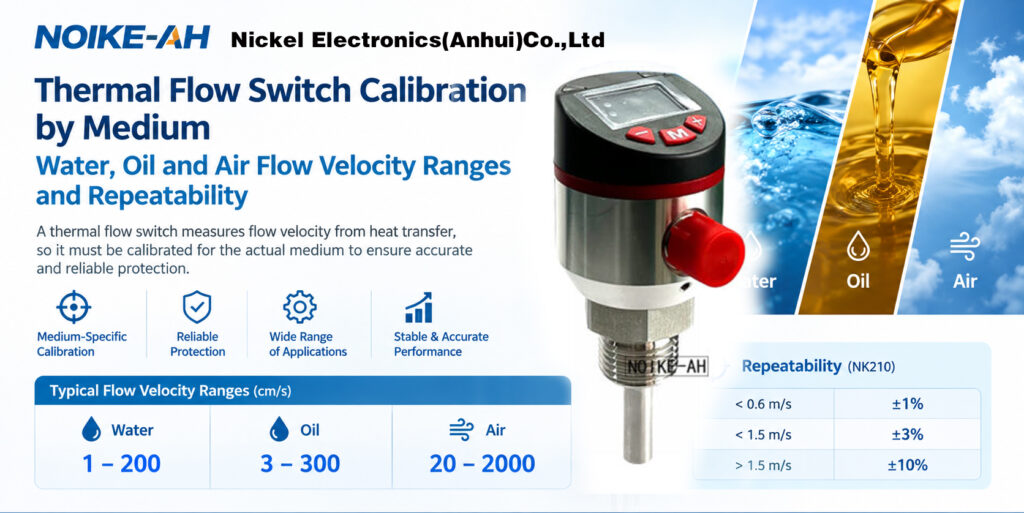
| Water velocity range | 1–200 cm/s |
| Oil velocity range | 3–300 cm/s |
| Air velocity range | 20–2000 cm/s |
| Repeatability | ±1% below 0.6 m/s; ±3% below 1.5 m/s; ±10% above 1.5 m/s |
| Flow outputs | PNP / NPN / relay; NO / NC configurable |
| Display | 0.96-inch OLED |
| Pressure rating | 100 bar; 300 bar optional |
| Protection rating | IP67 |
| Medium temperature | -20°C to +85°C |
| Ambient temperature | -40°C to +85°C |
| Wetted materials | 304 stainless steel probe and housing |
| Connection | M12 connector or 2 m cable (default) |
The published repeatability bands overlap as written. Confirm the exact velocity boundaries and calculation basis with the manufacturer before using these values for engineering acceptance criteria.
Recommended applications: Cooling-water monitoring, cutting-fluid circulation, lubrication systems, hydraulic applications and pump dry-run protection.
Product page: Integrated Flow & Temperature Sensor NK210
NK500C Flow & Temperature Integrated Transmitter
The NK500C is an alternative to consider when the application requires an integrated flow and temperature device with a temperature transmitter function.
According to the supplied product information, the NK500C combines a thermal-dispersion flow switch with integrated temperature transmission.
Before selection, confirm the available temperature range, temperature accuracy, output type and whether the required signal is a 4–20 mA temperature output or another configuration. Do not assume that every model provides a 4–20 mA flow signal.
Product page: Flow & Temperature Integrated Transmitter NK500C
7. Common Selection Mistakes
Assuming one output covers both functions: Confirm the actual number and type of flow and temperature outputs.
Treating a flow switch as a flow meter: A threshold switch does not automatically provide continuous calibrated flow-rate measurement or totalization.
Ignoring medium properties: Oil viscosity, temperature changes and deposits can influence thermal sensing performance.
Choosing a threshold without process data: Establish the required minimum flow and maximum allowable temperature from the equipment specifications.
Overlooking safety requirements: If a protection function requires independent channels or a safety-rated design, verify the complete system architecture rather than relying on device integration alone.
8. Frequently Asked Questions
How does an integrated flow and temperature switch work?
It combines flow-condition detection and temperature monitoring in one probe. In a thermal-dispersion design, the heated sensing element responds to cooling caused by flow, while the reference element monitors the medium temperature.
What is the main advantage of an integrated flow and temperature sensor?
It can monitor both parameters at the same location while reducing the number of process connections, instruments and wiring runs compared with separate sensors.
Can a flow switch also measure temperature?
Yes, if it is designed as an integrated flow and temperature device. The available temperature signal or alarm function depends on the model and its output configuration.
Does the NK210 provide a 4–20 mA temperature output?
The supplied NK210 specifications identify PNP, NPN and relay outputs, with integrated temperature monitoring. For a 4–20 mA temperature transmitter function, consider the NK500C and confirm the exact configuration with the manufacturer.
Is an integrated flow and temperature switch suitable for pump dry-run protection?
It can support a low-flow alarm or pump interlock when the selected model, switching threshold and response time meet the application’s requirements. The complete protection design should be evaluated against the pump manufacturer’s operating limits.
Should I use an integrated sensor or separate instruments?
Choose an integrated device when flow and temperature are monitored at the same point and threshold-based monitoring is sufficient. Choose separate instruments when you need higher temperature accuracy, different measurement locations, continuous flow measurement or independent safety channels.
9. Conclusion
An integrated flow and temperature switch provides a practical solution when flow-condition monitoring and temperature alarms are needed at the same process location. It can simplify installation and support equipment protection in cooling-water, cutting-fluid, lubrication and pump applications.
The key is to select the device according to the actual medium, flow threshold, temperature requirements, electrical outputs and installation conditions.
For applications requiring switch-type monitoring, consider the NOIKE-AH NK210. Where an integrated temperature transmitter function is needed, evaluate the NK500C and confirm its output specifications with the manufacturer.
Need Help Selecting an Integrated Flow and Temperature Sensor?
Share your process medium, flow velocity, operating temperature, working pressure, pipe size and required output signals with NOIKE-AH. Our team can help identify a suitable configuration based on your application requirements.
Email: [email protected]
Website: https://www.noikeah.com/