10 Types of Capacitive Sensors: How They Work and Where They Are Used
Direct Answer: What Are the 10 Types of Capacitive Sensors?
Capacitive sensors detect objects, measure physical changes, or monitor environmental conditions by sensing variations in electrical capacitance. Depending on their electrode structure and measurement method, they can be designed for proximity detection, liquid and solid level monitoring, touch sensing, position measurement, thickness measurement, humidity detection, displacement measurement, and material identification.
The 10 common types of capacitive sensors include capacitive proximity sensors, capacitive level sensors, capacitive solid-level sensors, capacitive touch sensors, linear position sensors, rotary position sensors, thickness sensors, humidity sensors, displacement sensors, and material identification sensors.
These sensors are widely used in industrial automation, manufacturing, packaging, process control, environmental monitoring, and precision measurement.
Key Takeaways
- Capacitive sensors detect changes in capacitance caused by variations in distance, electrode geometry, or dielectric properties.
- They can detect both conductive and non-conductive materials, depending on the sensor design.
- Common applications include object detection, liquid level monitoring, material positioning, thickness measurement, and humidity sensing.
- Environmental conditions such as moisture, temperature, contamination, and electromagnetic interference can affect sensor performance.
- Selecting the right capacitive sensor requires evaluating the target material, sensing range, installation conditions, operating environment, and output requirements.
1. What Is a Capacitive Sensor?
A capacitive sensor is an electronic sensing device that detects changes in electrical capacitance caused by variations in an object’s distance, position, material properties, or dielectric constant.
Unlike inductive sensors, which primarily detect metallic objects through electromagnetic induction, capacitive sensors can detect a wider range of materials, including:
- Metals
- Plastics
- Glass
- Liquids
- Powders
- Granular materials
- Other non-metallic substances
The operating principle is based on the capacitance between conductive elements. When a target approaches the sensing surface or changes its position, the electric field and effective capacitance change.
The sensor’s electronic circuit detects this capacitance variation and converts it into an electrical output for detection, measurement, or control.
Capacitive sensors are widely used in industrial automation, level monitoring, material detection, touch interfaces, precision positioning, and environmental measurement.
2. How Does a Capacitive Sensor Work?
The working principle of a capacitive sensor is based on the relationship between capacitance, electrode area, dielectric constant, and the distance between electrodes.
For an ideal parallel-plate capacitor, capacitance can be calculated using:
C = ε₀ × εᵣ × A / d
Where:
- C = Capacitance
- ε₀ = Permittivity of free space
- εᵣ = Relative permittivity of the dielectric material
- A = Effective overlapping electrode area
- d = Distance between electrodes
A capacitive sensor detects changes in one or more of these parameters.
For example:
1. Change in electrode distance
When the distance between electrodes changes, the capacitance changes accordingly.
2. Change in dielectric material
When a different material enters the sensing field, the effective dielectric properties change, resulting in a different capacitance value.
3. Change in liquid level
As the liquid level rises or falls, the dielectric environment around the sensing electrode changes.
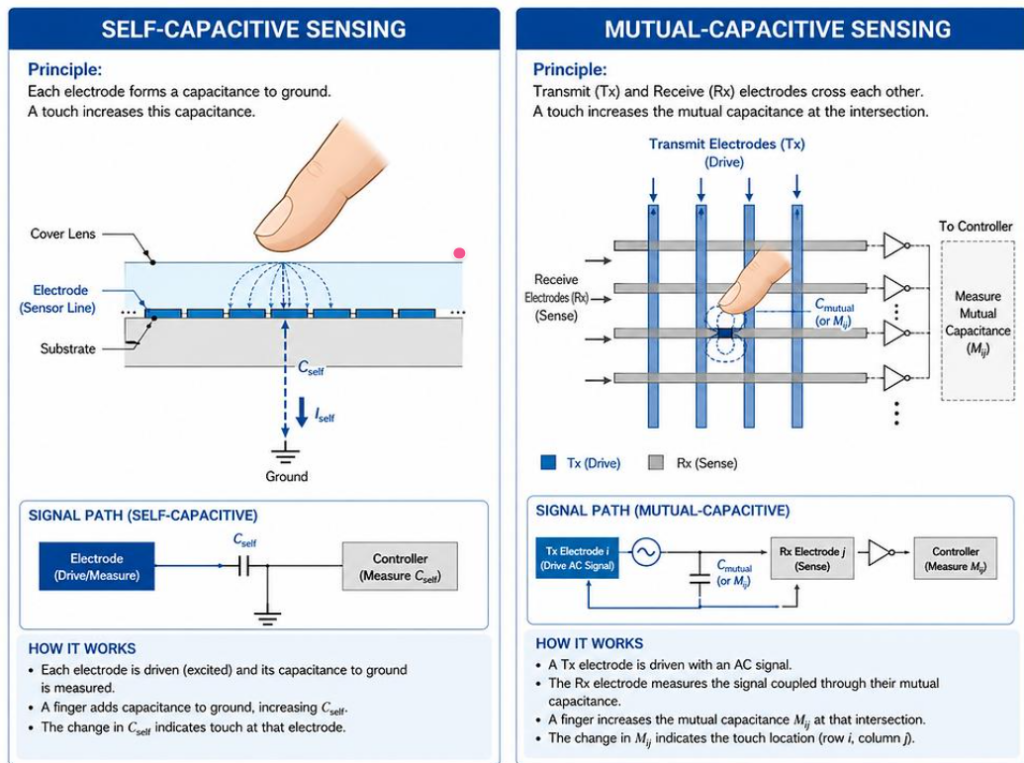
4. Finger detection
When a finger approaches a touch electrode, the local capacitance changes and the electronic circuit detects the touch event.
The sensor electronics measure these variations and convert them into usable outputs, such as switching signals, analog voltages, or digital measurement values.
The exact sensing mechanism depends on the electrode configuration and sensor design.
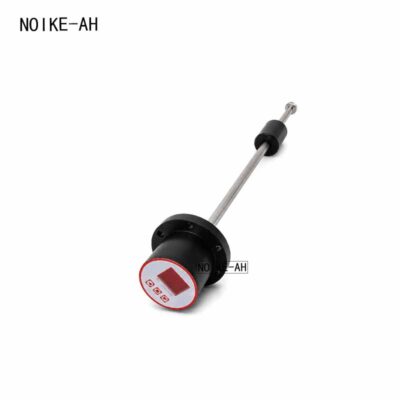
Electronic Liquid Level & Temperature Sensor NT400 Series
3. 10 Common Types of Capacitive Sensors
Although all these sensors share the same basic capacitance-based operating principle, their electrode structures, electronic circuits, and measurement methods vary according to their applications.
3.1 Capacitive Proximity Sensor
A capacitive proximity sensor detects the presence of an object without requiring direct physical contact.
When an object enters the sensor’s electric field, it changes the capacitance around the sensing electrode. The internal electronic circuit detects this change and generates a switching signal.
Typical detection targets:
- Metal objects
- Plastic components
- Glass
- Liquids
- Powders and granular materials
Common applications:
- Industrial automation
- Object presence detection
- Packaging machinery
- Conveyor systems
- Non-metallic material detection
Compared with inductive proximity sensors, capacitive proximity sensors can detect a wider range of materials.
However, sensing distance and stability depend on the target material, object size, mounting conditions, and environmental factors.
3.2 Capacitive Level Sensor
A capacitive level sensor detects liquid level by measuring capacitance changes caused by variations in the dielectric environment.
As the liquid level changes, the effective dielectric properties around the sensing electrode also change. The electronic circuit detects this variation and determines whether the liquid has reached a specific level.
Typical applications:
- Water tanks
- Chemical storage tanks
- Industrial liquid containers
- Plastic storage tanks
- Liquid presence and level alarms
Capacitive level sensing is particularly useful for non-metallic containers. Depending on the sensor design, it may be possible to install the sensor outside a tank without direct contact with the liquid.
However, tank wall thickness, liquid dielectric properties, foam, condensation, and material deposits may affect sensing performance.
3.3 Capacitive Solid-Level Sensor
A capacitive solid-level sensor is designed to detect the presence or level of bulk solid materials.
When powders, grains, or pellets enter the sensing area, the dielectric environment changes, producing a corresponding capacitance variation.
Typical applications:
- Grain storage silos
- Powder hoppers
- Plastic pellet storage
- Cement and construction material handling
- Industrial bulk material processing
These sensors are commonly used for high-level and low-level alarms in storage equipment.
During installation and calibration, material moisture content, bulk density, dielectric properties, and material buildup on the sensing probe should be considered.
3.4 Capacitive Touch Sensor
A capacitive touch sensor detects touch or proximity through changes in capacitance.
When a finger approaches or touches the electrode, the capacitance of the sensing circuit changes. A controller detects this variation and generates a touch signal.
Typical applications:
- Touchscreens
- Household appliances
- Industrial control buttons
- Human-machine interfaces (HMIs)
- Consumer electronic devices
Unlike conventional mechanical buttons, capacitive touch sensors do not require moving mechanical contacts for normal touch operation. This helps reduce mechanical wear.
3.5 Capacitive Linear Position Sensor
A capacitive linear position sensor measures the displacement or position of a moving object along a straight path.
As the target or movable electrode changes position, the effective overlapping area or electrode geometry changes, producing a corresponding capacitance variation.
Typical applications:
- Precision positioning systems
- Industrial automation equipment
- Linear motion monitoring
- Mechanical adjustment systems
- Electronic control mechanisms
Measurement performance depends on electrode design, mechanical alignment, signal processing, and environmental stability.
3.6 Capacitive Rotary Position Sensor
A capacitive rotary position sensor measures angular displacement by detecting capacitance changes as a rotating electrode moves relative to a stationary electrode.
Different electrode patterns can be used to identify angular position or rotational movement.
Typical applications:
- Rotary control knobs
- Industrial actuators
- Angular measurement systems
- Precision control equipment
- Robotic mechanisms
Compared with traditional mechanical-contact position sensing methods, capacitive designs can provide non-contact electrical sensing between the measurement electrodes.
3.7 Capacitive Thickness Sensor
A capacitive thickness sensor measures material thickness by detecting capacitance changes associated with electrode spacing, material properties, or the effective dielectric structure.
Depending on the sensor configuration, measurements may be performed without direct mechanical contact.
Typical applications:
- Plastic film thickness measurement
- Sheet material inspection
- Coating thickness monitoring
- Precision manufacturing
- Industrial quality control
For reliable measurements, dielectric properties, surface flatness, electrode geometry, and calibration conditions must be properly controlled.
3.8 Capacitive Humidity Sensor
A capacitive humidity sensor measures relative humidity by detecting changes in the dielectric properties of a moisture-sensitive material.
As humidity changes, the sensing material absorbs or releases moisture. This changes its dielectric constant and consequently its capacitance.
The electronic circuit converts the capacitance variation into a humidity reading.
Typical applications:
- Heating, ventilation, and air conditioning (HVAC) systems
- Environmental monitoring
- Industrial climate control
- Warehouses
- Agricultural environments
Capacitive humidity sensors are widely used because they support continuous humidity monitoring and can be integrated into electronic measurement systems.
3.9 Capacitive Displacement Sensor
A capacitive displacement sensor measures small changes in the distance between a sensing electrode and a conductive target.
When the distance changes, the capacitance also changes. With appropriate calibration and signal processing, the sensor can detect very small displacements with high resolution.
Typical applications:
- Precision mechanical measurement
- Shaft vibration monitoring
- Surface displacement measurement
- Semiconductor manufacturing
- Precision equipment positioning
Capacitive displacement sensors are particularly useful in applications requiring non-contact measurement of small movements.
Their performance depends on target conductivity, surface geometry, environmental conditions, and mounting stability.
3.10 Capacitive Material Identification Sensor
A capacitive material identification sensor distinguishes materials by detecting differences in their dielectric properties.
Under similar sensing conditions, different materials can produce different capacitance responses.
Typical detection materials:
- Plastics
- Glass
- Wood
- Paper
- Other non-metallic materials
Common applications:
- Material sorting
- Packaging inspection
- Industrial product identification
- Automated production lines
- Material presence detection
It is important to understand that capacitance alone does not guarantee unique material identification. Different materials may have overlapping dielectric properties.
Reliable classification requires appropriate electrode design, calibration, and signal processing.

4. Comparison of 10 Types of Capacitive Sensors
| Sensor Type | Primary Measurement Target | Typical Application |
|---|---|---|
| Capacitive Proximity Sensor | Object presence | Industrial automation |
| Capacitive Level Sensor | Liquid level | Tank monitoring |
| Capacitive Solid-Level Sensor | Powder and granular materials | Silos and hoppers |
| Capacitive Touch Sensor | Finger touch | Control panels |
| Capacitive Linear Position Sensor | Linear displacement | Position control |
| Capacitive Rotary Position Sensor | Angular displacement | Rotating equipment |
| Capacitive Thickness Sensor | Material thickness | Quality inspection |
| Capacitive Humidity Sensor | Relative humidity | HVAC and environmental monitoring |
| Capacitive Displacement Sensor | Small distance changes | Precision measurement |
| Capacitive Material Identification Sensor | Dielectric differences | Material sorting |
5. Advantages of Capacitive Sensors
Capacitive sensors offer several advantages in industrial and electronic sensing applications.
1. Non-contact detection
Many capacitive sensor designs can detect objects without physical contact, helping reduce mechanical wear.
2. Wide material compatibility
Depending on the design, capacitive sensors can detect both conductive and non-conductive materials.
3. High sensitivity
Capacitive sensing can detect small changes in distance, position, or dielectric properties.
4. Flexible sensor design
Electrode structures can be adapted for proximity detection, level monitoring, touch sensing, displacement measurement, and other applications.
5. Compact integration
Capacitive sensing circuits can be integrated into compact electronic devices and industrial control systems.
6. Limitations and Factors Affecting Capacitive Sensor Performance
Although capacitive sensors are versatile, their performance can be sensitive to environmental and installation conditions.
The following factors should be considered:
Humidity: Environmental moisture may affect capacitance and sensing stability.
Temperature: Temperature variations can influence dielectric properties and electronic components.
Material properties: Different dielectric constants produce different sensing responses.
Installation distance: Incorrect mounting distance or alignment may affect measurement results.
Contamination: Dust, moisture, and material buildup can change the effective sensing environment.
Electrical interference: Nearby electrical equipment and electromagnetic interference may affect signal stability.
For industrial applications, proper shielding, calibration, installation, and maintenance are essential for reliable operation.
7. How to Choose the Right Capacitive Sensor
Selecting a suitable capacitive sensor requires understanding the actual operating conditions rather than choosing a sensor based only on its appearance or nominal sensing range.
Consider the following factors:
1. Define the measurement objective
Determine whether the application requires object detection, liquid level measurement, solid-level detection, position measurement, thickness measurement, or humidity monitoring.
2. Identify the target material
Determine whether the target is metal, non-metal, liquid, powder, or granular material. Its dielectric properties can significantly affect sensor performance.
3. Determine the required sensing distance
For proximity and displacement applications, establish the required detection or measurement range.
4. Evaluate the operating environment
Consider temperature, humidity, dust, vibration, condensation, and electrical interference.
5. Select the appropriate output
Depending on the application, the sensor may require a switching output, analog signal, or digital communication interface.
6. Confirm installation requirements
Check available mounting space, electrode orientation, tank wall material, mechanical alignment, and electrical connections.
The best sensor is the one that matches the actual process conditions and measurement requirements.
8. Industrial Applications of Capacitive Sensors
Capacitive sensing technology is used across many industrial sectors.
| Industry | Typical Applications |
|---|---|
| Water Treatment | Liquid presence and level detection |
| Chemical Processing | Non-contact liquid detection |
| Food and Beverage | Container and material detection |
| Packaging | Product presence and thickness inspection |
| Manufacturing | Position and displacement measurement |
| Agriculture | Grain and powder level detection |
| HVAC | Humidity monitoring |
| Electronics | Touch sensing and precision positioning |
These applications demonstrate the flexibility of capacitive sensing technology in automated systems, process monitoring, and precision measurement.
9. Frequently Asked Questions (FAQ)
Q1: What materials can capacitive sensors detect?
Capacitive sensors can detect metals, plastics, glass, liquids, powders, and other materials, depending on their electrode structure and the dielectric properties of the target.
Q2: What is the difference between capacitive and inductive sensors?
Inductive sensors primarily detect metallic objects through electromagnetic induction. Capacitive sensors detect changes in capacitance and can detect both metallic and non-metallic materials.
Q3: Can a capacitive sensor detect liquid through a plastic tank?
Yes. Some capacitive level sensors can detect liquid through non-metallic tank walls without direct contact with the liquid.
Actual performance depends on tank wall thickness, liquid properties, sensor sensitivity, and installation conditions.
Q4: Are capacitive sensors suitable for powder measurement?
Yes. Capacitive sensors can detect the presence or level of powders and granular materials.
However, material moisture, bulk density, dielectric properties, and material buildup should be considered during installation and calibration.
Q5: What factors affect capacitive sensor accuracy?
Important factors include target material, dielectric properties, sensing distance, temperature, humidity, contamination, electrical interference, and installation stability.
Q6: Are capacitive sensors contact or non-contact sensors?
Many capacitive sensors operate without direct contact with the target. However, the exact sensing arrangement depends on the application and sensor design.
Q7: Can capacitive sensors measure small displacement?
Yes. Capacitive displacement sensors can detect very small changes in the distance between the sensing electrode and a suitable target, provided that the sensor is properly calibrated and installed.
10. Conclusion
Capacitive sensors are versatile sensing devices that use changes in electrical capacitance to detect objects, monitor liquid and solid levels, measure position, and identify material properties.
The 10 types discussed in this article demonstrate how the same basic sensing principle can be adapted to different measurement requirements, from industrial proximity detection and level monitoring to precision displacement measurement and humidity sensing.
Selecting the right capacitive sensor requires evaluating target materials, measurement range, operating environment, installation conditions, and required output signals.
For industrial applications, understanding these factors is essential to achieving stable, reliable, and accurate measurement results.
Looking for reliable industrial sensing and measurement solutions?
NOIKE-AH provides industrial instrumentation solutions for flow, pressure, temperature, and level measurement.
Contact the NOIKE-AH team to discuss your application requirements and explore suitable OEM/ODM instrumentation solutions.
Related pages:
9 Effective Methods for Troubleshooting Liquid Level Instruments