
What Are the Differences Between Six Types of Level Meters? How to Select the Right Level Measurement Solution?
A level meter is an essential instrument used in industrial process control to measure the height of liquid inside tanks and vessels. Based on different measurement principles, level meters can be divided into two main categories: contact level meters and non-contact level meters.
Glass Plate Level Meter
The glass plate level meter works based on the communicating vessel principle, allowing operators to directly observe the liquid level through a transparent glass tube. It features a simple structure, high reliability, and is commonly used for atmospheric or low-pressure storage tanks.
Float Level Meter
The float level meter uses a floating ball that moves with liquid level changes and drives a mechanical indicator or switch output. It offers low cost and simple operation, making it suitable for basic liquid level monitoring applications such as water tanks and oil containers.
Magnetic Flap Level Meter
The magnetic flap level meter uses a magnetic float that moves according to liquid level changes and drives external magnetic indicator panels. It provides clear visual indication and is widely applied in storage tanks, chemical processing, and petroleum industries where remote level observation is required.
Differential Pressure (DP) Level Meter
The differential pressure level meter calculates liquid level by measuring the pressure difference generated by the liquid column. It is suitable for closed vessels but requires consideration of factors such as liquid density and pressure variations.
Radar Level Meter
The radar level meter measures liquid level by transmitting electromagnetic waves and receiving reflected signals. Since it does not contact the medium, it is suitable for challenging applications involving high temperature, high pressure, or corrosive liquids.
Ultrasonic Level Meter
The ultrasonic level meter measures distance by transmitting ultrasonic waves and analyzing the returned echo signals. With non-contact measurement and easy installation, it is commonly used in water treatment, wastewater tanks, and open-channel applications.
In summary, each type of level meter has its own advantages. Glass plate, float, and magnetic flap level meters are suitable for simple and economical applications, while radar, ultrasonic, and differential pressure level meters are better choices for high-accuracy measurement and complex industrial conditions.
When selecting a level measurement solution, users should consider key factors including medium characteristics, temperature, pressure, corrosion resistance, foam conditions, installation environment, and communication requirements to ensure the most reliable and efficient level monitoring system.
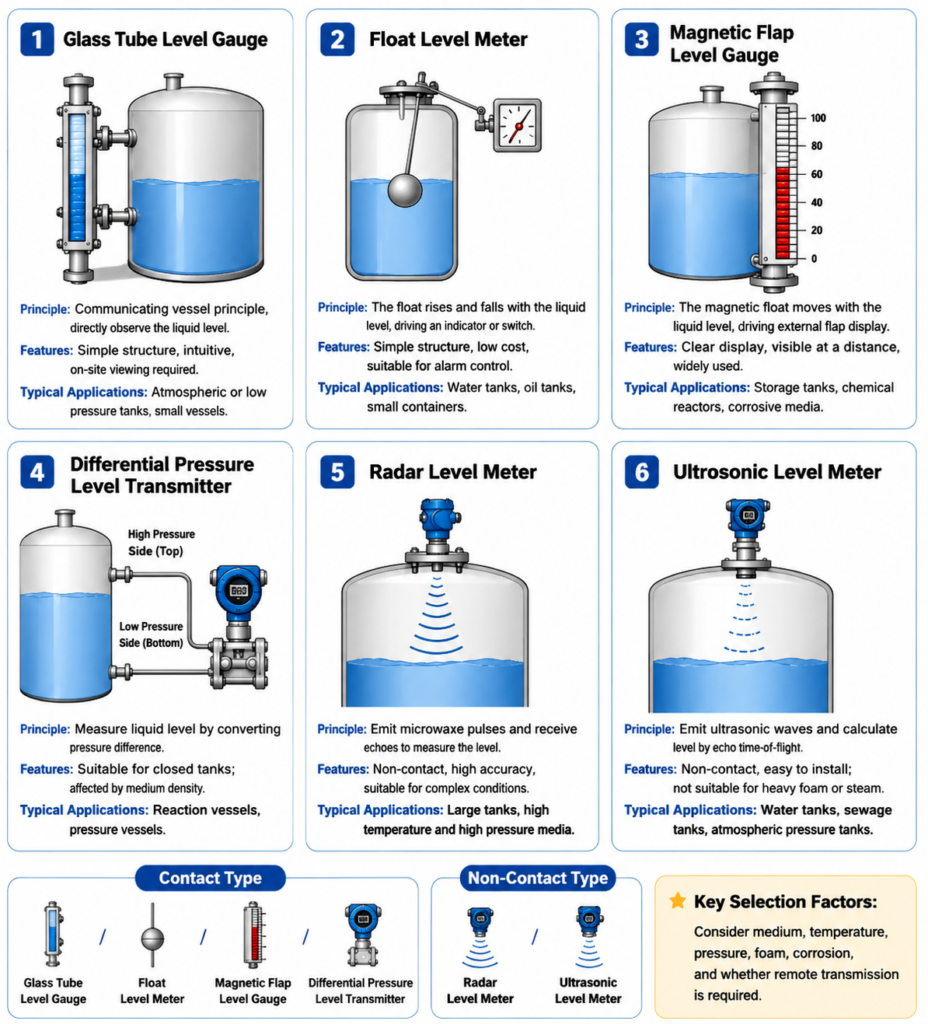
Key Considerations for Selecting the Right Level Meter
Selecting the correct level meter is critical for ensuring accurate measurement, stable operation, and long service life in industrial applications. Different level measurement technologies have their own advantages and limitations. Therefore, the selection process should be based on the actual operating conditions of the application.
1. Consider the Measured Medium Characteristics
The properties of the liquid directly affect the performance of the level meter. Important factors include:
- Liquid type: water, oil, chemicals, corrosive liquids, etc.
- Density and viscosity: especially important for differential pressure level meters.
- Corrosiveness: corrosive media may require special materials such as stainless steel, PTFE lining, or other corrosion-resistant components.
- Foam and solid particles: foam, suspended solids, or deposits may affect ultrasonic and radar measurement accuracy.
For clean liquids and simple applications, glass plate, float, or magnetic flap level meters can be suitable. For complex media, radar or ultrasonic level meters are usually preferred.
2. Consider Temperature and Pressure Conditions
Operating temperature and pressure are key parameters when selecting a level meter.
- Glass plate and magnetic flap level meters are commonly used for normal pressure and moderate temperature applications.
- Differential pressure level meters are suitable for pressurized or sealed vessels but require accurate compensation for pressure changes.
- Radar level meters are widely used in high-temperature, high-pressure, and harsh industrial environments due to their non-contact measurement principle.
The selected instrument must meet the maximum operating temperature and pressure requirements of the process system.
3. Contact or Non-Contact Measurement
Level meters can be divided into contact and non-contact types.
Contact Level Meters:
Including:
- Glass plate level meter
- Float level meter
- Magnetic flap level meter
- Differential pressure level meter
Advantages:
- Simple structure
- Easy maintenance
- Cost-effective
Limitations:
- The sensor or mechanical parts are in contact with the medium
- Material compatibility must be considered
Non-Contact Level Meters:
Including:
- Radar level meter
- Ultrasonic level meter
Advantages:
- No direct contact with liquid
- Suitable for corrosive or hazardous media
- Reduced maintenance requirements
Limitations:
- Installation conditions and environmental interference must be considered
4. Consider Measurement Accuracy Requirements
Different applications require different levels of measurement accuracy.
- For basic level indication, glass plate or float level meters can meet the requirements.
- For continuous monitoring and process control, magnetic flap, ultrasonic, radar, or differential pressure level meters are more suitable.
- For high-precision industrial applications, radar level meters are often selected due to their stable non-contact measurement performance.
5. Consider Installation Environment
Before selection, evaluate:
- Tank shape and installation position
- Available installation space
- Open or closed tank structure
- Presence of vibration, steam, dust, or electromagnetic interference
For open tanks such as wastewater pools, ultrasonic level meters are commonly used. For closed storage tanks with complex conditions, radar level meters are often a better choice.
6. Consider Signal Output and Remote Monitoring Requirements
Modern industrial systems often require integration with PLC, DCS, or IoT platforms.
Common output signals include:
- 4-20 mA analog output
- RS485 communication
- Relay switch output
- Digital communication protocols
If remote monitoring or automatic control is required, select a level meter with suitable communication interfaces.
Conclusion
The selection of a level meter should not be based only on price or measurement range. A reliable choice requires comprehensive evaluation of medium characteristics, temperature, pressure, installation conditions, accuracy requirements, and communication needs.
For simple and economical applications, glass plate, float, and magnetic flap level meters are practical solutions. For demanding industrial environments involving high temperature, high pressure, corrosion, or automation requirements, radar, ultrasonic, and differential pressure level meters provide more reliable measurement performance.
Choosing the right level measurement technology ensures higher system reliability, lower maintenance costs, and improved industrial process efficiency.
Comparison Guide to Six Types of Level Meters: Principles, Differences and Applications
MORE DETAIL INFORMATIONS—>



