
Introduction: Why Choosing the Right Flow Switch Matters
A flow switch is a critical protection and monitoring device used to detect whether liquid or gas is flowing inside a pipeline. Although flow switches appear simple, selecting the wrong type can lead to inaccurate detection, unnecessary shutdowns, pump damage, or even safety risks in industrial systems.
In applications such as HVAC systems, refrigeration equipment, water treatment plants, chemical processing, oil and gas systems, and industrial automation, a flow switch is often the first line of protection against:
- Pump dry running
- Cooling system failure
- Insufficient lubrication
- Pipeline blockage
- Abnormal flow conditions
However, different applications require different technologies. A mechanical paddle flow switch that works well in a clean water system may not be suitable for high-temperature oil, corrosive chemicals, or explosive environments.
Therefore, selecting the correct flow switch requires evaluating several key factors, including:
- Medium type
- Flow range
- Pipe size
- Temperature and pressure conditions
- Accuracy requirements
- Installation environment
- Output signal requirements
This guide explains how to choose the right flow switch for industrial and commercial applications in 2026.
1. Understand the Basic Working Principle of a Flow Switch
A flow switch detects changes in fluid movement and converts them into an electrical switching signal.
When the flow rate reaches a preset value, the internal sensing element activates and sends a signal to a controller, PLC, alarm system, or equipment protection circuit.
The basic operation includes:
- Fluid enters the pipeline.
- Flow creates movement or heat transfer at the sensing element.
- The sensor detects flow changes.
- The switch output changes status.
- Connected equipment receives the signal.
Typical outputs include:
- SPDT mechanical contact
- Relay output
- PNP/NPN transistor output
- 4-20mA analog signal
- Digital communication interfaces
The selection of output type depends on whether the application requires simple switching control or continuous monitoring.
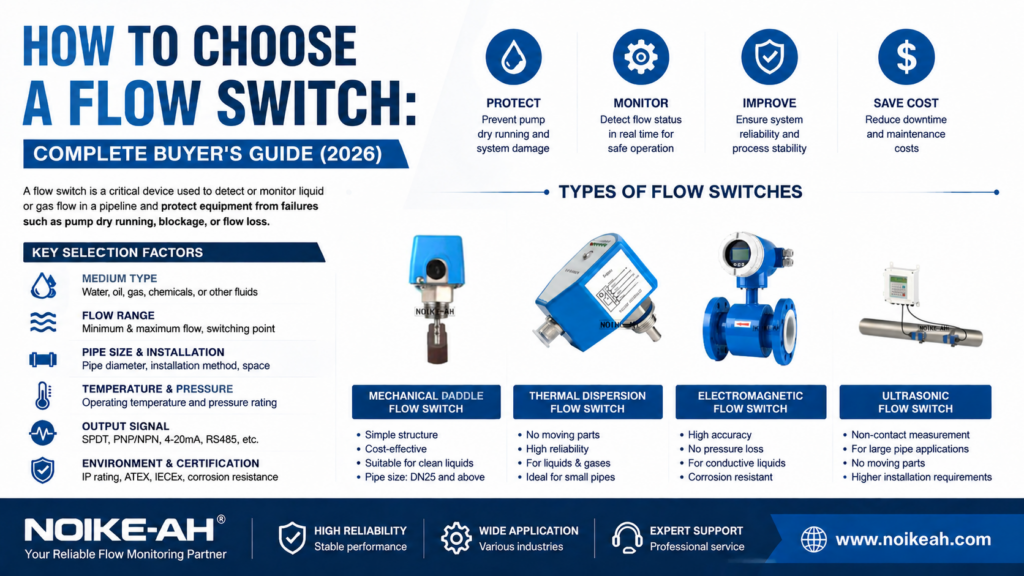
2. Main Types of Flow Switches and How They Compare
Different flow switch technologies are designed for different working conditions.
2.1 Mechanical Paddle Flow Switch
A mechanical paddle flow switch uses a paddle installed inside the pipeline. When fluid moves, the paddle deflects and activates a microswitch.
Advantages:
- Simple structure
- Low cost
- Easy installation
- No external power supply required
- Suitable for large pipe applications
Typical Applications:
- HVAC chilled water systems
- Cooling towers
- Pumps
- Water circulation systems
Limitations:
- Moving parts may wear over time
- Not ideal for dirty fluids containing particles
- Lower sensitivity compared with electronic types
Typical technical characteristics:
- Switching output: SPDT
- Pressure rating: commonly 10-16 bar
- Medium temperature: approximately -20°C to 80°C depending on model
- Installation size: usually DN25 and above
2.2 Thermal Dispersion Flow Switch
Thermal flow switches measure flow by detecting heat transfer from a heated sensing probe.
When fluid velocity changes, the cooling effect changes, allowing the sensor to determine flow conditions.
Advantages:
- No moving parts
- High reliability
- Low maintenance
- Suitable for liquids and gases
- Excellent for small pipe applications
Applications:
- Industrial automation
- Compressed air systems
- Chemical equipment
- Pump protection
- Hazardous area applications
Limitations:
- Requires correct medium parameter configuration
- Response characteristics depend on fluid properties
Thermal flow switches are especially suitable when reliability and long service life are more important than simple mechanical switching.
2.3 Electromagnetic Flow Switch
Electromagnetic technology uses Faraday’s law to detect conductive liquid movement.
Advantages:
- No moving parts
- High accuracy
- Suitable for corrosive liquids
- Low pressure loss
Applications:
- Wastewater treatment
- Chemical processing
- Food and beverage industries
Limitations:
- Only suitable for conductive liquids
- Higher cost compared with mechanical switches
2.4 Ultrasonic Flow Switch
Ultrasonic flow switches use ultrasonic waves to measure fluid velocity.
Advantages:
- Non-contact measurement
- Suitable for large pipelines
- No pressure loss
Applications:
- Large water pipelines
- Energy management systems
- Process monitoring
Limitations:
- Higher installation requirements
- Higher cost
3. Key Factors When Selecting a Flow Switch
Choosing a flow switch should not only consider price. The following parameters directly affect performance and reliability.
3.1 Identify the Medium Type
The first step is determining what fluid or gas needs to be monitored.
Common media:
| Medium | Recommended Flow Switch |
|---|---|
| Clean water | Mechanical / Thermal |
| Chilled water | Paddle / Thermal |
| Oil | Thermal / Gear type |
| Compressed air | Thermal |
| Chemical liquids | Corrosion-resistant thermal |
| Steam applications | Special high-temperature models |
Important parameters:
- Viscosity
- Conductivity
- Corrosion characteristics
- Particle content
- Density
For example, high-viscosity oil requires a different sensor design compared with low-viscosity water.
3.2 Check Flow Range Requirements
Every flow switch has a minimum and maximum detectable flow range.
Important values include:
- Minimum flow rate
- Maximum flow rate
- Switching point adjustment range
- Response time
If the flow switch sensitivity is too low:
→ It may fail to detect insufficient flow.
If the sensitivity is too high:
→ False alarms may occur.
The switching point should normally be selected according to actual operating flow conditions rather than the maximum pipeline capacity.
3.3 Consider Pipe Size and Installation Method
Pipe diameter directly affects sensor selection.
Common installation methods:
- Thread connection
- Flange connection
- Clamp installation
- Insertion type
Consider:
- Pipe diameter
- Straight pipe length
- Installation direction
- Available space
For example:
Small pipelines:
→ Thermal flow switches are often preferred.
Large water pipelines:
→ Paddle flow switches are commonly used.
3.4 Evaluate Temperature and Pressure Conditions
Industrial environments often involve extreme conditions.
Before selecting a flow switch, check:
Medium Temperature
Examples:
- Cooling water: 5-40°C
- Industrial oil: higher temperature
- Refrigeration systems: low temperature
Operating Pressure
The sensor pressure rating must exceed system pressure.
Common industrial ratings:
- PN10
- PN16
- PN25
- Higher customized ratings
A safety margin should always be considered.
3.5 Choose the Correct Electrical Output
Different control systems require different signals.
Switching Output
Common:
- SPST
- SPDT
Used for:
- Pump start/stop
- Alarm protection
- Simple control systems
Analog Output
Examples:
- 4-20mA
- 0-10V
Used for:
- PLC monitoring
- SCADA systems
- Process control
Digital Communication
Examples:
- RS485
- Modbus
Used for:
- Smart factories
- Industrial IoT systems
4. Flow Switch Selection for Different Industries
HVAC and Refrigeration
Recommended:
- Paddle flow switch
- Thermal flow switch
Applications:
- Chillers
- Heat pumps
- Cooling towers
Main purpose:
- Protect compressor
- Prevent freezing
- Detect pump operation failure
Pump Protection Systems
A flow switch protects pumps from:
- Dry running
- Blocked pipelines
- Valve failure
Recommended:
- Thermal flow switch
- Electronic flow switch
Chemical Industry
Requirements:
- Corrosion resistance
- Stable performance
- Explosion-proof certification
Recommended:
- Stainless steel thermal flow switch
- ATEX explosion-proof models
Compressed Air Systems
Important factors:
- Gas detection capability
- Low pressure loss
- Fast response
Recommended:
- Thermal dispersion flow switch
5. Mechanical Flow Switch vs Thermal Flow Switch
| Feature | Mechanical Flow Switch | Thermal Flow Switch |
|---|---|---|
| Detection Principle | Paddle movement | Heat dispersion |
| Moving Parts | Yes | No |
| Maintenance | Higher | Lower |
| Accuracy | Medium | Higher |
| Small Pipe Application | Limited | Excellent |
| Dirty Fluid | Limited | Better |
| Cost | Lower | Higher |
| Service Life | Depends on wear | Longer |
For simple water circulation systems, mechanical models are usually economical.
For industrial applications requiring reliability and continuous operation, thermal flow switches are often the better choice.
6. Common Mistakes When Buying a Flow Switch
Mistake 1: Selecting Only Based on Price
The cheapest flow switch may result in:
- Frequent alarms
- Incorrect detection
- Short service life
Mistake 2: Ignoring Fluid Characteristics
A sensor designed for water may fail in:
- High-viscosity oil
- Corrosive chemicals
- Gas applications
Mistake 3: Choosing Incorrect Flow Range
Wrong switching points can cause:
- False shutdown
- Failure to detect abnormal flow
Mistake 4: Ignoring Certification Requirements
For hazardous environments, certification may be mandatory.
Examples:
- ATEX
- IECEx
- IP protection rating
7. Flow Switch Buying Checklist
Before purchasing, confirm:
☑ Medium type
☑ Flow range
☑ Pipe size
☑ Temperature range
☑ Pressure rating
☑ Material compatibility
☑ Output signal
☑ Installation method
☑ Certification requirements
☑ Manufacturer support
FAQ: Frequently Asked Questions About Flow Switch Selection
What is the best type of flow switch?
There is no universal best flow switch. The ideal choice depends on the application. Mechanical flow switches are suitable for simple water systems, while thermal flow switches are better for industrial applications requiring higher reliability.
How do I choose a flow switch for a pump?
Select a flow switch based on pump flow rate, pipe size, operating pressure, and required protection level. Thermal flow switches are commonly used for pump protection because they have no moving parts.
Can one flow switch measure all liquids?
No. Different liquids have different viscosity, conductivity, temperature, and chemical properties. The flow switch must be selected according to the actual medium.
What information should I provide when ordering a flow switch?
Manufacturers usually need:
- Medium type
- Flow range
- Pipe diameter
- Pressure
- Temperature
- Electrical output
- Installation environment
Conclusion: Selecting the Right Flow Switch Improves System Reliability
A flow switch is a small component but plays a critical role in protecting industrial equipment and ensuring process stability.
The correct selection depends on understanding:
- Flow measurement technology
- Application requirements
- Fluid characteristics
- Environmental conditions
- Control system requirements
For HVAC systems, mechanical paddle flow switches provide economical protection.
For industrial automation, chemical processing, and demanding environments, thermal flow switches offer better reliability and long-term performance.
By evaluating these factors before purchase, engineers and buyers can reduce downtime, improve equipment safety, and achieve more reliable flow monitoring solutions.



