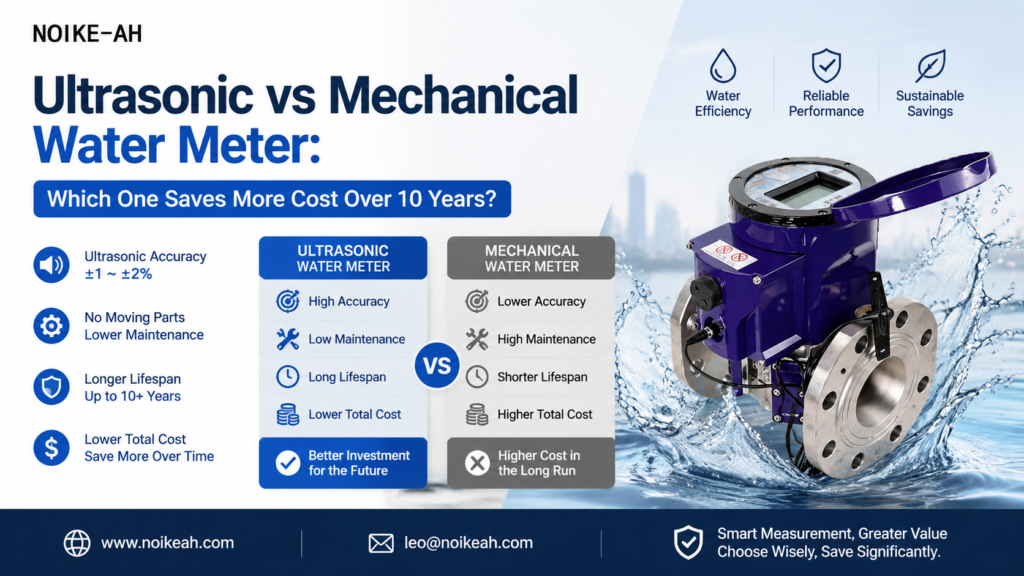
Ultrasonic vs Mechanical Water Meter: Which One Is Better?
Water meters are essential instruments for measuring water consumption in residential, commercial, and industrial applications. With the development of smart water management systems, many users are facing an important question:
Should you choose an ultrasonic water meter or a traditional mechanical water meter?
Both technologies are widely used, but they have significant differences in measurement principle, accuracy, maintenance requirements, lifespan, and total operating cost.
Mechanical water meters have been used for more than a century because of their simple structure and low initial cost. However, ultrasonic water meters are becoming increasingly popular due to their higher accuracy, no moving parts, and compatibility with digital monitoring systems.
This article compares ultrasonic and mechanical water meters based on real technical characteristics to help engineers and system integrators select the right solution.
1. Working Principle Comparison
How Does a Mechanical Water Meter Work?
A mechanical water meter measures flow by using moving components inside the water path.
The most common types include:
- Multi-jet meters
- Single-jet meters
- Positive displacement meters
- Turbine meters
When water flows through the meter, it rotates an impeller, turbine, or piston mechanism. The mechanical movement is transferred to the register, converting flow volume into a readable measurement.
Advantages of Mechanical Water Meters
✔ Simple structure
✔ Low purchase cost
✔ Easy installation
✔ Proven technology
Limitations
Because mechanical meters contain moving parts, performance can be affected by:
- Mechanical wear
- Sediment accumulation
- Water quality
- Bearing friction
- Flow disturbance
Over time, these factors may reduce measurement accuracy.
How Does an Ultrasonic Water Meter Work?
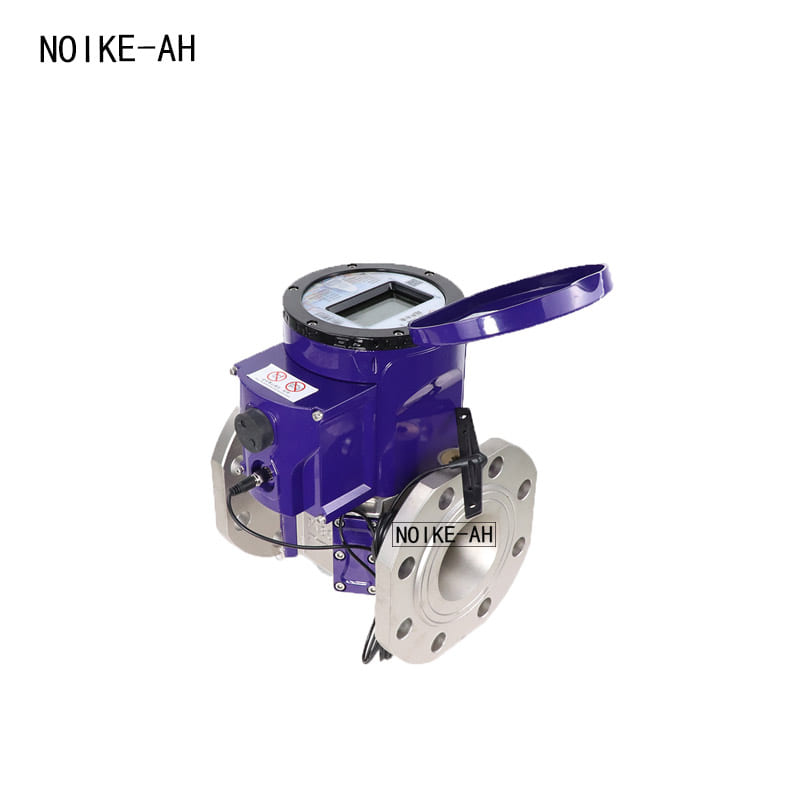
An ultrasonic water meter uses ultrasonic waves to measure water velocity without any mechanical moving components.
The meter typically uses two ultrasonic transducers installed inside the measuring tube.
The principle is based on transit-time measurement technology:
- Ultrasonic signals travel faster with the water flow direction.
- Signals travel slower against the water flow direction.
- The time difference is proportional to the flow velocity.
The flow rate is calculated electronically based on this time difference.
Advantages of Ultrasonic Water Meters
✔ No moving parts
✔ Low pressure loss
✔ High sensitivity at low flow rates
✔ Digital communication capability
✔ Long-term stability
2. Accuracy Comparison: Ultrasonic vs Mechanical Water Meter
Accuracy is one of the most important factors when selecting a water meter.
Mechanical Water Meter Accuracy
Traditional mechanical water meters typically have accuracy classes depending on design and standards.
Common characteristics:
- Accuracy decreases at very low flow rates.
- Wear of mechanical components can affect measurement performance.
- Flow measurement errors may increase after long-term operation.
For many conventional mechanical meters:
- Typical accuracy range: around ±2% under normal operating conditions
Actual performance depends on meter class, installation conditions, and water quality.
Ultrasonic Water Meter Accuracy
Ultrasonic water meters generally provide higher measurement stability because they have no rotating components.
Typical industrial ultrasonic water meters can achieve:
- Accuracy: approximately ±1% of reading
- High sensitivity for low flow measurement
- Better repeatability over long operation periods
Some advanced smart ultrasonic water meters designed according to standards such as ISO 4064 / OIML R49 can achieve higher accuracy classes.
Accuracy Comparison Table
| Feature | Ultrasonic Water Meter | Mechanical Water Meter |
|---|---|---|
| Measurement method | Transit-time ultrasonic | Mechanical rotation |
| Moving parts | No | Yes |
| Typical accuracy | Around ±1% | Around ±2% |
| Low flow detection | Excellent | Limited |
| Long-term stability | High | Reduced by wear |
| Pressure loss | Very low | Higher |
Winner: Ultrasonic Water Meter
For applications requiring accurate billing, leakage detection, or energy management, ultrasonic technology provides better performance.
3. Cost Comparison: Initial Investment vs Total Cost
Many buyers focus only on the purchase price, but the total lifecycle cost is more important.
Mechanical Water Meter Cost
Mechanical meters usually have:
Lower Initial Cost
Advantages:
- Affordable purchase price
- Easy replacement
- Large market availability
However, additional costs may include:
- Regular maintenance
- Calibration
- Replacement due to wear
- Accuracy degradation
Ultrasonic Water Meter Cost
Ultrasonic meters usually have a higher initial price because they include:
- Electronic sensors
- Signal processing circuits
- Digital communication modules
However, operating costs are lower because:
- No mechanical wear
- Less maintenance
- Longer service life
- Better monitoring capability
Cost Comparison
| Cost Factor | Ultrasonic Meter | Mechanical Meter |
|---|---|---|
| Initial price | Higher | Lower |
| Installation cost | Medium | Low |
| Maintenance cost | Low | Medium |
| Replacement frequency | Lower | Higher |
| Smart system integration | Excellent | Limited |
Which Is More Economical?
For short-term projects with limited budgets:
Mechanical water meters may be more economical.
For long-term operation, industrial applications, and smart water systems:
Ultrasonic water meters usually provide better total value.
4. Lifespan Comparison
Mechanical Water Meter Lifespan
Mechanical meters normally have a service life affected by:
- Water quality
- Flow velocity
- Operating hours
- Mechanical wear
Typical lifespan:
Approximately 5–10 years
In harsh environments, replacement may be required earlier.
Ultrasonic Water Meter Lifespan
Because ultrasonic meters have no moving parts, mechanical wear is eliminated.
Typical lifespan:
10 years or more
Many smart ultrasonic water meters are designed for long-term operation with battery-powered versions commonly supporting extended service periods depending on communication frequency and operating conditions.
5. Maintenance Requirements Comparison
Mechanical Meter Maintenance Problems
Common issues:
1. Moving Component Wear
The impeller and bearings may wear after continuous operation.
2. Measurement Drift
Deposits or mechanical friction may affect accuracy.
3. Sensitivity to Water Quality
Particles and impurities can influence mechanical movement.
Ultrasonic Meter Maintenance Advantages
Ultrasonic meters avoid many mechanical failures:
- No rotating parts
- No mechanical friction
- Less affected by water impurities
- Stable measurement performance
This makes them suitable for:
- Industrial water systems
- District metering
- Smart city water networks
- HVAC water circulation systems
6. Application Comparison
Mechanical Water Meter Applications
Mechanical meters are commonly used in:
- Residential water measurement
- Small commercial buildings
- Basic water monitoring systems
They remain popular because of their low cost and simple installation.
Ultrasonic Water Meter Applications
Ultrasonic meters are widely used in:
Smart Water Management
Used for:
- Remote meter reading
- Leakage monitoring
- Consumption analysis
Industrial Water Systems
Applications include:
- Cooling water systems
- Process water monitoring
- Factory water management
HVAC Systems
Used for:
- Chilled water measurement
- Heat pump systems
- Energy monitoring
7. Ultrasonic vs Mechanical Water Meter: Final Comparison
| Category | Ultrasonic Water Meter | Mechanical Water Meter |
|---|---|---|
| Accuracy | ⭐⭐⭐⭐⭐ | ⭐⭐⭐ |
| Initial cost | Higher | Lower |
| Maintenance | Very low | Higher |
| Lifespan | 10+ years | 5–10 years |
| Moving parts | None | Yes |
| Low flow measurement | Excellent | Moderate |
| Digital communication | Excellent | Limited |
| Smart water compatibility | Excellent | Moderate |
Conclusion: Which Water Meter Should You Choose?
The choice between an ultrasonic water meter and a mechanical water meter depends on the application requirements.
Choose a mechanical water meter if:
- Initial cost is the main concern
- The application is simple
- High precision is not required
Choose an ultrasonic water meter if:
- Accurate measurement is important
- Long service life is required
- Maintenance reduction is a priority
- Integration with smart monitoring systems is needed
For modern water management, industrial monitoring, and energy-efficient systems, ultrasonic water meters are becoming the preferred solution because they provide higher accuracy, longer lifespan, and better digital integration.
FAQ
1. Is an ultrasonic water meter more accurate than a mechanical water meter?
Yes. Ultrasonic water meters generally provide higher accuracy, especially at low flow rates, because they have no mechanical friction or moving parts.
2. How long does an ultrasonic water meter last?
Most ultrasonic water meters are designed for approximately 10 years or longer depending on battery life, environment, and operating conditions.
3. Are mechanical water meters still reliable?
Yes. Mechanical water meters remain reliable for many basic applications, especially where low cost and simple measurement are priorities.
4. Which water meter is better for smart water systems?
Ultrasonic water meters are generally better because they support digital communication, remote reading, and advanced data management.