
How to Choose the Right Liquid Level Switch Based on Medium Characteristics
A liquid level switch may work perfectly in one application and fail repeatedly in another.
The reason is often not the level switch itself—but the medium being measured.
When selecting a liquid level switch, engineers should look beyond tank size and switching point. Medium conductivity, viscosity, density, temperature, pressure, corrosiveness, foam, suspended solids, and buildup can all affect the performance and long-term reliability of a level switch.
So, how should you choose the right liquid level switch?
The answer starts with one question:
What are the actual characteristics of the medium?
1. Why Medium Characteristics Matter
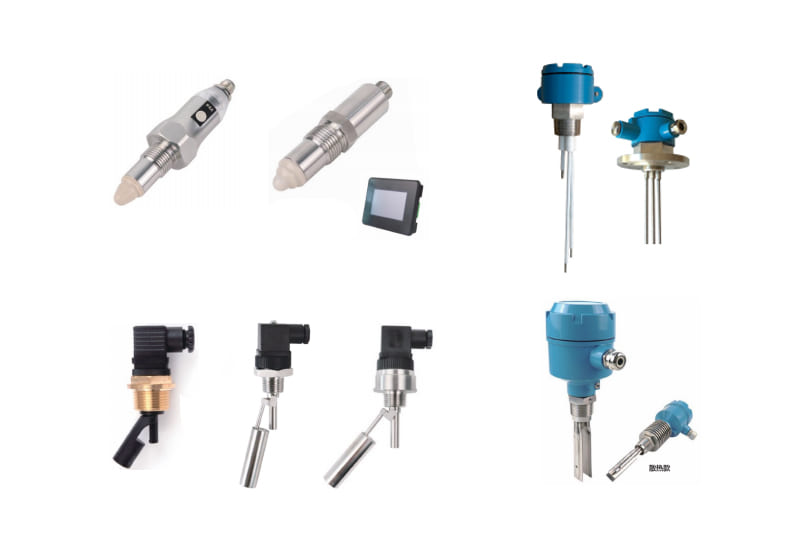
Liquid level switches use different detection principles.
Common technologies include:
- Float level switches
- Conductive/electrode level switches
- Vibrating fork level switches
- Capacitive level switches
Each technology responds differently to the physical and electrical properties of the medium.
For example, a conductive liquid may be suitable for an electrode-type level switch, while a non-conductive liquid requires a different detection principle.
Likewise, a highly viscous liquid may cause buildup on a probe or interfere with the movement of a float.
This is why “liquid level” alone is not enough information for level switch selection.
2. Conductivity: Is the Medium Electrically Conductive?
Conductivity is particularly important when considering a conductive/electrode level switch.
An electrode-type level switch detects whether the liquid can complete an electrical circuit between electrodes.
Therefore, it is generally intended for liquids with suitable electrical conductivity.
For non-conductive liquids, such as many oils and organic liquids, an electrode-based solution may not be appropriate.
Engineering question:
Does the medium have stable and sufficient electrical conductivity for the selected detection principle?
This should be confirmed from the actual medium rather than assumed from its appearance.
3. Viscosity: Will the Medium Stick to the Sensor?
Viscosity can have a major influence on level switch performance.
High-viscosity liquids may:
- Restrict float movement
- Build up on sensing elements
- Increase the possibility of coating or fouling
- Make cleaning more difficult
Examples may include certain oils, syrups, resins, slurries, and other viscous process liquids.
For these applications, engineers should pay particular attention to buildup and moving-part interference.
A level switch that performs well in clean water may not necessarily perform equally well in a viscous process liquid.
4. Density: An Important Factor for Float-Type Level Switches
Density is especially relevant to float-based level detection.
A float relies on buoyancy to move with the liquid level. If the medium density is significantly different from the conditions for which the float was designed, the mechanical behavior may change.
Therefore, when selecting a float level switch, the actual medium density should be considered together with the float design.
Do not simply ask:
“Is it a liquid?”
Instead ask:
“What is the actual density of the liquid under operating conditions?”
5. Corrosiveness: Check the Materials, Not Just the Switch
For corrosive liquids, selecting the right level switch involves more than choosing the correct detection principle.
The wetted materials should also be evaluated.
Depending on the design, this may include:
- Probe or electrode material
- Float material
- Process connection
- Sealing materials
- Wetted housing components
The compatibility of a material can depend on the chemical composition, concentration, temperature, and operating conditions of the medium.
For this reason, material compatibility should be confirmed against the actual process conditions rather than selected only by the general name of the chemical.
6. Temperature and Pressure: Can the Switch Handle the Process?
A level switch may be installed in a relatively simple tank, but the process conditions can still be demanding.
Before selection, confirm:
Temperature
- Minimum process temperature
- Normal operating temperature
- Maximum process temperature
Pressure
- Normal operating pressure
- Maximum working pressure
- Required process connection and sealing arrangement
High temperature can affect sensing elements, seals, cables, and electronic components.
Similarly, pressure-rated applications require appropriate process connections and pressure ratings.
Never select a level switch based only on the switching point.
7. Foam: Is the Switch Detecting Liquid or Foam?
Foam can create challenges for point-level detection.
If the process produces significant foam, engineers should consider whether the selected detection principle may respond to the foam layer rather than the actual liquid level.
This is particularly important in processes where:
- Agitation is present
- Gas is introduced into the liquid
- Foaming is a normal part of the process
The key question is:
Will the detection principle remain reliable under the actual foam conditions?
8. Suspended Solids and Slurries
Liquids containing suspended solids, particles, or sediment require additional consideration.
Potential problems include:
- Probe blockage
- Material accumulation
- Float obstruction
- Sensor coating
- Sediment around the detection point
For slurry or particle-containing applications, the engineer should evaluate both the detection principle and the physical installation environment.
Maintenance requirements should also be considered from the beginning.
9. A Practical Level Switch Selection Process
A reliable selection process can be divided into several steps.
Step 1 — Identify the Medium
Do not simply specify:
“Liquid”
Instead, identify the actual medium:
- Water
- Oil
- Chemical solution
- Wastewater
- Slurry
- Process liquid
- Other industrial fluid
Step 2 — Define the Medium Characteristics
Collect the following information:
| Parameter | Information Required |
|---|---|
| Conductivity | Conductive / Non-conductive |
| Density | Actual density |
| Viscosity | Operating viscosity |
| Temperature | Min. / Normal / Max. |
| Pressure | Normal / Maximum |
| Corrosiveness | Chemical composition and concentration |
| Foam | None / Low / Significant |
| Solids | Particle or suspended solids |
| Buildup | Yes / No |
| Scaling | Yes / No |
Step 3 — Select the Detection Principle
As a preliminary selection:
Conductive liquid
→ Consider electrode/conductive level detection.
Non-conductive liquid
→ Consider float, capacitive, or other suitable technologies depending on the application.
General clean liquid
→ Float and other conventional point-level technologies may be considered.
High-viscosity or buildup-prone liquid
→ Carefully evaluate probe fouling and mechanical movement.
Corrosive liquid
→ Prioritize material compatibility.
Foaming liquid
→ Evaluate how the selected detection principle responds to foam.
Particle-containing liquid
→ Evaluate blockage, buildup, sediment, and mechanical interference.
This is a preliminary engineering screening process—not a substitute for application-specific selection.
10. Installation Matters as Much as Product Selection
Even a correctly selected level switch can produce unreliable results if it is installed in the wrong location.
Avoid strong turbulence
Installation close to an inlet may expose the switch to:
- Turbulence
- Direct liquid impact
- Vortex formation
- Entrained air
These conditions can affect level detection.
Provide sufficient movement space
For float-type switches, make sure the float can move freely without interference from:
- Tank walls
- Internal pipes
- Structural components
- Sediment
Consider maintenance
The installation should allow reasonable access for:
- Inspection
- Cleaning
- Wiring checks
- Replacement
- Maintenance
A level switch should not only work when first installed—it should also remain serviceable throughout its operating life.
11. Common Problem: Why Does a Level Switch Give False Alarms?
When a level switch generates unexpected alarms, replacing the switch immediately may not solve the problem.
Check the system systematically:
Medium → Installation → Sensor → Wiring → Power Supply → Control System
Possible causes include:
- Foam affecting detection
- Sensor buildup
- Float obstruction
- Changes in medium conductivity
- Excessive turbulence
- Incorrect installation position
- Temperature outside the specified range
- Electrical or wiring problems
The important point is:
A false alarm does not automatically mean the level switch has failed.
12. Why Does a Level Switch Work in Water but Fail in Another Liquid?
This is a common engineering scenario.
A level switch may perform normally during testing with clean water but behave differently after being installed in the actual process.
The reason could be a difference in:
- Conductivity
- Density
- Viscosity
- Corrosiveness
- Foam characteristics
- Buildup tendency
- Operating temperature
Therefore, testing a switch in water does not automatically prove that it is suitable for another industrial medium.
The actual process medium should always be considered during selection.
13. Where Are Liquid Level Switches Used?
Liquid level switches are widely used where point-level detection or level-based control is required.
Typical applications include:
Water Treatment
- Water tanks
- Storage tanks
- Wastewater systems
- Water treatment equipment
Chemical Processing
- Chemical storage tanks
- Dosing systems
- Process liquid tanks
Material compatibility is particularly important when corrosive chemicals are involved.
Pump Protection
Level switches can be used for functions such as:
- Low-level pump protection
- High-level pump control
- Overflow prevention
- Tank level interlock
Industrial Equipment
They can also be integrated into industrial equipment where reliable point-level detection is required.
14. What Information Should You Provide When Selecting a Level Switch?
If you are requesting a level switch for an industrial application, providing only the required level height is usually not enough.
A better technical inquiry includes:
Medium:
What liquid are you measuring?
Density:
What is the actual density?
Viscosity:
Is the liquid low, medium, or highly viscous?
Temperature:
What are the minimum, normal, and maximum temperatures?
Pressure:
What are the operating and maximum pressures?
Tank:
What is the tank size and configuration?
Installation:
Top-mounted, side-mounted, threaded, flanged, etc.
Switching Point:
At what liquid level should the switch change state?
Output:
What type of switching or electrical output is required?
The more complete the process information, the more reliable the selection will be.
Final Engineering Checklist
Before selecting a liquid level switch, ask these questions:
☑ What is the actual medium?
☑ Is it conductive or non-conductive?
☑ What is its density?
☑ What is its viscosity?
☑ Is it corrosive?
☑ Does it contain particles or suspended solids?
☑ Does it foam?
☑ Does it create buildup or scaling?
☑ What are the operating temperature and pressure?
☑ Where will the switch be installed?
☑ What switching point is required?
☑ What output signal is required?
If these questions are answered before purchasing, the risk of selecting an unsuitable level switch can be significantly reduced.
Conclusion
Choosing a liquid level switch is not simply a matter of selecting a product according to tank size or switching point.
The medium comes first.
Conductivity affects conductive detection. Density is important for float-type designs. Viscosity and buildup can affect sensing elements and moving components. Corrosiveness determines material compatibility. Temperature and pressure determine whether the switch can operate reliably under the actual process conditions.
A professional selection process should therefore follow this logic:
Medium Characteristics → Detection Principle → Material Compatibility → Temperature & Pressure → Installation → Output → Final Model
The right level switch is not necessarily the most advanced one.
It is the one whose detection principle, materials, installation method, and operating limits match the actual process conditions.
Need Help Selecting the Right Liquid Level Switch?
If you are not sure which level switch is suitable for your application, send us:
Medium + Density + Viscosity + Temperature + Pressure + Tank Size + Installation + Switching Point + Output Requirement
Our engineering team can help evaluate the application and identify a suitable liquid level detection solution.
NOIKE-AH
Professional Manufacturer of Flow, Pressure, Level and Temperature Instrumentation & Sensors



