
Industrial Flow Meter Installation Guide: Requirements, Steps & Common Problems
Direct Answer
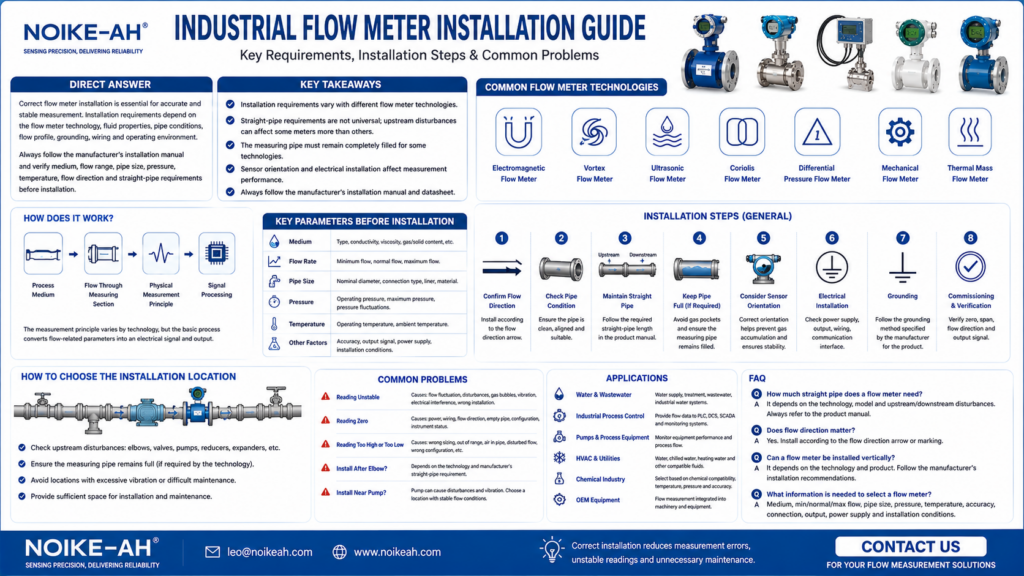
Industrial flow meter installation directly affects measurement reliability, but there is no single installation rule that applies to every flow meter. Electromagnetic, vortex, ultrasonic, Coriolis, differential-pressure and other flow meters use different measurement principles and therefore have different requirements for straight pipe, orientation, pipe condition, grounding and installation location.
Before installation, engineers should confirm the flow meter technology, fluid, minimum/normal/maximum flow rate, pipe size, pressure, temperature, process connection, flow direction and manufacturer’s installation requirements. The final installation should always follow the specific flow meter’s datasheet and installation manual rather than relying on a generic rule.
Key Takeaways
- Flow meter installation requirements depend on the measurement technology and specific model.
- Straight-pipe requirements are not universal. Elbows, valves, pumps, reducers and other upstream disturbances can affect some flow meters more than others.
- The measuring pipe may need to remain completely filled, depending on the flow meter technology and application.
- Sensor orientation matters for some flow meter technologies because air, gas, solids or condensate can affect measurement performance.
- Electrical installation, grounding and signal wiring are important for electronic flow meters, but the exact requirements depend on the instrument design.
- The manufacturer’s installation manual and datasheet should take precedence over generic installation recommendations.
What Is an Industrial Flow Meter?
An industrial flow meter is an instrument used to measure the flow rate of a liquid, gas or other process medium through a pipeline.
Different flow meters measure flow using different physical principles.
Common technologies include:
- Electromagnetic flow meters
- Vortex flow meters
- Ultrasonic flow meters
- Coriolis flow meters
- Differential-pressure flow meters
- Mechanical flow meters
- Thermal mass flow meters
Because the measurement principles are different, their installation requirements are also different.
For example, an electromagnetic flow meter measures the flow of a conductive liquid using electromagnetic induction, while a vortex flow meter determines flow from the frequency of vortices generated downstream of a bluff body. These different principles create different installation considerations.
How Does an Industrial Flow Meter Work?
Although the measurement principles vary, the basic measurement chain can be represented as:
Process Medium
↓
Flow Through Measuring Section
↓
Physical Measurement Principle
↓
Sensor Detects Flow-Related Parameter
↓
Signal Processing
↓
Flow Output
↓
Display / PLC / DCS / SCADA
For example, an electromagnetic flow meter uses a magnetic field and electrodes to detect the voltage generated by a conductive liquid moving through the magnetic field. The induced voltage is related to flow velocity.
A vortex flow meter, in contrast, detects vortices generated by a bluff body. The vortex frequency is used to determine the flow rate. Because vortex measurement depends on the formation of a suitable flow profile, upstream disturbances can have a significant effect on measurement performance.
This is why installation should always be evaluated according to the specific measurement technology.
Key Parameters Before Flow Meter Installation
Before installing a flow meter, collect the actual process information.
1. Medium
Identify exactly what the flow meter will measure.
Examples include:
- Water
- Wastewater
- Process liquids
- Steam
- Natural gas
- Compressed air
- Chemical liquids
- Other industrial media
The selected flow meter must be compatible with the physical and chemical characteristics of the medium.
2. Minimum, Normal and Maximum Flow Rate
Flow range is one of the most important parameters for flow meter selection.
Determine:
- Minimum flow
- Normal flow
- Maximum flow
The meter should be selected according to its specified measurement range and the actual operating conditions.
Pipe diameter alone is not enough to determine the correct flow meter.
3. Pipe Size
Confirm:
- Nominal pipe diameter
- Actual pipe inside diameter where relevant
- Pipe material
- Liner or internal coating where applicable
- Process connection
- Meter connection size
For clamp-on ultrasonic flow meters, additional pipe information may be required, including pipe outside diameter, wall thickness, pipe material and coating. These parameters affect ultrasonic signal transmission and sensor positioning.
4. Operating Pressure
Check:
- Normal operating pressure
- Maximum operating pressure
- Pressure fluctuations
- Pressure conditions during startup and shutdown
The flow meter’s specified pressure rating must be suitable for the actual process.
5. Operating Temperature
Check:
- Minimum process temperature
- Normal process temperature
- Maximum process temperature
- Ambient temperature
For certain technologies, temperature also affects installation orientation and sensor/electronics configuration.
6. Fluid Properties
Depending on the measurement technology, important fluid properties may include:
- Electrical conductivity
- Viscosity
- Density
- Temperature
- Pressure
- Gas content
- Solid content
- Acoustic properties
For example, electromagnetic flow meters require a sufficiently conductive liquid. Emerson states that its Rosemount magnetic flow meters typically require conductivity of at least 5 µS/cm, while certain configurations can measure lower conductivity.
This is an example of why the selection criteria must match the measurement principle.
How to Choose the Installation Location
The installation location should be evaluated before the pipe is modified.
Check the surrounding pipeline for:
- Elbows
- Tees
- Valves
- Pumps
- Reducers
- Expanders
- Control valves
- Other flow disturbances
These components can change the velocity profile entering the meter.
However, the effect is not identical for every flow meter.
For example, Endress+Hauser notes that vortex flow meters require a well-formed flow profile and that upstream fittings can cause significant measurement errors. The required inlet run depends on the type of disturbance and the specific meter.
Installation
1. Follow the Manufacturer’s Flow Direction
If the flow meter has a specified flow direction, install it according to the arrow or marking on the meter.
Do not assume that every meter can be installed in either direction.
Bidirectional measurement is available on some flow meters, but this is a product-specific feature.
2. Check the Straight-Pipe Requirement
This is one of the most misunderstood aspects of flow meter installation.
There is no universal rule such as “every flow meter needs 10D upstream and 5D downstream.”
The required straight-pipe length depends on:
- Measurement principle
- Meter design
- Type of upstream disturbance
- Downstream piping configuration
- Manufacturer’s specifications
For example, Endress+Hauser states that vortex meters may require approximately 10–40 × DN upstream, depending on the disturbance, with a minimum downstream run of approximately 5 × DN for the referenced technology.
A Siemens vortex flow meter manual gives another model-specific example with specified upstream and downstream requirements.
For electromagnetic flow meters, a commonly referenced installation arrangement is 5 × DN upstream and 2 × DN downstream, but specific products may have different requirements or may be designed for restricted installation conditions.
Therefore:
Always use the straight-pipe requirement specified for the actual flow meter model.
3. Keep the Measuring Pipe Full When Required
Some flow measurement technologies require the measuring pipe to remain full.
This is particularly important for many liquid applications.
For example, Emerson’s Rosemount 8600 vortex flow meter installation guidance states that the process piping should be designed so that the meter body remains full and free of entrapped air.
Endress+Hauser also notes that vortex meters are generally unable to measure correctly in a partially filled pipe.
Therefore, avoid installation locations where the pipe can unexpectedly drain or accumulate gas.
4. Consider Sensor Orientation
Sensor orientation should not be treated as a cosmetic installation choice.
It can affect:
- Gas accumulation
- Entrained solids
- Drainability
- Sensor exposure
- Measurement stability
For example, Endress+Hauser’s electromagnetic flow meter documentation recommends horizontal electrode positioning for horizontal installation to reduce the possibility of entrained air bubbles insulating the electrodes.
For vortex meters, Emerson provides different recommendations for vertical liquid, gas and steam installations.
This demonstrates an important principle:
The correct orientation depends on the flow meter technology and application.
5. Avoid Unnecessary Mechanical Stress
The flow meter should be installed without creating excessive mechanical stress on the instrument body or process connections.
Before tightening the connections, check:
- Pipe alignment
- Flange alignment
- Gasket position
- Connection dimensions
- Support arrangement
For certain flow meter designs, internal protrusions such as improperly positioned gaskets can disturb the flow profile. Endress+Hauser specifically identifies this as an important consideration for vortex flow meters.
6. Check Electrical Installation
For electronic flow meters, verify:
- Supply voltage
- Power requirements
- Output signal
- Signal wiring
- Communication interface
- Cable specification
- Grounding
- Shielding where required
Possible outputs include:
- 4–20 mA
- Pulse
- Frequency
- Digital communication
- Other manufacturer-specific outputs
The exact terminal assignment must always follow the product wiring diagram.
7. Grounding
Grounding requirements depend strongly on the flow meter technology and product design.
For example, electromagnetic flow meters can require specific process grounding arrangements involving grounding straps, grounding rings, grounding electrodes or lining protectors depending on the pipe and liner configuration.
Therefore, it would be incorrect to state that all flow meters require the same grounding method.
The correct approach is:
Follow the grounding requirements specified for the actual instrument and piping configuration.
8. Consider Electrical Interference
Electronic flow meters may be affected by electrical noise depending on the instrument design and installation environment.
Potential sources include:
- Motors
- Variable-frequency drives
- Transformers
- High-power electrical equipment
- Poor cable routing
- Inadequate shielding or grounding
Siemens, for example, advises avoiding strong electromagnetic fields around certain flow meter installations.
However, the susceptibility and mitigation requirements vary by product.
Common Problems
Why Is My Flow Meter Reading Unstable?
Possible causes include:
- Actual process flow fluctuation
- Pump or compressor operation
- Valve movement
- Flow disturbance
- Gas or air in the pipeline
- Mechanical vibration
- Electrical interference
- Incorrect installation
- Incorrect configuration
- Instrument malfunction
The first diagnostic question should be:
Is the process actually unstable, or is the measurement system unstable?
Do not replace the flow meter before checking the process and installation conditions.
Why Does the Flow Meter Read Zero?
Check:
- Power supply
- Wiring
- Flow direction
- Actual process flow
- Pipe filling condition
- Sensor installation
- Output configuration
- Instrument status
For liquid flow meters that require a full pipe, verify that the measuring section is actually full.
Why Is the Flow Reading Higher or Lower Than Expected?
Possible causes include:
- Incorrect flow meter sizing
- Flow outside the specified measurement range
- Incorrect installation
- Disturbed flow profile
- Incorrect process parameters
- Air or gas in the pipeline
- Incorrect configuration
- Electrical or signal problems
The correct troubleshooting procedure depends on the measurement technology.
Can a Flow Meter Be Installed Immediately After an Elbow?
Not necessarily.
An elbow can disturb the velocity profile.
The impact depends on the meter technology and model.
Vortex flow meters, for example, are particularly dependent on an adequately developed flow profile. Endress+Hauser identifies bends and valves as potential sources of significant upstream disturbance for vortex measurement.
Some modern flow meters are specifically designed for installations with limited straight pipe.
Therefore, the correct answer is:
Check the manufacturer’s installation requirement for the specific flow meter.
Can a Flow Meter Be Installed Near a Pump?
A pump can introduce:
- Flow disturbances
- Pressure pulsations
- Mechanical vibration
- Swirling flow
Therefore, the meter location should be evaluated carefully.
The correct distance cannot be defined by one universal number because it depends on the pump, pipeline configuration and flow meter technology.
Where possible, choose a location that provides stable flow conditions and follows the manufacturer’s installation recommendations.
Application
Industrial flow meters are used across many industries.
Water and Wastewater
Typical applications include:
- Raw water
- Process water
- Treated water
- Wastewater
- Water distribution
Electromagnetic flow meters are widely used for conductive liquid applications.
Industrial Process Control
Flow measurement can provide process data to:
- PLC
- DCS
- SCADA
- Data acquisition systems
Pumps and Process Equipment
Flow measurement can be used to monitor process flow and equipment operation.
HVAC and Utilities
Depending on the measurement technology and process conditions, flow meters can be used for compatible liquid or gas applications.
Chemical Industry
The meter must be selected according to:
- Chemical compatibility
- Temperature
- Pressure
- Conductivity where relevant
- Required accuracy
- Installation conditions
OEM Equipment
Flow measurement can also be integrated into OEM machinery and equipment.
For retrofit applications, clamp-on ultrasonic flow meters can be particularly useful because the sensors can be mounted externally without opening the pipeline. Endress+Hauser describes clamp-on ultrasonic meters as non-intrusive solutions that can be used where process interruption is undesirable.
Recommended Instrument
For industrial applications, the recommended flow meter should be selected according to the actual process conditions rather than simply matching the pipe diameter.
Before recommending a specific NOIKE-AH flow meter, the following information should be confirmed:
- Medium
- Minimum flow rate
- Normal flow rate
- Maximum flow rate
- Pipe size
- Operating pressure
- Operating temperature
- Required accuracy
- Process connection
- Output signal
- Power supply
- Installation conditions
For the final product recommendation, the current NOIKE-AH product datasheet should take precedence over general marketing information or older specifications.
This is especially important because installation requirements, measurement ranges, accuracy specifications and available outputs can vary between models.
FAQ
What is the most important factor when installing a flow meter?
There is no single factor that applies to every flow meter.
The correct starting point is to identify the measurement technology and specific model, then verify the manufacturer’s installation requirements.
How much straight pipe does a flow meter need?
There is no universal answer.
The required straight-pipe length depends on the measurement principle, meter design and upstream/downstream disturbances.
Some meters require relatively long straight runs, while others are specifically designed for restricted piping layouts.
Does flow direction matter?
Yes, when the product specifies a flow direction.
Install the meter according to the manufacturer’s flow-direction marking.
If bidirectional measurement is supported, the manufacturer should specify the applicable conditions.
Does pipe size determine flow meter size?
No.
Pipe size is important, but the correct meter also depends on:
- Minimum flow
- Normal flow
- Maximum flow
- Medium
- Pressure
- Temperature
- Required accuracy
- Measurement technology
Why is my flow meter reading unstable?
Possible causes include actual process fluctuations, flow disturbances, gas or air, vibration, electrical interference, incorrect installation, incorrect configuration or instrument problems.
Start with the process and installation conditions before replacing the meter.
Can I install a flow meter vertically?
It depends on the flow meter technology and model.
Some meters permit vertical installation with specific flow-direction recommendations.
For example, Emerson’s Rosemount 8600 vortex meter provides different guidance for vertical liquid, gas and steam installations.
Therefore, always check the manufacturer‘s installation manual.
What information should I provide when selecting a flow meter?
At minimum:
Medium + Minimum Flow + Normal Flow + Maximum Flow + Pipe Size + Pressure + Temperature + Accuracy + Process Connection + Output + Power Supply
For special applications, additional information may be required.
Conclusion
Industrial flow meter installation is not simply a matter of connecting the instrument to the pipeline.
The installation environment is part of the measurement system.
Reliable flow measurement requires consideration of:
Measurement Technology → Medium → Flow Range → Pipe Size → Flow Profile → Installation Location → Orientation → Process Connection → Electrical Installation → Grounding → Commissioning
The most important rule is:
Do not apply one generic installation rule to every flow meter.
Straight-pipe requirements, pipe filling conditions, orientation, grounding and electrical requirements can vary significantly between technologies and individual products.
For example:
- Vortex flow meters can be sensitive to upstream flow disturbances.
- Electromagnetic flow meters require appropriate conductivity and may have specific grounding requirements.
- Some ultrasonic clamp-on meters require accurate knowledge of pipe dimensions and material for correct sensor positioning.
- Some modern flow meters are specifically designed to operate where conventional straight-pipe space is limited.
Therefore, before installation, always check the actual product datasheet and installation manual.
Correct installation helps reduce measurement errors, unstable readings, unnecessary troubleshooting and avoidable instrument replacement.
RFQ CTA
Need Help Selecting or Installing an Industrial Flow Meter?
Send us your application information:
📌 Medium:
📌 Minimum / Normal / Maximum Flow:
📌 Pipe Size:
📌 Operating Pressure:
📌 Operating Temperature:
📌 Required Accuracy:
📌 Process Connection:
📌 Output Signal:
📌 Power Supply:
📌 Installation Conditions:
NOIKE-AH can help evaluate your application requirements and recommend a suitable industrial flow measurement solution.
📧 Email: [email protected]
🌐 Website: www.noikeah.com
NOIKE-AH — Professional Manufacturer of Flow, Pressure, Level and Temperature Instrumentation & Sensors.



