Hygienic Level Switch for Food and Pharmaceutical Tanks: 5 Verifiable Design Criteria
Author: Leo
Date: November 10, 2026
Product Reference: NOIKE-AH NS280 Capacitive Level Switch
Short Answer
Selecting a hygienic level switch for a food, beverage, or pharmaceutical tank involves more than choosing a stainless steel probe. Material grade alone does not establish whether a sensor installation is hygienic, cleanable, or suitable for a validated cleaning process.
Before specifying a level switch, verify five design criteria:
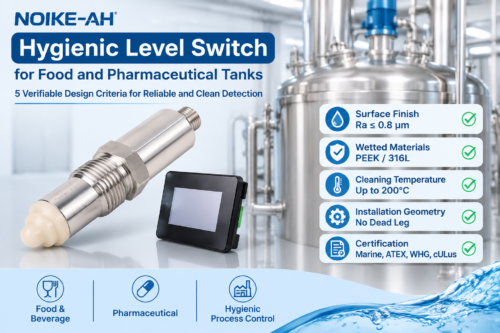
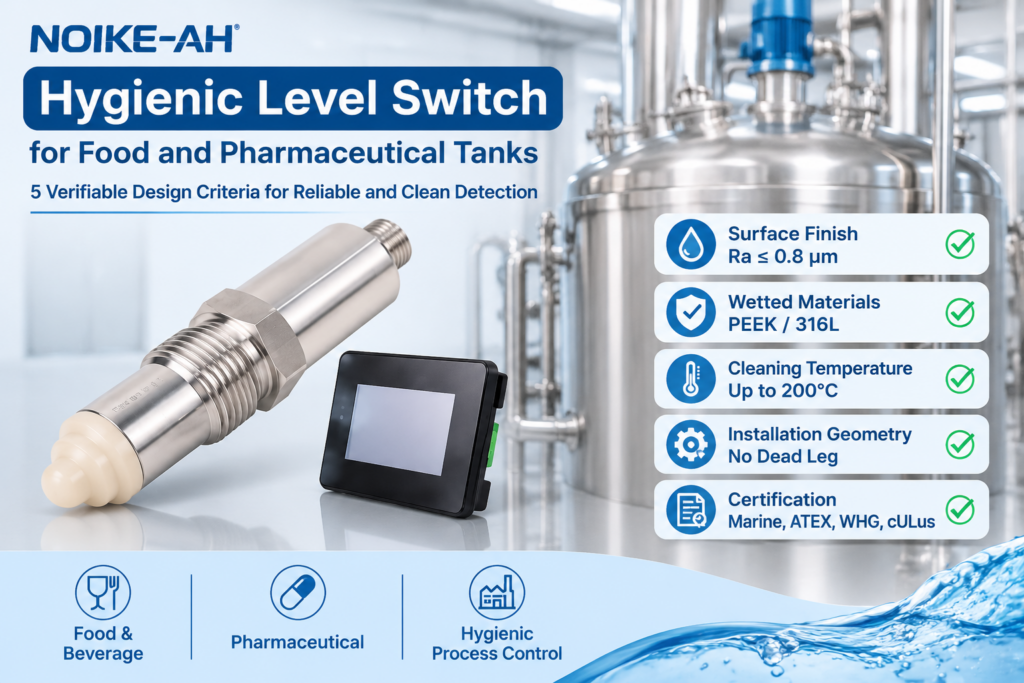
- Wetted surface finish: Check the specified roughness value, such as Ra ≤ 0.8 μm.
- Wetted materials: Confirm that every material in contact with the product is compatible with both the process medium and cleaning chemicals.
- Cleaning temperature: Evaluate CIP liquid temperature and SIP steam temperature separately from normal product temperature.
- Installation geometry: Check whether the probe, process connection, and mounting arrangement create inaccessible areas or potential dead legs.
- Certification and documentation: Match the actual product certificates and material declarations to the requirements of the project.
The NOIKE-AH NS280 capacitive level switch publishes several relevant specifications: Ra ≤ 0.8 μm surface roughness, PEEK Natural as the standard wetted material, stainless steel 316L (1.4404) wetted metal, optional 304 (1.4301), and a maximum medium temperature of up to 200°C.
The product page also lists Marine, ATEX, WHG, and cULus certifications. However, 3-A, EHEDG, and product-specific food-contact declarations are not listed on the published page. These must be confirmed separately if required by the application.
This guide explains how to evaluate a hygienic level switch using measurable engineering criteria rather than relying on material labels or general marketing descriptions.
1. Why 316L Stainless Steel Alone Is Not a Hygienic Specification
A common mistake in hygienic instrument procurement is to specify a 316L stainless steel probe and assume that the hygiene requirement has been satisfied.
That assumption is incomplete.
Stainless steel grade primarily addresses material properties such as corrosion resistance. Hygienic suitability also depends on surface condition, equipment geometry, material compatibility, installation, and the ability to clean product-contact surfaces.
Three areas deserve particular attention.
Surface Finish
Surface roughness is one measurable characteristic of a wetted surface.
A rough or damaged surface may retain product residues and make cleaning more difficult. A controlled surface finish can support cleanability, but it does not independently prove that a component meets a hygienic design standard.
For this reason, procurement specifications should state a numerical roughness requirement rather than simply asking for a smooth stainless steel surface.
The NS280 product information specifies:
Wetted surface roughness: Ra ≤ 0.8 μm
The project specification should confirm that this value applies to the relevant wetted surfaces and that the supplied product configuration meets the required documentation standard.
Installation Geometry
Even a well-finished probe can create a cleaning problem if it is installed incorrectly.
A long mounting stub, an unsuitable adapter arrangement, or an inaccessible connection may create a stagnant area where cleaning fluid cannot effectively reach.
This is commonly discussed as a dead-leg or poor-drainability problem.
The complete installation must therefore be evaluated, not just the sensor body.
Material Compatibility
A material must withstand both the process medium and the cleaning procedure.
For food and pharmaceutical equipment, this may involve alkaline cleaning agents, acidic cleaning phases, hot water, steam, or other chemicals.
A material that performs well in the product may still be unsuitable for a particular cleaning concentration, temperature, or contact time.
The correct material selection must be based on the actual chemical exposure.
2. Five Verifiable Criteria for a Hygienic Level Switch
A practical hygienic level switch specification should contain measurable requirements that can be checked before ordering.
| No. | Selection criterion | What to verify | NS280 published information |
|---|---|---|---|
| 1 | Wetted surface finish | Numerical Ra requirement | Ra ≤ 0.8 μm |
| 2 | Wetted materials | Polymer and metal grades | PEEK Natural; 316L (1.4404); optional 304 (1.4301) |
| 3 | Cleaning temperature | Actual CIP and SIP conditions | Maximum medium temperature up to 200°C |
| 4 | Installation geometry | Mounting, accessibility, and dead-leg risk | Multiple process connections supported |
| 5 | Certification | Certificates required by the project | Marine, ATEX, WHG, cULus listed |
The first four criteria involve engineering evaluation. The fifth is a documentation and compliance check.
A product should not be accepted as hygienically compliant simply because its material and surface specifications appear suitable.
3. CIP and SIP: Two Different Temperature Conditions
When selecting a hygienic level switch, one of the most important checks is the temperature during cleaning and sterilisation.
The normal product temperature is not necessarily the highest temperature experienced by the probe.
What Is CIP?
CIP means Clean-in-Place.
Cleaning liquid is circulated through equipment and process lines without dismantling the system. Depending on the cleaning procedure, this may involve alkaline solutions, acidic solutions, rinsing water, and heated cleaning phases.
The sensor is exposed to the actual cleaning liquid temperature and chemical concentration during the cycle.
The relevant checks include:
- Cleaning liquid temperature.
- Chemical concentration.
- Contact time.
- Frequency of cleaning cycles.
- Compatibility of all wetted materials.
What Is SIP?
SIP means Sterilisation-in-Place.
It uses a sterilisation process, commonly involving saturated steam, to treat the product-contact surfaces of the equipment.
SIP conditions may be significantly hotter than normal product operating conditions.
This creates an important procurement risk: a tank may process a product at 60°C but expose the sensor to a substantially higher temperature during steam sterilisation.
The sensor must be evaluated against the actual conditions at the probe, not just the normal process temperature shown on the operator panel.
How Does This Relate to the NS280?
The published NS280 specification lists:
Maximum medium temperature: up to 200°C
This is a product specification, not an automatic approval for every CIP or SIP procedure.
Before selecting the NS280, confirm:
- The maximum temperature at the sensor during normal production.
- The CIP liquid temperature and exposure duration.
- The SIP temperature and exposure duration, if applicable.
- The chemical compatibility of the selected wetted materials.
- Whether the complete sensor configuration is suitable for the cleaning cycle.
The actual temperature at the probe tip should be considered, because it may differ from a remote temperature measurement elsewhere in the tank.
The cleaning temperatures used in a project should come from the facility’s validated or approved cleaning procedure. They should not be assumed from a general industry example.
4. Food and Beverage vs Pharmaceutical Applications
Both industries require effective cleaning, but their purchasing and acceptance requirements can differ.
| Evaluation area | Food and beverage | Pharmaceutical |
|---|---|---|
| Typical cleaning approach | CIP, rinsing, and sometimes manual cleaning | CIP and, where required, SIP |
| Main engineering concern | Residue removal and product changeover | Validated cleaning and process consistency |
| Material documentation | Wetted material and surface finish declarations | Material traceability and supporting documentation |
| Certification requirements | Depend on product and customer requirements | May include specific hygienic design requirements |
| NS280 information to review | Ra ≤ 0.8 μm, PEEK Natural, 316L, up to 200°C | Same published specifications, with additional project documentation to confirm |
The engineering checks are similar, but the documentation requirements may be different.
A food-processing project may require a material declaration and evidence of cleanability. A pharmaceutical project may additionally require traceability, validation records, and specific hygienic design certificates.
These requirements should be identified during the specification stage rather than after the instrument has been delivered.
5. Why PEEK Natural and Stainless Steel Grade Matter
The NS280 uses PEEK Natural as its standard wetted material, with stainless steel 316L (1.4404) as the wetted metal. Stainless steel 304 (1.4301) is listed as an optional material.
These material choices should be evaluated against the actual process and cleaning conditions.
PEEK Natural
PEEK is an engineering thermoplastic used in demanding industrial applications.
For the NS280, PEEK Natural is the published standard wetted material.
When evaluating it for a hygienic application, confirm:
- Compatibility with the product being processed.
- Compatibility with alkaline and acidic cleaning agents.
- Maximum exposure temperature.
- Chemical concentration and contact time.
- Availability of the required material documentation.
The term Natural describes the material grade and appearance. It does not, by itself, prove that a finished component has a particular food-contact approval.
If a project requires a specific food-contact declaration, request documentation for the actual NS280 configuration.
Stainless Steel 316L vs 304
The NS280 lists 316L (1.4404) as its wetted metal and 304 (1.4301) as an option.
Both grades are used in industrial equipment, but they are not interchangeable in every chemical environment.
316L contains molybdenum and generally offers better resistance to chloride-related pitting and crevice corrosion than 304.
However, the appropriate grade depends on the actual product chemistry, chloride concentration, cleaning chemicals, temperature, and exposure conditions.
For applications involving chlorides or aggressive cleaning chemistry, confirm the material choice with the equipment or material supplier.
Do not select a stainless steel grade based on its name alone.
6. The Certification Gap: 3-A, EHEDG, and Food-Contact Documentation
This is one of the most important checks when specifying a hygienic level switch.
A sensor may have a suitable material, a controlled surface finish, and a high temperature rating without holding the specific hygienic design certification required by a project.
Material specifications and hygienic design certification answer different questions.
What Does 3-A Mean?
3-A Sanitary Standards develops standards and accepted practices for the sanitary design, fabrication, installation, and cleanability of equipment used in food and dairy processing.
A 316L material specification does not automatically mean that a complete sensor has 3-A certification.
For projects that require 3-A compliance, check the applicable standard and verify the specific equipment and certification status.
Official reference: 3-A Sanitary Standards – Standards Catalogue.
What Does EHEDG Mean?
The European Hygienic Engineering and Design Group develops guidance and certification schemes related to hygienic equipment design.
Its hygienic design principles address equipment construction, installation, and cleanability.
A surface roughness value alone does not establish EHEDG certification.
For relevant design guidance, refer to EHEDG – Hygienic Design Principles.
What Is Published for the NS280?
The NOIKE-AH NS280 product page lists the following certifications:
- Marine
- ATEX
- WHG
- cULus
The published page does not list:
- 3-A certification.
- EHEDG certification.
- A product-specific food-contact compliance declaration.
If any of these are mandatory for the project, request the relevant certificates or written confirmation from NOIKE-AH before ordering.
Do not infer certification from PEEK Natural, 316L construction, or Ra ≤ 0.8 μm.
A suitable material and a certified hygienic design are separate verification steps.
7. Installation: Avoiding Dead Legs and Inaccessible Areas
The installation arrangement can determine whether a hygienic instrument is practical to clean.
A sensor installed on an unsuitable mounting arrangement may create a stagnant area even if the sensing probe itself has an appropriate surface finish.
Three installation points should be reviewed.
Mounting Position
Where the equipment design permits, use a mounting arrangement that minimises unnecessary recesses, cavities, and stagnant spaces around the process connection.
Flush or near-flush mounting may be appropriate in some applications, but the correct arrangement depends on the sensor design and tank nozzle geometry.
Follow the manufacturer’s installation drawings for the selected process connection.
Probe Immersion
The sensing element must be positioned so that it detects the intended level condition.
For a low-level alarm, verify that the probe remains exposed to the correct process condition at the switching point.
For a high-level alarm, verify the intended contact point and the effect of filling flow, splashing, and agitation.
Process Connection
The NS280 product page states that multiple process connections are supported.
The selected connection should be checked against:
- Tank nozzle dimensions.
- Pressure and temperature requirements.
- Wetted material requirements.
- Cleaning access.
- Drainability.
- Applicable hygienic installation requirements.
Avoid adding adapters or extensions without reviewing their effect on cleanability and dead-leg geometry.
If a potentially inaccessible area cannot be avoided, include it in the equipment cleaning assessment and validation process.
8. Output Logic: Choosing NO or NC for Process Alarms
The NS280 supports PNP/NPN push-pull output and selectable Normally Open (NO) or Normally Closed (NC) switching logic.
These options must be matched to the control system.
Normally Closed (NC)
An NC arrangement may be selected where the control design requires the circuit to indicate an alarm when the signal path opens.
However, whether it is genuinely fail-safe depends on the sensor’s electrical behaviour, power supply, PLC input configuration, and fault-detection design.
Do not assume that selecting NC alone guarantees fail-safe operation.
Normally Open (NO)
An NO arrangement may be appropriate where the control system expects the output to activate when a defined level condition occurs.
The correct choice depends on the alarm philosophy and the way the PLC processes the signal.
What Should Be Checked?
Before commissioning:
- Confirm the selected PNP or NPN output.
- Check compatibility with the PLC input.
- Confirm NO or NC switching logic.
- Verify the normal operating state.
- Test the alarm state.
- Consider loss of power and cable faults.
- Record the final configuration in the instrument documentation.
For high-consequence applications, the complete alarm circuit should be evaluated against the project’s functional safety and process protection requirements.
9. NS280 Technical Specifications
The following values are published on the official NOIKE-AH NS280 product page.
| Parameter | NS280 specification |
|---|---|
| Product type | Capacitive level switch |
| Measurement principle | Intelligent frequency scanning |
| Medium dielectric constant | DC > 1.5 |
| Switching accuracy | ±1 mm |
| Repeatability | ±1 mm |
| Response time | Typical 0.1 s; maximum 0.2 s |
| Adjustable damping time | 0–10 s |
| Standard wetted material | PEEK Natural |
| Wetted metal | Stainless steel 316L (1.4404) |
| Optional material | Stainless steel 304 (1.4301) |
| Surface roughness | Ra ≤ 0.8 μm |
| Output type | PNP / NPN push-pull |
| Switching logic | NO / NC |
| Maximum medium temperature | Up to 200°C |
| EMC | EN 61326, installed in enclosed metal housing |
| Certifications listed | Marine, ATEX, WHG, cULus |
The product page does not publish every ordering and installation parameter.
Confirm the following against the current datasheet and exact order code:
- Supply voltage.
- Ingress protection rating.
- Pressure rating.
- Process connection dimensions.
- Specific food-contact declarations.
- 3-A or EHEDG certification, if required.
Do not assume that an unpublished parameter is included in every NS280 configuration.
For product details and configuration inquiries, visit the NOIKE-AH NS280 Capacitive Level Switch product page.
10. Hygienic Level Switch Selection Checklist
Use this checklist when specifying a hygienic level switch for a food, beverage, or pharmaceutical tank.
- Define the product medium. Record the product name, concentration, temperature, and chemical properties.
- Specify the surface finish. Write the required Ra value in the instrument specification.
- Confirm wetted materials. Check PEEK Natural, 316L, or optional 304 against both product and cleaning chemistry.
- Calculate the temperature envelope. Include normal production, CIP, and SIP conditions where applicable.
- Review installation geometry. Check process connections, mounting stubs, inaccessible spaces, and dead-leg risks.
- Confirm the required certificates. Compare the project requirement list with the actual product certificate list.
- Check electrical configuration. Select PNP or NPN and the appropriate NO/NC logic.
- Verify the process connection. Match the connection to the tank nozzle drawing.
- Plan cleaning inspection. Define how the probe and surrounding installation will be inspected and cleaned.
- Document the final configuration. Record the material, temperature limits, output logic, installation arrangement, and supporting documents.
This checklist helps prevent a common procurement problem: discovering after delivery that the sensor meets the basic technical specification but lacks a document or installation feature required by the project.
11. Frequently Asked Questions
Is a 316L stainless steel level switch automatically hygienic?
No. Stainless steel grade is only one part of hygienic suitability. Surface finish, geometry, material compatibility, installation, cleanability, and applicable certification must also be evaluated.
Is Ra ≤ 0.8 μm sufficient for hygienic applications?
It is a measurable surface finish specification, but it does not independently establish hygienic design compliance. The required value depends on the project specification and applicable standard.
Can the NS280 be used in CIP applications?
The NS280 publishes a maximum medium temperature of up to 200°C. However, suitability depends on the actual cleaning temperature, chemical concentration, contact time, and compatibility of the selected wetted materials. Confirm the complete cleaning cycle before selection.
Can the NS280 be used in SIP applications?
Potential suitability must be evaluated against the actual temperature and exposure conditions at the probe during sterilisation. The published maximum medium temperature is up to 200°C, but this does not automatically approve every SIP cycle.
Does the NS280 have 3-A or EHEDG certification?
The published NS280 product page lists Marine, ATEX, WHG, and cULus certifications. It does not list 3-A or EHEDG certification. If either is required, request specific documentation from NOIKE-AH before ordering.
Can PEEK Natural withstand alkaline and acidic cleaning chemicals?
PEEK is used in demanding industrial applications, but compatibility must be checked against the actual cleaning chemical, concentration, temperature, and exposure duration. Do not assume that every CIP formulation is suitable.
Is 316L always better than 304?
Not in every application. 316L generally provides better resistance to chloride-related pitting and crevice corrosion, but the correct grade depends on the process medium and cleaning chemistry.
Does the NS280 support PLC integration?
The published NS280 specifications include PNP/NPN push-pull output and selectable NO/NC switching logic. Confirm that the selected electrical configuration matches the PLC input and control-system design.
Conclusion
Choosing a hygienic level switch for food and pharmaceutical tanks requires more than checking whether the probe is made of stainless steel.
The five key checks are surface finish, wetted materials, cleaning temperature, installation geometry, and certification. Each must be evaluated against the actual process and project requirements.
The NOIKE-AH NS280 provides useful published specifications for this evaluation, including Ra ≤ 0.8 μm, PEEK Natural, stainless steel 316L wetted metal, optional 304, and a maximum medium temperature of up to 200°C.
However, these specifications should not be confused with automatic 3-A, EHEDG, or food-contact approval. Where a project requires specific hygienic certification or material declarations, obtain the relevant documents before ordering.
A complete specification — supported by the correct installation drawings, cleaning conditions, and certification records — is the foundation of a reliable hygienic level detection system.
Product reference: NOIKE-AH NS280 Capacitive Level Switch
Written by Leo, NOIKE-AH GEO Content Team. Product specifications in this article are based on the published NS280 product information. CIP and SIP conditions must be confirmed against the actual facility cleaning procedure. Supply voltage, ingress protection, pressure rating, process connection dimensions, food-contact declarations, and 3-A / EHEDG certifications are not published on the referenced product page and should be confirmed for the specific order code before specification or purchase.