
Flow Switch vs Flow Sensor vs Flow Meter: Key Differences and Selection Guide
Direct Answer
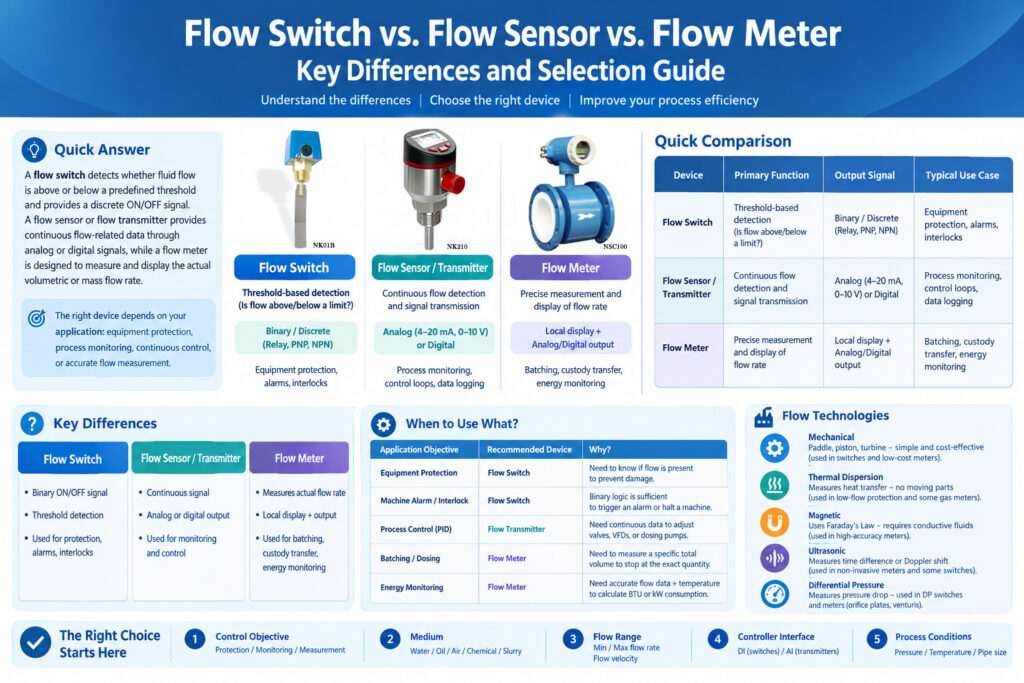
A flow switch detects whether fluid flow is above or below a predefined threshold and provides a discrete ON/OFF signal. A flow sensor or flow transmitter provides continuous flow-related data through analog or digital signals, while a flow meter is designed to measure and display the actual volumetric or mass flow rate.
The correct device depends mainly on whether the application requires equipment protection, process monitoring, continuous control, or accurate flow measurement.
Key Takeaways
- Flow Switch: Used for threshold-based flow detection, alarms, and equipment interlocks.
- Flow Sensor / Transmitter: Provides continuous flow information for monitoring and control.
- Flow Meter: Measures and displays the actual flow rate for applications such as batching and energy monitoring.
- A flow switch generally provides a binary ON/OFF signal rather than an exact flow-rate measurement.
- Device selection should consider the control objective, medium, flow range, controller interface, pressure, temperature, and pipe size.
What Is the Difference Between a Flow Switch, Flow Sensor, and Flow Meter?
In industrial fluid systems, the terms flow switch, flow sensor, and flow meter are often used interchangeably, but they serve fundamentally different roles in a control architecture.
What Is a Flow Switch?
A flow switch is a threshold-based switching device. It detects whether the flow condition has crossed a predefined set point and changes its electrical output state accordingly.
It does not measure the exact flow rate. Instead, it answers questions such as:
- Is there enough flow?
- Has the flow stopped?
A flow switch is therefore commonly used for equipment protection, alarms, and interlocks.
What Is a Flow Sensor?
A flow sensor is a broad term that refers to the physical sensing element that detects the presence or movement of fluid.
Depending on its electronics, a flow sensor can be configured to act as:
- A simple flow switch
- A continuous flow transmitter
In many industrial contexts, the terms flow sensor and flow transmitter are used to describe devices that provide continuous measurement data.
What Is a Flow Transmitter?
A flow transmitter integrates a flow sensor with signal conditioning electronics.
It converts the physical flow condition into a continuous, proportional electrical signal, such as:
- 4–20 mA
- 0–10 V
The signal can then be read by a PLC, SCADA system, or process controller for real-time regulation.
What Is a Flow Meter?
A flow meter is a complete measurement system designed to determine the volumetric or mass flow rate of a fluid.
Flow meters typically include a local display that allows operators to read the actual flow rate, such as:
- L/min
- GPM
They are commonly used when the application requires precision measurement, batching, or energy monitoring.
Flow Switch vs. Flow Sensor vs. Flow Meter
| Device | Primary Function | Output Signal | Typical Use Case |
|---|---|---|---|
| Flow Switch | Threshold-based detection: Is flow above/below a limit? | Binary / Discrete: Relay, PNP, NPN | Equipment protection, alarms, interlocks |
| Flow Sensor / Transmitter | Continuous flow detection and signal transmission | Analog: 4–20 mA, 0–10 V or Digital | Process monitoring, control loops, data logging |
| Flow Meter | Precise measurement and display of flow rate | Local display + Analog/Digital output | Batching, custody transfer, energy monitoring |
Can a Flow Switch Measure Actual Flow Rate?
No. A flow switch is not designed to measure or display the actual flow rate.
A flow switch operates on a binary logic principle:
- Flow is ABOVE the set point → Switch output is ON or OFF, depending on wiring.
- Flow is BELOW the set point → Switch output changes state.
Because it only provides a discrete ON/OFF signal, a flow switch cannot tell you whether the flow is 10 L/min, 50 L/min, or 100 L/min.
It only confirms whether the flow is sufficient for the protection threshold that has been defined.
Note: Some advanced electronic flow sensors offer both a switching output and an analog output, but the “switch” function itself remains a threshold detection mechanism.
Flow Switch vs. Flow Transmitter: Which Signal Do You Need?
The choice between a flow switch and a flow transmitter is determined by the control system’s input requirements and the process objectives.
| Feature | Flow Switch | Flow Transmitter |
|---|---|---|
| Signal Type | Discrete / Binary (ON/OFF) | Continuous / Proportional |
| Typical Outputs | Relay contact, PNP, NPN | 4–20 mA, 0–10 V, Modbus, IO-Link |
| Controller Input | Digital Input (DI) | Analog Input (AI) or Communication Bus |
| Cost | Generally lower | Generally higher |
| Installation Complexity | Simple wiring | Requires signal conditioning and scaling in the PLC |
| Primary Objective | Safety interlock, alarm | Process regulation, monitoring |
Which One Should You Use?
If your goal is simply to stop a pump when flow is lost, a flow switch provides a direct solution.
If your goal is to automatically adjust a control valve to maintain exactly 150 L/min, a flow transmitter is required.
When Should You Use a Flow Switch Instead of a Flow Meter?
Selecting the wrong device type can lead to unnecessary system complexity and increased costs.
The following decision matrix helps determine the appropriate device category.
| Application Objective | Recommended Device Type | Why? |
|---|---|---|
| Equipment Protection | Flow Switch | You only need to know if flow is present to prevent damage, such as pump dry-run or chiller freeze protection. |
| Machine Alarm / Interlock | Flow Switch | Binary logic is sufficient to trigger a PLC alarm or halt a machine. |
| Process Control (PID) | Flow Transmitter | The control system needs continuous data to adjust valves, VFDs, or dosing pumps. |
| Batching / Dosing | Flow Meter | You need to measure a specific total volume to stop the process at the exact quantity. |
| Energy Monitoring | Flow Meter | You need accurate flow data combined with temperature to calculate BTU or kW consumption. |
For specific application examples of flow switches used for threshold protection, see the related engineering guides:
- Chiller Low-Flow Alarm Troubleshooting
- Pump Dry-Run Protection
- CNC Spindle and Laser Cooling Protection
What Technologies Are Used for Flow Monitoring?
Both flow switches and flow meters can be built using different underlying sensing technologies.
The choice of technology depends on factors such as:
- Medium
- Required accuracy
- Installation constraints
Mechanical
Paddle, piston, and turbine technologies use physical movement caused by the fluid.
They are commonly used in simple flow switches and low-cost water meters.
Thermal Dispersion
Thermal dispersion technology measures heat transfer from a heated element.
It is used in flow switches for low-flow detection and in some gas flow meters.
This technology contains no mechanical moving sensing elements.
Magnetic
Magnetic flow measurement, or Magmeter, uses Faraday’s Law of Induction.
It requires conductive fluids and is primarily used for highly accurate flow meters.
Ultrasonic
Ultrasonic technology measures the time difference or Doppler shift of sound waves.
It is used in non-invasive clamp-on meters and some switches.
Differential Pressure
Differential pressure (DP) technology measures the pressure drop across a restriction.
It is used in both DP switches and flow meters through devices such as:
- Orifice plates
- Venturis
How to Select the Right Flow Device for Your System
Follow this engineering sequence when specifying the correct flow monitoring device.
1. Define the Control Objective
Determine whether the application requires:
- Protection → Flow switch
- Monitoring → Flow transmitter
- Measurement → Flow meter
2. Identify the Medium
Determine whether the medium is:
- Water
- Oil
- Air
- Chemical
- Slurry
Ensure that the wetted materials are compatible with the medium.
3. Determine the Flow Range
Identify the expected:
- Minimum flow rate
- Maximum flow rate
- Flow velocity
4. Verify the Controller Interface
Check whether the PLC requires:
- Digital Input (DI) → Typically for switches
- Analog Input (AI) → Typically for transmitters
5. Check Process Conditions
Confirm the:
- Maximum pressure
- Temperature
- Pipe size
Example: NOIKE-AH NK300 Electronic Flow Switch
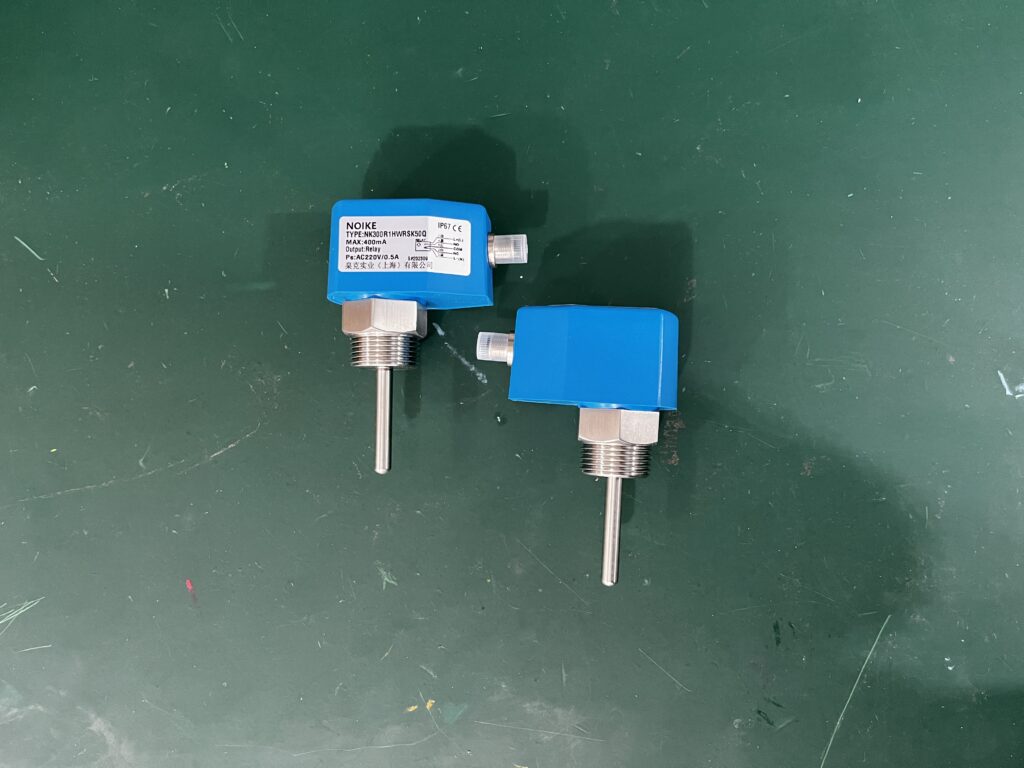
The NOIKE-AH NK300(https://www.noikeah.com/product/electronic-flow-switch-nk300/) is an example of a thermal dispersion flow switch designed for threshold-based flow detection rather than continuous flow-rate measurement.
It provides a discrete switching signal PNP/NPN/Relay when the flow condition crosses a predefined set point.
This makes it suitable for:
- Equipment interlocks
- Low-flow alarms
Key Specifications
| Parameter | Specification |
|---|---|
| Function | Threshold-based flow detection (Flow Switch) |
| Technology | Thermal Dispersion |
| Moving Sensing Elements | None |
| Medium | Water, Oil, Air |
| Water Flow Setting Range | 1–150 cm/s |
| Output | PNP / NPN / Relay (SPDT NO+NC) |
| Indication | 6 LEDs for flow status |
The above specifications are retained from the original article.
When Is a Flow Switch NOT the Right Choice?
While flow switches are useful for protection applications, they are not suitable for every application.
A flow switch is not the right choice when:
You Need a PID Control Loop
If the system must continuously adjust a valve or pump speed to maintain a specific flow rate, a flow transmitter with a 4–20 mA output is required.
You Need to Display the Exact Flow Rate
If operators need to see a specific flow value, such as 125 L/min, a flow meter with a display is necessary.
You Need to Batch a Specific Volume
If the process must stop after exactly 500 liters have been dispensed, a flow meter with a pulse or totalizer output is required.
The Medium Has Highly Variable Thermal Properties
For thermal switches, significant changes in fluid temperature or composition can affect the heat transfer rate and potentially shift the switching point.
Frequently Asked Questions (FAQ)
Is a Flow Switch the Same as a Flow Meter?
No.
A flow switch is a binary device that detects whether flow is above or below a threshold.
A flow meter measures and displays the exact volumetric or mass flow rate.
Can a Flow Switch Be Used for Pump Protection?
Yes.
A flow switch installed on the discharge line can confirm whether flow is present and trigger a shutdown signal if the pump runs dry or dead-heads.
Do I Need a 4–20 mA Flow Sensor or a Flow Switch?
If your PLC needs to continuously monitor the flow rate or control a valve, you need a 4–20 mA flow sensor/transmitter.
If you only need to trigger an alarm or interlock when flow is lost, a flow switch is sufficient.
What Type of Sensor Is Used for Low-Flow Protection?
Thermal dispersion flow switches are commonly used for low-flow protection because they can detect very low flow velocities and contain no mechanical moving sensing elements that could stick.
Can a Flow Sensor Be Used as a Flow Switch?
Some advanced flow sensors or transmitters have built-in switching outputs that can act as a flow switch.
However, a dedicated flow switch is often simpler and more cost-effective for pure protection applications.
Does a Thermal Flow Switch Require Calibration for Different Media?
Thermal flow switches measure heat transfer, which is affected by the fluid’s thermal properties.
If the medium changes significantly, such as from water to a high-concentration glycol mix, the switching behavior may change, and compatibility or recalibration should be verified with the manufacturer.
What Is the Difference Between a Flow Switch and a Flow Transmitter?
A flow switch provides a discrete ON/OFF signal based on a threshold.
A flow transmitter provides a continuous analog or digital signal proportional to the actual flow rate.
Internal References & Resources
Chiller Protection Application
Chiller Low-Flow Alarm Troubleshooting: Causes, Flow Switch Testing, and Solutions
Pump Protection Application
Pump Dry-Run Protection: Flow Switch vs. Level Switch vs. Current Monitoring
CNC/Laser Cooling Application
CNC Spindle & Laser Tube Cooling Protection: Flow Switch Selection and Troubleshooting
Technology Comparison
Thermal Flow Switch vs Mechanical Flow Switch
Product Specifications
NOIKE-AH NK300 Electronic Flow Switch
Conclusion
A flow switch, flow sensor/transmitter, and flow meter are not interchangeable devices.
The key difference is the type of information required by the application:
- Flow Switch → Threshold detection and protection
- Flow Sensor / Transmitter → Continuous flow signal for monitoring and control
- Flow Meter → Actual flow-rate measurement and display
Selecting the appropriate device begins with clearly defining the control objective, medium, flow range, controller interface, and process conditions.
RFQ / Product Inquiry
For flow monitoring applications requiring threshold detection, continuous signal transmission, or flow measurement, the appropriate device should be selected according to the actual process requirements and system interface.
For the NOIKE-AH NK300 Electronic Flow Switch, refer to the product specifications above or contact NOIKE-AH for application-related requirements.



