
What Is Flow Velocity and Why Does It Matter in Industrial Piping?
Whether you are designing a complex industrial water system, configuring fire pump pipelines, or selecting precision instrumentation, understanding fluid dynamics is non-negotiable. Among all the parameters engineers must calculate, flow velocity stands out as one of the most critical factors determining the long-term health and efficiency of a system.
Here is a comprehensive, technical breakdown of what flow velocity is, why it matters, and how it impacts your instrumentation and piping architecture.
What Exactly is Flow Velocity?
It is common to confuse volumetric flow rate with flow velocity, but they measure two different things.
- Flow Rate ($Q$): The volume of fluid passing through the system over a specific period (e.g., cubic meters per hour, gallons per minute).
- Flow Velocity ($v$): The speed at which the fluid particles are moving linearly through the pipe (e.g., meters per second, feet per second).
The relationship between the two is defined by the following mathematical formula:
$$v = \frac{Q}{A}$$
Where:
- $v$ = Flow velocity
- $Q$ = Volumetric flow rate
- $A$ = Cross-sectional internal area of the pipe
To change the velocity without altering the total volume of fluid being moved, engineers must change the pipe diameter. A smaller pipe forces the fluid to travel faster, while a larger pipe allows the fluid to slow down.
Why Does Flow Velocity Matter? (5 Critical Impacts)
Selecting the correct pipe size to achieve an optimal flow velocity is a balancing act. If the velocity is too high or too low, the system will suffer from mechanical and financial inefficiencies.
1. Pressure Drop and Energy Consumption
Friction is the enemy of pump efficiency. As flow velocity increases, the friction against the internal pipe walls increases exponentially (proportional to the square of the velocity). High velocities cause a severe pressure drop, forcing pumps to work harder, consume more electricity, and degrade faster [1].
2. Instrumentation and Measurement Accuracy
Flow sensors—such as electromagnetic meters and thermal conductivity flow switches—rely on specific velocity profiles to function correctly.
- If the velocity is too low, the flow profile may become unstable, resulting in weak signals and delayed switch response times.
- If the velocity is too high, extreme turbulence can introduce “noise” into the sensor readings, causing erratic measurements. High-quality flow switches are calibrated to operate within optimal velocity windows to guarantee rapid, repeatable triggering.
3. Erosion and Mechanical Wear
Fluids traveling at extreme speeds act like sandpaper, especially if they contain suspended solids, rust, or particulates. High flow velocity aggressively erodes pipe elbows, valve seats, and pump casings. Over time, this leads to premature mechanical failure and system leaks.
4. Acoustic Noise and Water Hammer
Water traveling too fast generates high decibel levels (hydrodynamic noise). More dangerously, when a fast-moving liquid column is suddenly stopped by a closing valve, the kinetic energy converts into a massive pressure spike known as water hammer. This shockwave can shatter fittings, blow out gaskets, and destroy delicate pressure switches.
5. Particulate Settling and Blockages
Conversely, designing a system with a velocity that is too low carries its own risks. If the fluid moves too sluggishly, it lacks the kinetic energy to keep particulates suspended. Sludge, scale, and debris will settle at the bottom of horizontal pipe runs, eventually causing severe blockages and sanitary hazards.
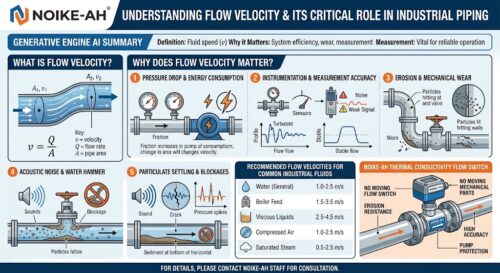
Recommended Flow Velocities for Common Industrial Fluids
To avoid the issues outlined above, engineers design piping systems to keep velocities within standardized “safe” ranges. Below is a general reference guide for industrial fluid handling:
| Fluid Type | Common Application | Recommended Velocity Range (m/s) |
| Water | General process / Fire pumps | 1.0 – 2.5 |
| Water | Boiler feed systems | 2.0 – 3.5 |
| Viscous Liquids | Heavy oils / Lubricants | 0.5 – 1.5 |
| Gases | Compressed air lines | 10.0 – 20.0 |
| Steam | Saturated steam systems | 20.0 – 40.0 |
Ensuring Precision Control with the Right Instrumentation
Maintaining optimal flow velocity requires reliable real-time monitoring. For mission-critical infrastructure, relying on mechanical paddle switches—which can bend or break under high-velocity stress—is increasingly obsolete.
Modern industrial systems utilize advanced instrumentation, such as thermal conductivity flow switches. Because these devices have no moving mechanical parts protruding into the pipeline, they are highly resistant to velocity-induced wear and provide exceptionally accurate flow state monitoring, dry-run protection, and pump automation without causing secondary pressure drops [1].
For more details, please contact NOIKE-AH staff for consultation.



