
How to Select a Steam Flow Meter? Orifice Plate, Flow Nozzle, and Venturi Tube for Different Operating Conditions
Direct Answer
Selecting a steam flow meter should not be based on pipe size alone. Engineers should consider steam type, pressure, temperature, flow range, allowable permanent pressure loss, installation conditions, and measurement requirements. Orifice plates, flow nozzles, and Venturi tubes are all differential-pressure flow measurement devices. They generate a pressure difference across a primary element, which is then used to calculate flow rate.
In general:
- Standard orifice plate: Simple construction, widely used, and suitable for many conventional steam flow measurement applications.
- Flow nozzle: Suitable for applications involving relatively high velocity, high temperature, or demanding industrial conditions, depending on the specific nozzle design.
- Venturi tube: Suitable when permanent pressure loss is an important consideration, although it generally requires more installation space and a higher equipment investment.
The final selection should always be based on actual operating conditions and the applicable measurement standard rather than simply choosing an orifice, nozzle, or Venturi tube because it is commonly used for steam.
Key Takeaways
- Orifice plates, flow nozzles, and Venturi tubes are all differential-pressure flow measurement primary elements.
- Orifice plates have relatively simple construction and are widely used, but permanent pressure loss should be considered.
- Flow nozzles can be suitable for higher-velocity or higher-temperature industrial applications, depending on the specific design and applicable standard.
- Venturi tubes generally provide lower permanent pressure loss than comparable throttling devices, but they require more space and may involve higher equipment costs.
- Steam measurement requires careful consideration of pressure, temperature, steam condition, and density compensation. For steam systems with significant pressure or temperature variation, differential pressure alone may not be sufficient for reliable mass-flow calculation.
What Is a Steam Differential Pressure Flow Meter?
A steam differential-pressure flow meter typically consists of three main parts:
- Primary Element
- Differential Pressure Transmitter
- Flow Computer or Flow Indicator
Orifice plates, flow nozzles, and Venturi tubes are all primary throttling elements.
When steam passes through the primary element, the flow area changes. This causes a change in velocity and static pressure, creating a differential pressure between the upstream and downstream sides.
The differential pressure transmitter measures this pressure difference, and the flow calculation system uses the measured differential pressure together with the geometry of the primary element and steam properties to determine the flow rate.
Because steam is a compressible fluid, steam density must also be considered in flow calculations. When pressure or temperature changes significantly, pressure and temperature compensation may be required to obtain an appropriate mass-flow calculation.
The ISO 5167 series specifies requirements for differential-pressure flow measurement in full, circular pipes. Relevant parts include:
- ISO 5167-2: Orifice plates
- ISO 5167-3: Nozzles and Venturi nozzles
- ISO 5167-4: Venturi tubes
These standards define the applicable geometry, installation requirements, and flow calculation methods for the corresponding primary elements.
How Does It Work?
The three devices use the same basic measurement principle but have different geometries.
1. Standard Orifice Plate
An orifice plate is a plate installed inside the pipeline with a precisely defined opening.
As steam passes through the opening, the available flow area is reduced. The flow velocity changes, producing a differential pressure between the upstream and downstream sides.
The differential pressure transmitter measures ΔP. The flow rate is then calculated based on the orifice geometry, steam density, and other relevant parameters.
The basic relationship can be expressed as:
Flow rate is related to the square root of differential pressure.
Therefore, differential-pressure measurement is not simply a fixed one-to-one relationship between pressure difference and flow rate.
2. Flow Nozzle
A flow nozzle uses a more streamlined inlet profile to accelerate the fluid and generate the pressure conditions required for flow measurement at the throat.
ISO 5167-3 covers several standardized nozzle designs, including:
- ISA 1932 nozzle
- Long-radius nozzle
- Throat-tapped nozzle
- Venturi nozzle
The geometry and pressure-tapping arrangement are not identical for all nozzle types. Therefore, engineering design should identify the specific nozzle type rather than treating all flow nozzles as the same primary element.
3. Venturi Tube
A conventional Venturi tube generally consists of:
Converging section → Throat → Diverging section
As steam enters the converging section, its velocity increases and the static pressure changes. The throat provides the required measurement condition, after which the flow enters the diverging section.
Compared with an orifice plate, a Venturi tube has a more complex geometry. However, its gradual expansion section helps reduce permanent pressure loss.
ISO 5167-4 specifically addresses the geometry and application of classical Venturi tubes.
Standard Orifice vs. Nozzle vs. Venturi Tube
| Comparison | Standard Orifice Plate | Flow Nozzle | Venturi Tube |
|---|---|---|---|
| Measurement principle | Differential pressure | Differential pressure | Differential pressure |
| Construction | Relatively simple | More complex than an orifice plate | More complex |
| Installation | Installed inside the pipeline | Installed inside the pipeline | Integrated pipe section |
| Permanent pressure loss | Generally significant | Generally lower than an orifice under comparable conditions, depending on design | Generally lower |
| Equipment cost | Generally lower | Generally higher than a basic orifice plate | Generally higher |
| Space requirement | Relatively easy to accommodate | Depends on nozzle design and required straight pipe | Requires more overall installation space |
| Maintenance | Inspection and replacement are relatively straightforward | Nozzle condition needs to be inspected | Maintenance can be more involved |
| Typical considerations | Cost, standardization, conventional measurement | High velocity, high temperature, demanding conditions | Pressure-loss-sensitive systems |
| Typical applications | Conventional steam measurement | Specific industrial steam applications | Large or pressure-loss-sensitive systems |
Note: These are general engineering comparisons. Actual pressure loss, measurement range, and applicability depend on pipe size, β ratio, flow rate, pressure, temperature, Reynolds number, and the specific primary-element design. The ISO 5167 series defines applicable conditions for different primary elements.
Key Parameters
When selecting a steam flow meter, the following parameters should be confirmed.
1. Steam Type
First determine whether the application uses:
- Saturated steam
- Superheated steam
Steam condition directly affects density and flow calculation.
If system pressure and temperature vary significantly, using a fixed design density may not provide an appropriate result. Pressure and temperature compensation should therefore be considered.
2. Pipe Size
The following information may be required:
- Nominal pipe size
- Actual internal diameter
- Pipe material
- Wall thickness, where necessary
The orifice, nozzle, or Venturi tube should not be selected based on nominal pipe size alone.
The primary element needs to be designed and calculated according to the actual pipe dimensions, flow rate, and fluid conditions.
3. Steam Pressure
At minimum, determine:
- Minimum pressure
- Normal pressure
- Maximum pressure
For steam measurement, pressure variation changes steam density and therefore affects mass-flow calculation.
4. Steam Temperature
Provide:
- Minimum temperature
- Normal temperature
- Maximum temperature
For superheated steam, pressure and temperature generally need to be considered together.
5. Flow Range
It is recommended to provide:
- Minimum flow
- Normal flow
- Maximum flow
Do not provide only a single design-flow value.
A steam system may operate through different conditions such as:
Start-up → Low Flow → Normal Operation → Peak Flow → Shutdown
If the primary element operates for extended periods at very low flow, the differential-pressure signal may become small. Therefore, the actual operating range should be considered during selection.
How to Choose?
Operating Condition 1: Conventional Steam Measurement — Consider a Standard Orifice Plate
If the application has:
- Clearly defined pipe dimensions
- Relatively stable steam conditions
- A defined flow range
- Acceptable permanent pressure loss
- A need for a relatively simple primary element
- A preference for a mature differential-pressure measurement method
a standard orifice plate can be considered.
Orifice plates have been widely used for industrial steam measurement and offer relatively simple construction and established measurement methods.
However, engineers should pay attention to permanent pressure loss, possible wear of the orifice, pressure-tapping arrangements, impulse piping, and maintenance requirements.
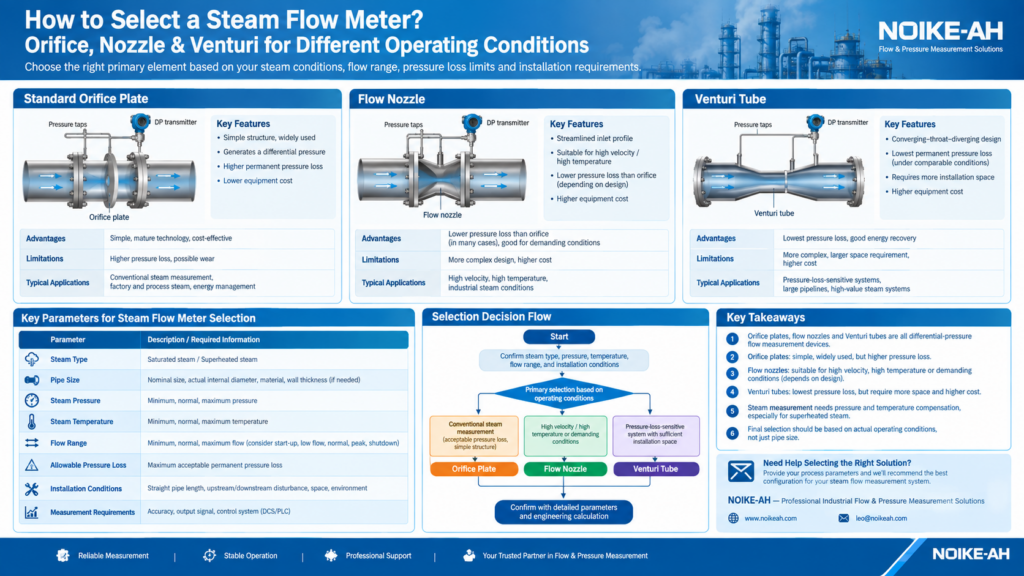
Operating Condition 2: Higher Velocity or Higher Temperature — Consider a Flow Nozzle
For steam systems involving:
- Relatively high flow velocity
- Higher temperature
- Demanding industrial conditions
- A specific standardized nozzle design
a flow nozzle may be considered.
A nozzle should not simply be regarded as an “upgraded orifice plate.” Its geometry, pressure-tapping arrangement, and calculation method are different.
ISO 5167-3 defines different nozzle configurations, including ISA 1932 nozzles, long-radius nozzles, throat-tapped nozzles, and Venturi nozzles. Therefore, the specific nozzle type and operating conditions need to be clearly identified during engineering design.
Operating Condition 3: Pressure-Loss-Sensitive Systems — Consider a Venturi Tube
If an important system-design objective is:
Reducing permanent pressure loss caused by the flow restriction
a Venturi tube can be considered.
The Venturi tube has a converging section and a diverging section. Under appropriate conditions, the gradual expansion allows part of the static pressure to be recovered, resulting in lower permanent pressure loss than a comparable conventional orifice in many applications.
ISO 5167-4 specifically addresses classical Venturi tubes.
However, Venturi tubes generally require more installation space and involve more complex construction.
Therefore, a Venturi tube should not be selected solely because it has lower pressure loss. Available installation space, pipe configuration, flow conditions, manufacturing requirements, and project cost should also be considered.
Installation
The actual performance of a steam differential-pressure flow measurement system depends not only on the primary element but also on its installation.
1. Provide Appropriate Straight Pipe Lengths
Elbows, valves, tees, reducers, and other upstream disturbances can change the velocity profile.
The required straight pipe length should therefore be determined according to the applicable primary-element standard and engineering calculation rather than applying one fixed value to every installation.
ISO 5167-1 provides general requirements related to differential-pressure flow measurement and installation conditions.
2. Pay Attention to Condensate
Condensate in the steam pipeline can affect differential-pressure measurement.
For steam measurement systems using an orifice plate and differential-pressure transmitter, the pressure taps, impulse lines, and condensate management require particular attention.
Steam measurement systems may require appropriate pressure-tapping arrangements and impulse piping between the process connections and differential-pressure transmitter.
The steam pipeline arrangement, transmitter location, and operating temperature should therefore be considered during system design.
3. Do Not Overlook the Differential Pressure Transmitter
A complete steam differential-pressure flow measurement system is not simply an orifice plate.
A typical system includes:
Orifice Plate / Nozzle / Venturi Tube
↓
Pressure Tapping System
↓
Differential Pressure Transmitter
↓
Pressure & Temperature Measurement
↓
Flow Calculation
↓
Display / PLC / DCS
After selecting the primary element, the differential-pressure measurement and flow calculation system must also be properly matched.
Common Problems
1. Unstable Steam Flow Reading
The following should be checked:
- Whether the steam operating conditions are stable
- Whether pressure is changing
- Whether temperature is changing
- Whether the differential-pressure signal is stable
- Whether the impulse lines have condensate or blockage
- Whether the primary element is installed correctly
Do not replace the flow meter before determining the actual cause of the unstable reading.
2. Flow Error Increases When Steam Pressure Changes
Steam is a compressible fluid, so its density changes with pressure and temperature.
If the flow calculation uses a fixed design condition while the actual pressure changes significantly, it is necessary to check whether pressure and temperature compensation is required.
3. Measurement Changes After the Orifice Plate Has Operated for an Extended Period
An orifice plate is a mechanical primary element.
During long-term operation, wear or changes in the geometry of the orifice can affect the flow calculation. Therefore, the condition of the orifice plate and its maintenance should be included in long-term operation management.
Orifice wear is also identified as a factor that can affect long-term steam measurement performance.
4. Poor Measurement at Low Flow
The key signal in differential-pressure flow measurement is ΔP.
As flow decreases, differential pressure also decreases. Therefore, low-flow operation requires careful consideration of the differential-pressure range and transmitter measurement range.
For steam systems with a wide operating range or frequent start-up and shutdown, the measurement range should be checked during the selection stage rather than selecting the primary element only according to maximum flow.
Application
Typical Considerations for Standard Orifice Plates
Suitable applications may include:
- Factory steam measurement
- Boiler steam pipelines
- Process steam measurement
- Steam energy management
- General industrial process measurement
Key considerations include:
Cost, standardization, installation conditions, allowable pressure loss, and maintenance.
Typical Considerations for Flow Nozzles
Flow nozzles can be considered for applications involving:
- Relatively high flow velocity
- Higher temperature
- Demanding industrial steam conditions
- Specific standardized nozzle requirements
Actual application suitability must be determined according to the specific nozzle type and operating conditions rather than selecting a nozzle simply because the application involves “high-temperature steam.”
Typical Considerations for Venturi Tubes
Venturi tubes can be considered for:
- Systems where permanent pressure loss is important
- Large industrial pipelines
- Applications where reducing throttling-related energy loss is desirable
- Installations with sufficient available space
However, the selection should also consider pipe size, flow rate, differential pressure, installation space, manufacturing requirements, and cost.
Recommended Instrument
For a steam differential-pressure flow measurement system using an orifice plate, flow nozzle, or Venturi tube, the configuration can generally be considered as follows.
Primary Element
Select one according to the operating conditions:
Orifice Plate / Flow Nozzle / Venturi Tube
Differential Pressure Measurement
Use a:
Differential Pressure Transmitter
to measure the pressure difference across the primary element.
Pressure and Temperature Compensation
For steam systems with significant pressure or temperature variation, additional:
- Steam Pressure Measurement
- Steam Temperature Measurement
- Flow Computer / Flow Calculation
may be required to calculate steam mass flow under actual operating conditions.
FAQ
1. Does a steam flow meter always have to use an orifice plate?
No.
Orifice plates, flow nozzles, and Venturi tubes can all be used as primary elements in differential-pressure flow measurement.
The selection should be based on flow rate, pressure, temperature, pipe size, allowable pressure loss, installation conditions, and measurement requirements.
2. Which has lower pressure loss, an orifice plate or a Venturi tube?
Under comparable design conditions, a Venturi tube generally has lower permanent pressure loss because its diverging section provides more gradual pressure recovery.
However, actual pressure loss must be calculated based on the specific primary-element geometry and operating conditions. It should not be determined solely by the device type.
3. What is the main difference between a nozzle and an orifice plate?
Both are differential-pressure primary elements, but their geometries are different.
An orifice plate uses an opening in a plate to create the restriction, while a nozzle uses a defined inlet profile and throat geometry.
ISO 5167-2 and ISO 5167-3 specify requirements for orifice plates and nozzles, respectively.
4. Is the selection the same for saturated steam and superheated steam?
The basic differential-pressure measurement principle can be the same, but the thermodynamic parameters used in the flow calculation are different.
For superheated steam in particular, actual pressure and temperature should be considered when determining steam properties and density. A single fixed density should not simply be applied across a wide range of operating conditions.
5. Why does steam flow measurement require pressure and temperature compensation?
Because steam is a compressible fluid, its density changes with pressure and temperature.
The differential-pressure measurement provides a signal related to the flow condition, while mass-flow calculation also requires the appropriate fluid density. Therefore, when pressure and temperature vary significantly, these process parameters may need to be incorporated into the flow calculation.
6. Should a steam flow meter be selected according to pipe size?
Pipe size is an important parameter, but it is not the only selection criterion.
At minimum, the following should also be provided:
- Pipe size
- Minimum / normal / maximum flow
- Steam pressure
- Steam temperature
- Saturated or superheated steam
- Allowable pressure loss
- Installation space
- Output and control requirements
The primary-element type and size can then be determined through engineering calculation.
7. Can ISO 5167 be used as a reference for steam differential-pressure flow measurement?
Yes, ISO 5167 can be an important engineering reference, but its scope and application conditions must be considered.
The ISO 5167:2022 series covers differential-pressure flow measurement devices including orifice plates, nozzles, and Venturi tubes. It specifies relevant geometry, installation conditions, and calculation methods. Its general scope applies to conditions such as full-flowing circular pipes and single-phase, subsonic flow, and it does not apply to pulsating flow.
If the actual steam conditions fall outside the applicable scope, the project should use the appropriate engineering standard, calibration data, or specialized design method.
Conclusion
Selecting a steam flow meter is not simply a matter of deciding whether an orifice plate, flow nozzle, or Venturi tube is “better.” The primary element and the complete measurement system should be selected according to the actual operating conditions.
A simple initial selection approach is:
Conventional steam measurement → Standard Orifice Plate
Higher velocity, higher temperature, or specific industrial conditions → Flow Nozzle
Pressure-loss-sensitive system with sufficient installation space → Venturi Tube
However, the final solution should be based on:
Pipe Size + Minimum/Normal/Maximum Flow + Pressure + Temperature + Steam Condition + Allowable Pressure Loss + Installation Conditions
Most importantly, selecting the correct primary element does not automatically guarantee reliable steam flow measurement. The differential-pressure transmitter, pressure-tapping system, impulse lines, condensate management, and pressure/temperature compensation can also affect the final measurement result.
RFQ CTA
If you are selecting an orifice plate, flow nozzle, Venturi tube, or complete differential-pressure steam flow measurement system, we recommend providing the following information:
- Pipe Size
- Minimum Flow
- Normal Flow
- Maximum Flow
- Steam Pressure
- Steam Temperature
- Saturated or Superheated Steam
- Allowable Pressure Loss
- Installation Conditions
- Output Requirements
Based on these parameters, the appropriate combination of Orifice Plate, Flow Nozzle, Venturi Tube, and Differential Pressure Transmitter can be further evaluated.
NOIKE-AH — Professional Industrial Flow & Pressure Measurement Solutions



