
What Are the Advantages and Disadvantages of Submersible and External-Mounted Level Meters?
Liquid level measurement is an essential part of many industrial processes, including storage tanks, water tanks, oil tanks, process vessels, and liquid handling systems. Depending on the installation method and measurement principle, different types of level instruments are available.
Submersible level meters and external-mounted level meters are two solutions that differ significantly in installation method and measurement approach.
What are the differences between them? What are their respective advantages and limitations? And how should engineers select the appropriate level measurement solution for a specific application?
This article compares submersible and external-mounted level meters from the perspectives of installation method, measurement principle, application conditions, maintenance requirements, process media, and vessel characteristics.
1. What Is a Submersible Level Meter?
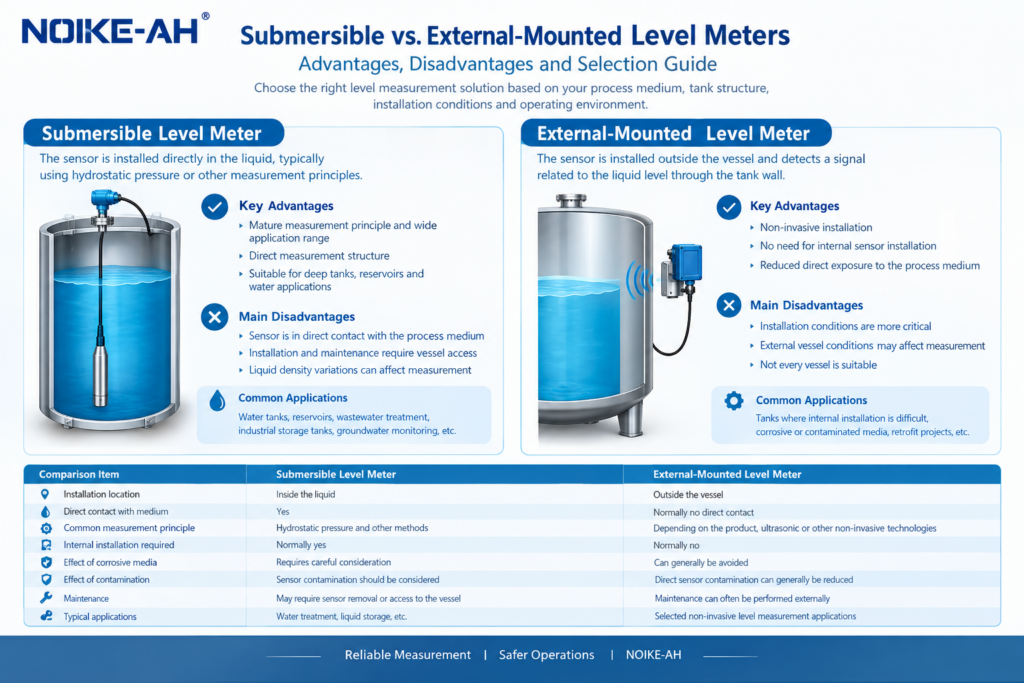
A submersible level meter is a level measurement instrument whose sensing element is installed directly inside the liquid being measured.
A common measurement method is based on hydrostatic pressure. For a hydrostatic submersible level transmitter, the sensing probe is typically installed near the bottom of a tank, reservoir, or other liquid container.
As the liquid level changes, the hydrostatic pressure acting on the sensor changes accordingly. The instrument then converts the measured pressure into a corresponding liquid level.
For a liquid with relatively stable density, the relationship between hydrostatic pressure and liquid level can be expressed as:
P = ρgh
Where:
- P = hydrostatic pressure
- ρ = density of the liquid
- g = gravitational acceleration
- h = liquid level height
For this reason, hydrostatic submersible level meters are commonly used for water, wastewater, and other liquid applications where the density remains relatively stable.
It is important to note that hydrostatic level measurement is affected by changes in liquid density. If the density of the process medium varies significantly, the measured pressure may no longer correspond directly to liquid level. Therefore, process conditions should be considered carefully during instrument selection.
2. What Is an External-Mounted Level Meter?
An external-mounted level meter is generally installed on the outside wall of a tank or vessel. Instead of placing the sensing element directly into the liquid, the instrument detects a signal related to the liquid level through the vessel wall.
The main characteristic of an external-mounted level meter is:
The sensor does not normally come into direct contact with the process liquid.
This type of measurement can be useful in applications where internal sensor installation is difficult or where direct contact between the sensor and the process medium should be avoided.
It should be noted that external-mounted level meter is not a single measurement principle. Depending on the product design, external-mounted level measurement may use technologies such as ultrasonic measurement or other non-invasive techniques.
Therefore, the actual measurement performance, installation requirements, and applicable media must be evaluated according to the specific measurement technology and manufacturer’s technical specifications.
3. Main Advantages of Submersible Level Meters
3.1 Mature Measurement Principle and Wide Application Range
Hydrostatic level measurement is based on the relationship between liquid pressure and liquid height. It is a well-established measurement method and is widely used in applications such as water treatment, storage tanks, and industrial water systems.
For liquids with relatively stable properties and density, a properly selected hydrostatic level transmitter can provide continuous level measurement.
3.2 Relatively Direct Measurement Structure
The sensing element of a submersible level meter is installed directly in the process liquid, providing a relatively direct measurement path.
Under suitable operating conditions, submersible level meters can be used for continuous level monitoring and can provide standard industrial output signals depending on the product configuration.
The actual output signal should always be verified against the product’s technical specifications.
3.3 Suitable for Deep Tanks, Reservoirs, and Water Applications
For tanks, reservoirs, wells, and other liquid containers with considerable liquid depth, hydrostatic submersible level meters can determine liquid level by measuring hydrostatic pressure.
Typical applications include:
- Water tank level monitoring
- Reservoir and sump level measurement
- Wastewater treatment systems
- Industrial storage tanks
- Groundwater level monitoring
- Certain industrial liquid level measurement applications
Actual suitability depends on the process medium, temperature, pressure, corrosiveness, sensor materials, and other operating conditions.
4. Main Disadvantages of Submersible Level Meters
4.1 The Sensor Is in Direct Contact with the Process Medium
Direct contact with the liquid is one of the defining characteristics of a submersible level meter. It is also an important consideration during instrument selection.
Depending on the application, engineers may need to consider:
- Corrosiveness of the medium
- Process temperature
- Solid particles
- Sludge or sediment
- Liquid viscosity
- Material compatibility
If the process medium tends to contaminate, coat, or deposit material on the sensing element, long-term measurement stability and maintenance requirements should be evaluated carefully.
4.2 Installation and Maintenance Requirements
Because the sensing element is installed inside the liquid, installation and maintenance may require access to the tank, reservoir, well, or other vessel.
For large tanks, deep wells, wastewater basins, and similar applications, engineers may need to consider:
- Sensor positioning
- Sensor fixation
- Cable protection
- Lifting and removal
- Maintenance access
- Personnel safety
Therefore, the overall installation design should be considered in addition to the level instrument itself.
4.3 Liquid Density Variations Can Affect Measurement
For hydrostatic level measurement, pressure depends not only on liquid height but also on liquid density.
If the density of the process medium changes significantly, the hydrostatic pressure at the same liquid level will also change.
Therefore, for applications where density varies considerably, it is not appropriate to simply assume that every pressure change represents a corresponding level change. The measurement principle and process conditions should be evaluated during instrument selection.
5. Main Advantages of External-Mounted Level Meters
5.1 Non-Invasive Installation
One of the key advantages of external-mounted level measurement is that the sensing element is installed outside the vessel rather than being immersed in the liquid.
This can reduce issues associated with direct contact between the sensor and the process medium.
It can be particularly useful for certain corrosive, contaminated, or otherwise difficult-to-access liquids.
5.2 No Sensor Installation Inside the Vessel
For existing storage tanks where drilling, process shutdown, or internal access is inconvenient, an external-mounted measurement solution may provide an alternative approach.
This can be particularly relevant for retrofit projects.
However, the actual installation feasibility should be confirmed based on the vessel material, wall thickness, vessel structure, and the installation requirements of the selected instrument.
5.3 Reduced Direct Exposure to the Process Medium
Because the sensor is installed outside the vessel, it can avoid direct exposure to the process liquid.
This can help reduce certain issues associated with direct immersion, such as:
- Sensor contamination
- Corrosion caused by direct liquid contact
- Deposits or solids accumulating on the sensing element
However, external-mounted measurement is not completely independent of process conditions.
For example, ultrasonic measurement can be affected by factors related to acoustic transmission, vessel construction, installation conditions, and the characteristics of the process liquid.
6. Main Disadvantages of External-Mounted Level Meters
6.1 Installation Conditions Can Be More Critical
External-mounted level meters may require appropriate contact, coupling, or installation conditions between the sensor and the vessel wall, depending on the measurement technology.
Important factors may include:
- Vessel material
- Vessel wall thickness
- Vessel geometry
- External wall condition
- Sensor installation position
- Internal vessel structures
- Characteristics of the liquid and vessel that may affect signal transmission
For complex vessels, it should not be assumed that a sensor will provide reliable measurement simply because it can physically be mounted on the outside wall.
6.2 External Vessel Conditions May Affect Measurement
If the external surface of the vessel has significant corrosion, coatings, scale, insulation, or other structural layers, installation may become more difficult.
Therefore, the actual condition of the proposed installation location should be evaluated before selecting an external-mounted level meter.
6.3 Not Every Vessel Is Suitable
The suitability of an external-mounted level meter depends strongly on the measurement technology being used.
Different vessel materials, wall thicknesses, geometries, and process media may require different installation conditions.
Therefore, when selecting an external-mounted level meter, it is recommended to provide complete application information and have the supplier or manufacturer verify technical compatibility rather than selecting a product solely because it uses a “non-invasive” installation method.
7. Comparison of Submersible and External-Mounted Level Meters
| Comparison Item | Submersible Level Meter | External-Mounted Level Meter |
|---|---|---|
| Installation location | Inside the liquid | Outside the vessel |
| Direct contact with medium | Yes | Normally no direct contact |
| Common measurement principle | Hydrostatic pressure and other methods | Depending on the product, ultrasonic or other non-invasive technologies |
| Internal installation required | Normally yes | Normally no |
| Effect of corrosive media | Requires careful consideration | Direct contact with the medium can generally be avoided |
| Effect of contamination | Sensor contamination should be considered | Direct sensor contamination can generally be reduced |
| Installation requirements | Sensor position and fixation are important | Vessel wall and installation conditions are particularly important |
| Effect of density changes | Important for hydrostatic measurement | Depends on the measurement principle |
| Retrofit applications | Requires evaluation of installation accessibility | Can be advantageous for some tanks where internal installation is difficult |
| Maintenance | May require sensor removal or access to the vessel | Maintenance can often be performed externally |
| Application | Suitable for many water treatment and liquid storage applications | Suitable for selected non-invasive level measurement applications |
The comparison above describes the general characteristics of the two measurement approaches. It does not replace product-specific selection criteria.
Different manufacturers and models may use different measurement principles, construction methods, installation requirements, and performance specifications.
8. How Should You Choose Between a Submersible and an External-Mounted Level Meter?
Level meter selection should not be based solely on whether the instrument is “submersible” or “external-mounted.”
The actual process conditions should be evaluated first.
8.1 What Is the Process Medium?
Typical media may include:
- Clean water
- Wastewater
- Industrial water
- Oil-based liquids
- Chemical liquids
- Liquids containing suspended solids
- High-viscosity liquids
Different media can impose different requirements on the measurement principle and sensor materials.
8.2 What Is the Measurement Range?
The actual liquid level range of the tank or vessel should be determined before selecting the instrument.
The selected measurement range should cover the required operating level while remaining appropriate for the instrument’s specified performance.
The specific range should always be selected according to the manufacturer’s technical specifications and the actual application.
8.3 Is Tank Modification or Internal Installation Possible?
If the vessel is already in service and drilling, shutdown, or internal installation is difficult, a non-invasive measurement solution may be worth evaluating.
If the vessel already has a suitable process connection or mounting interface, submersible or other contact-type instruments may also be considered.
8.4 Is the Process Medium Corrosive or Contaminated?
If the liquid is corrosive, contains significant amounts of suspended solids, or tends to form deposits on sensing elements, sensor materials and long-term maintenance requirements should be carefully evaluated.
8.5 What Is the Vessel Structure?
For external-mounted level measurement, particular attention should be paid to:
- Vessel material
- Wall thickness
- Vessel geometry
- External surface condition
- Insulation or coatings
- Internal structures
- Sensor installation position
These factors may directly affect the feasibility and performance of the measurement solution.
9. Neither Technology Is Universally Better
From an engineering perspective, submersible and external-mounted level meters are designed to address different application requirements.
The key characteristics of a submersible level meter are that the sensing element is installed inside the liquid and obtains level information through the applicable measurement principle. Its advantages include a well-established measurement approach and broad application potential, while its selection requires careful consideration of media compatibility, sensor contamination, installation, and maintenance.
The key characteristic of an external-mounted level meter is that the sensor is installed outside the vessel and obtains level information through a non-invasive measurement method. This can reduce direct exposure to the process medium and can be useful for certain vessels where internal sensor installation or tank modification is inconvenient. However, vessel structure and installation conditions may impose more specific requirements.
Therefore, the appropriate level measurement solution should be selected based on actual operating conditions, including:
Process medium + measurement range + vessel structure + installation conditions + operating temperature + operating pressure + output signal + maintenance requirements.
10. Conclusion
Both submersible and external-mounted level meters have their own applicable conditions and engineering considerations.
If the application allows a sensor to be installed inside the liquid and the sensor materials are compatible with the process medium, a submersible level measurement solution can be considered.
If tank modification is difficult or direct contact between the sensor and the process medium should be minimized, an external-mounted or non-invasive level measurement solution may be considered.
Before selecting a level meter, it is recommended to provide the following basic application information:
Process medium + measurement range + vessel material + vessel wall thickness + operating temperature + operating pressure + installation method + output signal.
A complete evaluation of these parameters helps ensure that the selected level measurement solution is technically compatible with the actual application.
Frequently Asked Questions (FAQ)
Q1: Is a submersible level meter always more accurate than an external-mounted level meter?
Not necessarily.
Measurement accuracy depends on factors such as the measurement principle, sensor performance, installation conditions, process medium, and actual operating environment.
Different measurement technologies should therefore be compared based on the specific product specifications and application conditions.
Q2: Does an external-mounted level meter require drilling the tank?
External-mounted level meters are generally installed outside the vessel and therefore may avoid the need to install a sensor inside the tank.
Whether tank modification or drilling is required depends on the specific product design and installation method.
Q3: Can a submersible level meter be used for wastewater?
Certain submersible level meters can be used for wastewater level measurement.
However, factors such as contamination, suspended solids, corrosiveness, temperature, sensor construction, and potential sediment accumulation should be evaluated before selection.
Q4: Can an external-mounted level meter be used on any storage tank?
No.
The suitability of an external-mounted level meter depends on factors such as vessel material, wall thickness, vessel structure, installation position, and the specific measurement principle.
The actual tank conditions should be verified before selecting the instrument.
Q5: How should I select a level meter?
Start by identifying the process medium, required measurement range, vessel structure, installation conditions, and operating environment.
The appropriate measurement principle can then be selected based on these parameters.
For special process media or unusual vessel configurations, it is recommended to provide complete application data to the instrument manufacturer or supplier for technical evaluation.



