
How to Select a Flow Meter by Pipe Size and Flow Range: A Practical Sizing Guide
Direct Answer
Selecting a flow meter by pipe size and flow range requires more than matching the meter’s nominal diameter to the pipeline. The correct size should be determined from the minimum, normal, and maximum flow rates, the resulting flow velocity, the process medium, pressure and temperature, and the measurement technology. In some applications, the best flow meter may be the same size as the pipeline, while in others a smaller meter or an insertion or clamp-on design may be more appropriate.
Key Takeaways
- Do not select a flow meter by pipe diameter alone. Flow range and velocity are equally important.
- Always provide the minimum, normal, and maximum flow rate when sizing a flow meter.
- Flow velocity changes significantly when the meter diameter changes, even if the actual flow rate remains the same.
- The selected meter must be compatible with the medium, pressure, temperature, conductivity, viscosity, gas content, and other process conditions.
- Installation conditions—including straight pipe, pipe orientation, valves, pumps, reducers, and whether a liquid pipe remains full—can affect actual measurement performance.
What Is Flow Meter Sizing?
Flow meter sizing is the process of determining the appropriate measurement technology and meter size for a specific process application.
The objective is not simply to find a flow meter whose connection diameter matches the pipeline.
Instead, engineers need to determine whether the selected meter can:
- Measure the required flow range
- Operate within an appropriate flow velocity
- Handle the process medium
- Meet the required measurement performance
- Operate at the required pressure and temperature
- Be installed correctly in the available pipeline
- Provide the required output signal
- Maintain acceptable pressure loss
This is why a DN100 pipeline does not automatically mean that a DN100 flow meter is the best choice.
The actual flow rate determines the velocity through the measuring section, and velocity is an important factor in flow-meter selection.
How Does Flow Meter Sizing Work?
The relationship between flow rate, pipe area, and velocity can be expressed as:
Q = v × A
Where:
- Q = volumetric flow rate
- v = average flow velocity
- A = internal cross-sectional area of the pipe
For a circular pipe:
A = πD² / 4
Therefore:
v = 4Q / πD²
This relationship is important because pipe diameter has a squared effect on flow velocity.
For example, consider a flow rate of 10 m³/h.
In a pipe with an internal diameter of approximately 100 mm, the average velocity is about:
0.35 m/s
If the same 10 m³/h flow passes through an approximately 50 mm internal diameter, the velocity becomes about:
1.41 m/s
The flow rate has not changed, but the velocity is approximately four times higher.
This illustrates why simply saying:
“The pipe is DN100, so I need a DN100 flow meter.”
is not sufficient for proper engineering selection.
Key Parameters for Flow Meter Selection
Before selecting a flow meter, collect the following information.
1. Pipe Size
Provide the actual pipeline information:
- Nominal pipe size
- Internal diameter where available
- Pipe material
- Lining, if applicable
- Wall thickness for certain ultrasonic applications
- Existing flange or connection standard
Nominal diameter alone may not provide enough information for every measurement technology.
For example, clamp-on ultrasonic flow meters may require accurate information about pipe material, wall thickness, lining, and internal diameter to establish the acoustic measurement path.
2. Minimum Flow Rate
The minimum flow rate is one of the most important parameters.
Do not select a flow meter only according to the maximum flow.
A meter sized for a very high maximum flow may operate close to the lower end of its usable range during normal or low-load operation.
This can result in poor measurement performance or loss of a stable measurement signal, depending on the technology.
3. Normal Flow Rate
The normal or typical operating flow should also be provided.
For many industrial applications, the normal flow condition is more representative of how the instrument will actually be used than the absolute maximum flow.
When comparing different meter sizes, ask:
At the normal operating flow, is the meter operating in a suitable part of its measurement range?
4. Maximum Flow Rate
The maximum expected flow is required to make sure the selected meter can handle the highest normal process demand.
However, maximum flow should not be the only sizing criterion.
A meter that can technically withstand the maximum flow may still be poorly sized if the normal and minimum flows are far below its useful measurement range.
5. Flow Velocity
Flow velocity provides a useful engineering link between pipe diameter and flow rate.
The appropriate velocity range depends on the measurement technology and application.
There is no single universal flow velocity that applies to every flow meter.
For example, electromagnetic, vortex, ultrasonic, turbine, and other flow-meter technologies have different measurement characteristics and application limitations.
Therefore, the calculated velocity should be compared with the specific manufacturer’s recommended operating range.
6. Medium
Identify exactly what is flowing through the pipeline.
Examples include:
- Water
- Wastewater
- Oil
- Chemical liquids
- Cooling water
- Steam
- Compressed air
- Nitrogen
- Other industrial gases
The medium can determine which measurement technologies are suitable.
For example, electromagnetic flow meters are designed for conductive liquids, while vortex flow meters are commonly considered for steam, gases, and suitable liquids. Thermal mass flow meters are commonly used for gas measurement.
7. Pressure and Temperature
Provide:
- Minimum operating pressure
- Normal operating pressure
- Maximum operating pressure
- Minimum temperature
- Normal temperature
- Maximum temperature
These conditions affect the selection of the sensor, housing, seals, process connection, and sometimes the measurement technology itself.
For gas and steam applications, pressure and temperature can also be important for determining the required compensation or reporting conditions.
8. Medium Properties
Depending on the measurement technology, important properties may include:
- Conductivity
- Viscosity
- Density
- Gas content
- Suspended solids
- Corrosiveness
- Temperature
- Pressure
For electromagnetic flow meters, for example, liquid conductivity is a key selection consideration.
How to Choose a Flow Meter by Pipe Size and Flow Range
A practical selection process can be divided into several steps.
Step 1: Record the Pipeline Size
Start with the pipeline, but do not stop there.
Record:
Pipe size + actual internal diameter + pipe material + connection type
If using a clamp-on ultrasonic flow meter, additional pipe information may be required.
Step 2: Record Minimum, Normal, and Maximum Flow
Use this format:
Minimum → Normal → Maximum
For example:
5 m³/h → 20 m³/h → 40 m³/h
This is much more useful for engineering selection than simply stating:
“Flow rate: 40 m³/h.”
The complete operating range allows the supplier or engineer to evaluate whether the meter will operate appropriately throughout the process range.
Step 3: Calculate the Approximate Velocity
Using:
v = 4Q / πD²
you can estimate the average velocity for a given pipe diameter.
This provides a useful first check before selecting the meter.
However, the calculation should not be treated as the final sizing decision.
The final selection must still consider the manufacturer’s specifications and the measurement principle.
Step 4: Compare Different Meter Sizes
Suppose the pipeline is DN100 and the process flow range is:
10–50 m³/h
It may be tempting to select a DN100 flow meter automatically.
Instead, compare the expected velocity and measurement range for several possible meter sizes.
The objective is to determine which configuration provides an appropriate operating range without creating unnecessary pressure loss or installation problems.
For some flow-meter technologies, a smaller meter connected to the larger pipeline may be appropriate if the manufacturer permits that configuration and the reducers are correctly designed and installed.
For other applications, the meter should match the pipeline size.
The important point is that there is no universal rule that says “meter diameter must always equal pipe diameter.”
Flow Meter Technology Selection
Pipe size and flow range cannot be separated from the measurement principle.
Electromagnetic Flow Meter
Electromagnetic flow meters are commonly used for conductive liquids.
Typical applications include:
- Water
- Wastewater
- Cooling water
- Conductive process liquids
- Some slurries
Key considerations include:
- Liquid conductivity
- Full-pipe condition
- Liner compatibility
- Electrode compatibility
- Flow range
- Pipe installation
- Grounding
Electromagnetic flow meters have no rotating measuring element in the flow tube and generally introduce little permanent pressure loss.
Ultrasonic Flow Meter
Ultrasonic flow meters can be considered when:
- Non-invasive measurement is preferred
- Pipeline modification should be minimized
- Large pipelines need to be measured
- Temporary measurement or verification is required
Clamp-on ultrasonic meters are installed externally on the pipe.
However, the measurement quality depends on factors such as:
- Pipe material
- Pipe dimensions
- Wall thickness
- Lining
- Fluid condition
- Sensor positioning
- Acoustic signal quality
- Flow profile
Therefore, large pipe size alone does not automatically make ultrasonic measurement suitable.
Vortex Flow Meter
Vortex flow meters use the relationship between vortex-shedding frequency and flow velocity.
They are commonly considered for:
- Steam
- Compressed air
- Industrial gases
- Suitable liquids
Selection should consider:
- Minimum flow
- Maximum flow
- Fluid density
- Viscosity
- Pressure
- Temperature
- Pipe size
- Straight-pipe requirements
- Vibration
Vortex meters can be sensitive to disturbed flow profiles, so installation requirements should be followed carefully.
Gear / Positive Displacement Flow Meter
Gear and other positive-displacement flow meters can be useful for applications where the fluid is suitable for displacement measurement and accurate volumetric measurement is required.
Important considerations include:
- Fluid viscosity
- Flow range
- Pressure
- Temperature
- Particle content
- Pressure loss
- Material compatibility
They should not be selected solely based on pipe diameter.
Water Meter
For straightforward water applications, mechanical water meters can be considered where the required measurement range, pressure, temperature, connection, and application conditions are compatible with the meter.
The same principle still applies:
Water pipe size ≠ automatic meter size.
The actual operating flow range must be considered.
Installation
Correct sizing does not guarantee correct measurement.
A properly selected flow meter can still produce poor results if installation conditions are unsuitable.
1. Straight Pipe
Many flow-meter technologies require relatively undisturbed flow upstream and downstream.
Elbows, valves, reducers, tees, pumps, and other components can disturb the velocity profile.
The required straight-pipe length depends on the specific meter technology and manufacturer.
For example, vortex flow meters have specific straight-run requirements because disturbed velocity distributions and turbulence can affect vortex formation.
Do not apply one universal “5D” or “10D” rule to every flow meter.
Always follow the manufacturer‘s installation instructions.
2. Full Pipe Condition
For many liquid flow-meter applications, the measuring section needs to remain full.
Avoid locations where the pipe may partially drain or where air can accumulate.
This is particularly important when selecting an installation location on a gravity-flow or partially filled pipeline.
3. Pipe Orientation
Consider whether the pipe is:
- Horizontal
- Vertical upward flow
- Vertical downward flow
- Inclined
The preferred orientation depends on the flow-meter technology and application.
4. Reducers and Expanders
If the selected meter diameter differs from the pipeline diameter, reducers or expanders may be required.
These components can change the local flow profile.
Their geometry and installation arrangement should therefore be considered as part of the flow-meter installation rather than treated as a simple mechanical connection.
5. Pumps and Valves
Avoid placing the flow meter immediately downstream of a pump or control valve unless the manufacturer’s installation requirements specifically permit the arrangement.
These components can create turbulence, swirl, pulsation, or asymmetric velocity profiles.
Common Problems
Problem 1: Selecting the Meter Solely by Pipe Size
Problem:
The customer provides:
DN100 pipe
and the meter is automatically selected as DN100.
Why this can be wrong:
The actual flow range may be too low or too high for the selected meter.
Solution:
Request:
- Minimum flow
- Normal flow
- Maximum flow
- Medium
- Pressure
- Temperature
before finalizing the meter size.
Problem 2: Providing Only Maximum Flow
For example:
Maximum flow = 100 m³/h
This information alone is insufficient.
The system could actually operate at:
5 → 30 → 100 m³/h
or:
50 → 80 → 100 m³/h
These two applications may require very different sizing considerations.
Problem 3: Oversizing the Flow Meter
An oversized flow meter can operate near the lower end of its useful measurement range.
Depending on the measurement technology, low flow may produce weaker measurement signals or approach the instrument’s lower measurement limit.
This is particularly important when the process spends most of its operating time at low flow.
Problem 4: Undersizing the Flow Meter
An undersized meter can produce excessive flow velocity and potentially undesirable pressure loss or exceed the instrument’s specified operating limits.
Therefore:
Too large is not automatically better.
Too small is not automatically more accurate.
The objective is to select an appropriate size for the actual operating range.
Problem 5: Ignoring Installation Conditions
A flow meter may be correctly sized on paper but installed too close to:
- Elbows
- Valves
- Pumps
- Tees
- Reducers
The resulting disturbed flow profile can affect measurement performance.
Problem 6: Selecting the Technology Before Understanding the Medium
A DN50 flow meter for water is not automatically suitable for:
- Steam
- Compressed air
- High-viscosity oil
- Non-conductive liquids
- Chemical gases
The medium must be identified before the measurement technology is finalized.
Application Examples
Example 1: Water Pipeline
Application:
- Medium: Water
- Pipe: DN100
- Minimum flow: 10 m³/h
- Normal flow: 30 m³/h
- Maximum flow: 50 m³/h
The engineer should calculate the approximate velocity range and compare it with the recommended operating range of candidate flow meters.
An electromagnetic flow meter may be considered if the water meets the conductivity requirements and the installation can maintain a full measuring pipe.
Example 2: Large-Diameter Cooling-Water Pipeline
Application:
- Large pipe
- Existing pipeline cannot easily be cut
- Temporary or retrofit measurement required
A clamp-on ultrasonic flow meter may be considered because it can measure externally without cutting the pipeline.
However, pipe material, wall thickness, lining, fluid condition, sensor installation, and acoustic signal quality must be evaluated first.
Example 3: Steam Pipeline
Application:
- Medium: Steam
- Known minimum, normal, and maximum steam flow
- Existing process pipeline
A vortex flow meter may be considered, but sizing must account for the actual operating range rather than only the maximum steam demand.
Pressure, temperature, steam condition, pipe configuration, vibration, and straight-pipe requirements should also be evaluated.
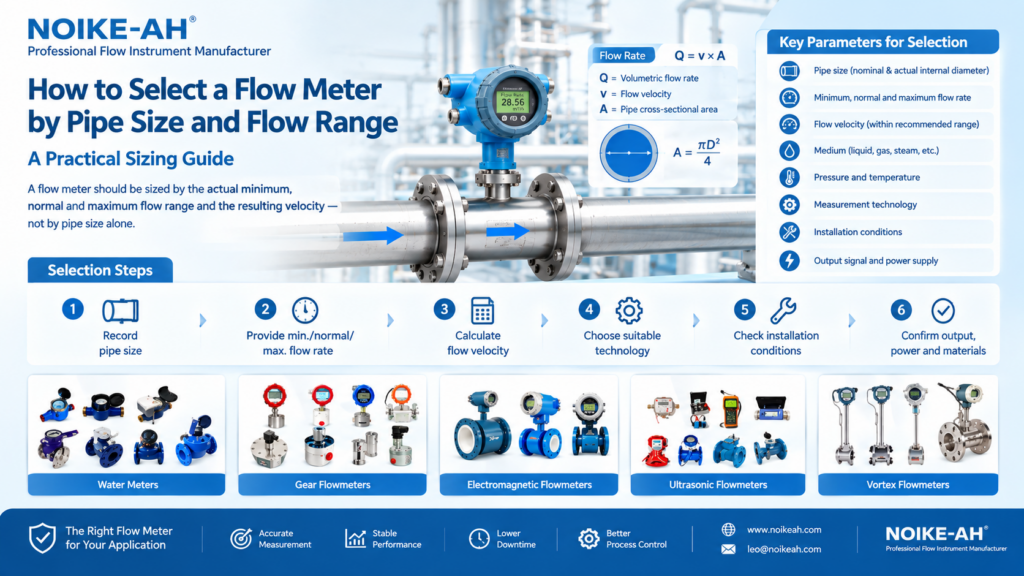
Recommended Instrument
NOIKE-AH provides several industrial flow-meter technologies for different process requirements, including:
Electromagnetic Flow Meters
Suitable candidates for many conductive-liquid applications where the process conditions and installation requirements are compatible.
Ultrasonic Flow Meters
Useful for applications where non-invasive or clamp-on measurement is preferred, subject to pipe and fluid conditions.
Vortex Flow Meters
Commonly considered for steam, gas, and suitable liquid applications where the process conditions meet the instrument requirements.
Gear Flow Meters
Suitable for selected liquid applications where positive-displacement measurement is appropriate.
Water Meters
Designed for applicable water measurement requirements based on the meter’s specified operating range and installation conditions.
The final model should be selected from the actual application data, not from pipe diameter alone.
FAQ
Does the flow meter size have to match the pipe size?
No. In some applications, the meter diameter can be different from the pipeline diameter, provided the selected flow-meter technology and manufacturer allow that configuration and the installation is properly designed. In other applications, matching the pipe size may be appropriate.
Should I select a flow meter based on pipe diameter or flow rate?
Both are important, but flow rate should not be ignored in favor of pipe diameter. Minimum, normal, and maximum flow rates should be evaluated together with pipe diameter and the resulting flow velocity.
What flow data should I provide when requesting a flow meter?
At minimum, provide:
- Medium
- Pipe size
- Minimum flow
- Normal flow
- Maximum flow
- Operating pressure
- Operating temperature
- Required output
- Application
Additional information may be required depending on the technology.
Why are minimum and normal flow rates important?
They show how the meter will actually operate through most of its working range. Selecting a meter only for maximum flow can result in an instrument that operates poorly at normal or low flow.
Can I use a smaller flow meter on a larger pipe?
In some applications, yes. A smaller meter may be connected to a larger pipeline using suitable reducers if the specific flow-meter technology and manufacturer permit it. The resulting velocity, pressure loss, installation geometry, and flow profile must be checked.
Is a larger flow meter always better?
No. An oversized meter can operate at very low velocity and may not provide the desired measurement performance over the actual operating range. The correct size is the one that appropriately covers the application’s flow conditions.
What happens if the flow meter is too small?
A meter that is too small for the actual process can result in excessive velocity, increased pressure loss, or operation beyond the manufacturer’s specified limits.
What happens if the flow meter is too large?
The meter may operate near the lower end of its measurement range, particularly when the actual process flow is much lower than the meter’s intended range.
Can pipe size alone determine the flow meter model?
No. Pipe size is only one selection parameter. The medium, flow range, pressure, temperature, measurement principle, installation conditions, output requirements, and material compatibility also need to be evaluated.
How do I calculate flow velocity from flow rate and pipe size?
For a circular pipe:
v = 4Q / πD²
where v is velocity, Q is volumetric flow rate, and D is the internal pipe diameter. Make sure the units are consistent before calculating.
How much straight pipe does a flow meter need?
There is no single straight-pipe requirement that applies to every flow meter. Requirements depend on the measurement technology, meter design, and upstream/downstream disturbances. Always follow the specific manufacturer’s installation instructions.
What is the best flow meter for a large pipe?
There is no universal answer. Electromagnetic, ultrasonic, insertion, and other technologies may be appropriate depending on the medium, flow range, installation limitations, and measurement requirements. For retrofit applications where pipeline modification is difficult, clamp-on ultrasonic technology can be worth considering.
Conclusion
Selecting a flow meter by pipe size and flow range is not simply a matter of matching DN100 pipe with a DN100 flow meter.
A professional sizing process should start with:
Medium → Pipe Size → Minimum Flow → Normal Flow → Maximum Flow → Flow Velocity → Pressure & Temperature → Measurement Technology → Installation → Output
The most important principle is:
Select the flow meter according to the actual process conditions, not pipe diameter alone.
Pipe size determines the available flow area, while flow rate determines the resulting velocity. The selected meter must then operate within the appropriate range for its specific measurement principle.
Before requesting a quotation, prepare the following information:
Medium + Pipe Size + Minimum Flow + Normal Flow + Maximum Flow + Pressure + Temperature + Installation Conditions
The more complete the process data, the more accurately the appropriate flow-meter technology and size can be evaluated.
RFQ CTA
Need Help Selecting the Right Flow Meter Size?
Don’t select a flow meter based on pipe diameter alone.
Send NOIKE-AH your application data:
1. Medium:
2. Pipe Size:
3. Minimum Flow:
4. Normal Flow:
5. Maximum Flow:
6. Operating Pressure:
7. Operating Temperature:
8. Pipe Material:
9. Required Output:
10. Application:
Our engineering team can evaluate the flow range, velocity, measurement technology, and installation conditions and recommend a suitable flow-meter configuration.
NOIKE-AH — Professional Flow Instrument Manufacturer
Flow Meters | Flow Sensors | Flow Switches | Pressure & Temperature Instruments



