
Why Is My Flow Meter Reading Unstable? Direct Answer
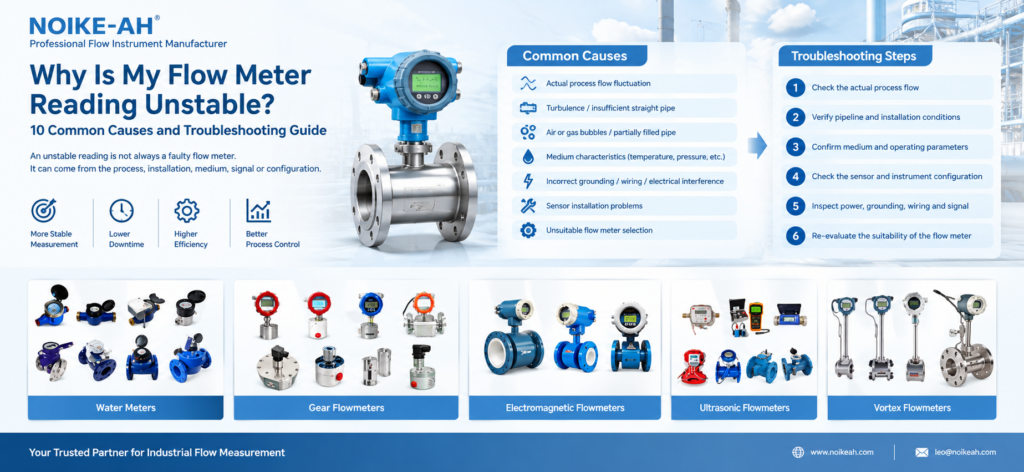
An unstable flow meter reading is not always caused by a faulty flow meter. Common causes include unstable process flow, insufficient straight pipe, turbulence, air or gas bubbles, partially filled pipes, incorrect grounding, sensor installation problems, electrical interference, and unsuitable flow-meter selection. The correct troubleshooting approach is to check the process conditions and installation first, then inspect the sensor, wiring, configuration, and instrument itself.
Key Takeaways
- Unstable readings can originate from the process, installation, sensor, electronics, or signal system.
- Turbulence and an undeveloped flow profile are common installation-related causes of fluctuating readings.
- Air bubbles, gas entrainment, partially filled pipes, or solids can affect measurement depending on the flow-meter technology.
- Incorrect grounding, wiring, shielding, or electrical interference can cause unstable output signals.
- Before replacing a flow meter, compare the instrument reading with the actual process condition and troubleshoot systematically.
What Is an Unstable Flow Meter Reading?
A flow meter reading is considered unstable when the displayed flow rate or output signal changes significantly even though the actual process flow is expected to be relatively steady.
For example, an operator may observe:
- The displayed flow continuously fluctuates.
- The reading suddenly increases or decreases.
- The output signal oscillates around a certain value.
- The flow reading periodically drops to zero.
- The displayed flow does not correspond to the expected process condition.
- The reading becomes unstable only under certain operating conditions.
However, it is important to distinguish between measurement instability and actual process fluctuation.
A flow meter may be accurately reporting a process that is genuinely changing.
For example, a centrifugal pump operating under changing demand can produce a changing flow rate. A control valve may also continuously adjust the flow. In these cases, the fluctuating reading may be a real process response rather than an instrument problem.
Therefore, the first troubleshooting question should be:
Is the process flow actually unstable, or is only the measurement unstable?
How Does a Flow Meter Produce an Unstable Reading?
Different flow-meter technologies use different measurement principles, so the specific causes of instability can vary.
Examples include:
- Electromagnetic flow meters measure flow based on the interaction between conductive liquid flow and a magnetic field.
- Ultrasonic flow meters determine flow using ultrasonic signals traveling through the fluid.
- Vortex flow meters detect vortices generated by a bluff body in the flow.
- Thermal flow meters determine gas or fluid flow from heat-transfer behavior.
- Differential-pressure flow meters determine flow from the pressure difference generated by a primary element.
Because these technologies respond differently to the process, a problem such as air entrainment may have a different effect on an electromagnetic flow meter than on a vortex or ultrasonic flow meter.
This is why troubleshooting should always consider the measurement principle of the specific flow meter.
Key Parameters to Check
When a flow meter reading is unstable, check the following parameters before replacing the instrument.
1. Actual Flow Stability
First determine whether the process itself is stable.
Check:
- Pump operation
- Valve position
- Process demand
- Pressure fluctuations
- Upstream equipment
- Downstream restrictions
- Control-loop behavior
If the process flow is changing, the meter may simply be displaying the real flow condition.
2. Flow Velocity
Extremely low or high flow velocity can affect measurement performance depending on the flow-meter technology and selected model.
The meter should be selected so that the normal operating flow falls within its appropriate measurement range.
3. Pipe Condition
Check whether the pipeline is:
- Completely filled
- Properly connected
- Free from unexpected restrictions
- Free from significant leakage
- Appropriate for the selected flow meter
For liquid applications, a partially filled pipe can be particularly problematic for technologies that require a full measuring pipe.
4. Medium Characteristics
The actual process medium must match the conditions for which the flow meter is suitable.
Important factors may include:
- Conductivity
- Density
- Viscosity
- Temperature
- Pressure
- Gas content
- Suspended solids
The importance of each parameter depends on the flow-meter technology.
5. Electrical Signal
If the local display is stable but the PLC or control system receives an unstable signal, the problem may be in the signal path rather than the flow measurement itself.
Check:
- Power supply
- Signal wiring
- Shielding
- Grounding
- Cable routing
- Analog output configuration
- Communication connections
How to Choose the Right Flow Meter
Preventing unstable readings begins with correct instrument selection.
Step 1: Identify the Medium
Clearly define whether the application involves:
- Water
- Wastewater
- Oil
- Chemical liquid
- Steam
- Compressed air
- Natural gas
- Other industrial fluids
Do not select a flow meter based only on pipe diameter.
Step 2: Determine the Operating Flow Range
Provide at least:
- Minimum flow
- Normal flow
- Maximum flow
A flow meter should be selected according to the actual operating range rather than only the maximum possible flow.
Step 3: Check Temperature and Pressure
Confirm the actual process temperature and pressure, including possible operating extremes.
The instrument’s process connection, sensor materials, seals, and electronics must be suitable for the application.
Step 4: Evaluate Installation Conditions
Before selecting the instrument, determine:
- Available straight-pipe length
- Pipe orientation
- Upstream and downstream fittings
- Installation space
- Maintenance access
- Whether the pipe can remain full
Installation limitations can influence which measurement technology is appropriate.
Step 5: Select the Measurement Technology
Different technologies have different strengths.
For example:
Electromagnetic flow meter:
Commonly considered for conductive liquids.
Ultrasonic flow meter:
Can be useful where non-invasive or clamp-on measurement is required, depending on application conditions.
Vortex flow meter:
Often used for applications involving gases, steam, and certain liquids where the process conditions are suitable.
Thermal flow meter:
Commonly used for gas-flow measurement based on thermal properties.
The technology should be selected based on the medium, flow range, pressure, temperature, pipe configuration, and required measurement performance.
Installation: The Most Common Area to Check
Incorrect installation is one of the first areas engineers should investigate when a flow meter reading becomes unstable.
1. Insufficient Straight Pipe
Flow disturbances caused by elbows, valves, reducers, pumps, and other fittings can create a non-uniform velocity profile.
If the meter is installed too close to such disturbances, the flow entering the measuring section may not be sufficiently developed.
Always follow the specific manufacturer’s installation requirements for straight-pipe length.
2. Installation Near a Pump or Valve
Pumps and control valves can create significant flow disturbances.
Where practical, the flow meter should be installed in a location that provides a suitable and representative flow profile.
3. Incorrect Flow Direction
Some flow meters have a specified flow direction.
Installing the instrument against the specified direction can result in incorrect or abnormal operation.
4. Pipe Not Completely Filled
For many liquid flow-meter applications, the measuring pipe needs to remain full.
Installing the meter at an unsuitable high point or in a location where air can accumulate may cause unstable measurement.
A downward-flow section or an appropriate piping arrangement may be preferable depending on the system and meter technology.
5. Air or Gas Bubbles
Air entrainment can significantly affect liquid-flow measurement for some technologies.
Possible sources include:
- Leakage on the suction side of a pump
- Poorly designed piping
- Gas entering the process
- Inadequate deaeration
- Improper installation
If unstable readings occur together with visible bubbles or process conditions that can introduce gas, this should be investigated before changing the flow meter.
6. Sensor Installation
For insertion-type or inline instruments, verify:
- Sensor position
- Insertion depth
- Orientation
- Sealing
- Mechanical installation
- Sensor cleanliness
The sensing element must interact correctly with the process flow.
Common Problems and Troubleshooting
Problem 1: Flow Reading Jumps Up and Down
Possible Causes
- Actual flow fluctuation
- Turbulent flow
- Air bubbles
- Insufficient straight pipe
- Flow meter installed too close to a disturbance
- Electrical interference
- Poor grounding
What to Check
Compare the flow-meter reading with process pressure, pump operation, valve position, and another reliable reference if available.
If the process parameters fluctuate at the same time, the flow variation may be real.
Problem 2: Reading Suddenly Drops to Zero
Possible causes include:
- Flow interruption
- Empty or partially filled pipe
- Air entering the pipeline
- Loss of power
- Sensor or signal connection problem
- Incorrect configuration
Check the process first, followed by power supply, wiring, sensor status, and instrument configuration.
Problem 3: Local Display Is Stable but PLC Signal Is Unstable
This situation is particularly useful for troubleshooting.
If the local display remains stable but the PLC receives a fluctuating signal, inspect the output circuit and signal transmission path.
Check:
- 4–20 mA wiring
- Power supply
- Grounding
- Shielding
- Cable routing
- Electrical interference
- PLC input configuration
This can help determine whether the problem is occurring inside the flow meter or after the measurement signal leaves the instrument.
Problem 4: Reading Is Unstable After Installation
If the flow meter worked correctly during testing but becomes unstable after installation, check the installation conditions first.
Possible causes include:
- Different pipe configuration
- Insufficient straight pipe
- Incorrect orientation
- Air accumulation
- Pump or valve disturbance
- Grounding differences
- Different process conditions
Commissioning conditions may not perfectly represent actual operating conditions.
Problem 5: Reading Becomes Unstable After Process Changes
Changes to the process can change the flow profile and measurement conditions.
For example:
- Pump replacement
- Pipeline modification
- Valve replacement
- Pipe diameter change
- Increased flow rate
- Changed medium
- Changed process temperature
After a process modification, the original flow-meter installation may no longer provide the same measurement conditions.
Problem 6: Reading Is Stable at High Flow but Unstable at Low Flow
This may indicate that the operating condition is approaching the lower measurement capability or recommended operating range of the selected instrument.
Check the manufacturer’s specified measurement range and compare it with the actual minimum operating flow.
If the application normally operates near the lower end of the meter’s range, instrument selection should be reviewed.
Application Considerations
Different industries may experience different causes of unstable flow measurement.
Water Treatment
Potential issues include:
- Air entrainment
- Partially filled pipelines
- Pump operation
- Flow fluctuations
- Incorrect installation
Chemical Processing
Engineers should pay particular attention to:
- Medium compatibility
- Temperature
- Pressure
- Conductivity where relevant
- Corrosion
- Process changes
HVAC and Cooling Systems
Common factors include:
- Pump operation
- Control-valve adjustment
- Variable flow conditions
- Air in the system
- Incorrect installation
Steam Measurement
For steam applications, engineers should consider:
- Flow conditions
- Pressure
- Temperature
- Pipeline configuration
- Condensation
- Meter sizing and installation
The exact troubleshooting method depends on the selected flow-meter technology and steam measurement configuration.
Compressed Air and Gas
Gas applications require attention to:
- Pressure
- Temperature
- Gas composition
- Flow range
- Installation
- Pipe conditions
Thermal, vortex, ultrasonic, and other technologies may respond differently to changes in gas conditions.
Recommended Instrument
There is no single flow-meter technology that is ideal for every unstable-reading problem.
The correct instrument should be selected according to the medium and actual process conditions.
For example:
| Application Requirement | Flow Meter Technology to Consider |
|---|---|
| Conductive liquid measurement | Electromagnetic flow meter |
| Non-invasive measurement requirement | Clamp-on ultrasonic flow meter |
| Steam measurement | Vortex flow meter |
| Gas measurement based on thermal principle | Thermal flow meter |
| Flow measurement using pressure difference | Differential-pressure flow meter |
These are general technology considerations rather than universal rules. The final selection should be based on the actual medium, flow range, pressure, temperature, pipe configuration, and required performance.
For industrial applications where installation conditions are difficult or the process has significant disturbances, the installation environment should be evaluated together with the instrument specification.
FAQ
Why is my flow meter reading unstable?
The most common causes include actual process-flow fluctuations, turbulence, insufficient straight pipe, air or gas bubbles, partially filled pipes, incorrect installation, electrical interference, grounding problems, and unsuitable instrument selection.
Can a flow meter be unstable even when the instrument is not faulty?
Yes. A flow meter can correctly respond to a fluctuating process. Installation conditions and process changes can also create unstable measurement even when the instrument itself is functioning normally.
Can air bubbles cause an unstable flow meter reading?
Yes. Air or gas entrainment can affect liquid-flow measurement, depending on the measurement technology. The source of the gas should be investigated rather than simply replacing the meter.
Does insufficient straight pipe cause unstable readings?
It can. Valves, elbows, pumps, reducers, and other fittings can disturb the velocity profile. If the meter is installed too close to these disturbances, measurement performance can be affected.
Why does my flow meter read zero intermittently?
Possible causes include actual flow interruption, an empty or partially filled pipe, air entering the pipeline, power interruption, wiring problems, sensor issues, or incorrect configuration.
Why is the flow meter display stable but the PLC signal unstable?
If the local display is stable while the PLC signal fluctuates, the signal transmission path should be investigated. Possible areas include the output wiring, power supply, grounding, shielding, electrical interference, and PLC input configuration.
Can pipe size affect flow-meter stability?
Yes. Pipe size affects flow velocity and installation conditions. A meter should be selected according to the actual flow range and pipeline configuration rather than pipe diameter alone.
Does changing the pump affect flow-meter readings?
Yes. A pump change can alter flow rate, pressure, pulsation, and the velocity profile entering the meter. If a flow meter becomes unstable after pump modification, the new process conditions should be evaluated.
Should I replace my flow meter if the reading is unstable?
Not immediately. First determine whether the instability comes from the process, installation, medium, sensor, wiring, or configuration. Replacing the meter without identifying the cause may not solve the problem.
How can I make my flow meter reading more stable?
Start by confirming actual flow stability, then check installation, straight-pipe conditions, pipe filling, air entrainment, sensor position, grounding, wiring, and instrument configuration. If the operating range is unsuitable, review the flow-meter selection.
Conclusion
An unstable flow meter reading does not automatically mean that the flow meter is defective.
The measurement can be affected by actual process fluctuations, disturbed flow profiles, insufficient straight pipe, air or gas entrainment, partially filled pipes, sensor installation, medium conditions, grounding, wiring, electrical interference, and incorrect instrument selection.
The most effective troubleshooting method is therefore systematic:
1. Check the actual process flow
↓
2. Check pipeline and installation conditions
↓
3. Check the medium and operating parameters
↓
4. Check the sensor and instrument configuration
↓
5. Check power, grounding, wiring and output signals
↓
6. Review whether the selected flow-meter technology is suitable
In many cases, identifying the real cause is more effective than simply replacing the instrument.
A stable measurement starts with the right flow-meter technology + correct sizing + representative installation + proper commissioning.
RFQ CTA
Is Your Flow Meter Reading Unstable?
Before replacing the instrument, let us help you identify the possible cause.
Send us your application information:
- Medium:
- Pipe size:
- Minimum / normal / maximum flow:
- Operating pressure:
- Medium temperature:
- Flow meter type:
- Current installation position:
- Output signal:
- Power supply:
- Description of the unstable reading:
Our team can help evaluate the application and recommend a suitable flow measurement solution.
NOIKE-AH | Professional Flow Instrument Manufacturer
📧 [email protected]
🌐 www.noikeah.com
Flow Sensors | Flow Switches | Flow Meters | Pressure & Temperature Instruments



