
Pressure Instruments
Selecting a pressure transmitter, switch, or gauge based solely on pressure range and signal output is a common oversight that leads to premature equipment failure. In industrial applications, the wetted materials—the parts that come into direct contact with your process medium—are the most critical factor for longevity and safety.
Using the wrong material can lead to corrosion, process leakage, sensor clogging, signal drift, or catastrophic system failure. This guide outlines how to select the right materials for common industrial media.
1. Quick Reference: Wetted Material Selection Table
2. Deep Dive by Application
Water Systems
- Clean Water: 316L stainless steel is the industry standard.
- Industrial/Cooling Water: Beware of high chloride content and chemical additives. Even “water” can be corrosive if it is treated or recycled. Never assume all water is non-corrosive.
Hydraulic Oil
- Compatibility: While stainless steel is generally resistant to oil, the internal seals (O-rings) are often the point of failure. Ensure seal materials (e.g., Viton vs. Buna) are rated for the specific oil additives and temperature ranges.
- Performance: Hydraulic systems often have high-frequency pressure spikes; ensure your sensor has an appropriate overpressure rating and, if necessary, a snubber.
Steam Applications
- Thermal Protection: High temperatures will destroy internal sensor electronics.
- Best Practices: Never connect a standard transmitter directly to high-pressure/high-temperature steam. Use siphon tubes, cooling elements, or remote diaphragm seals with capillaries to dissipate heat before it reaches the instrument.
Chemical Liquids
- Validation: Never choose a material based on the word “chemical.” You must define the chemical name, exact concentration, pH, and temperature.
- Isolation: For highly corrosive substances, use diaphragm seals or isolation rings. Exotic materials like Tantalum or Hastelloy may be required to prevent the process from eating through the diaphragm.
Wastewater and Slurry
- Clogging: Standard small-port sensors will clog quickly in sludge or slurry.
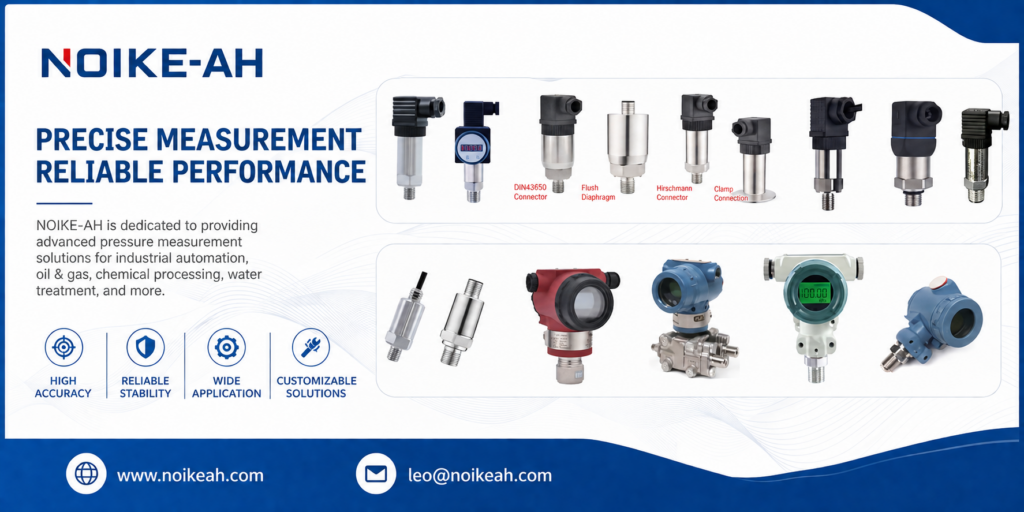
- Solutions: Use flush diaphragm transmitters or large-bore diaphragm seals. These designs prevent solids from accumulating at the sensing point.
Compressed Air
- Moisture & Oil: Even if the air is “dry,” condensate or compressor oil mist can degrade certain materials.
- Oxygen Safety: Oxygen systems require specialized, oil-free cleaning and specific oxygen-compatible materials to prevent spontaneous combustion. Standard air-rated instruments are not safe for oxygen service.
3. Recommended Configuration Strategy: NOIKE-AH
For complex process environments, NOIKE-AH provides specialized instrumentation to ensure diagnostic accuracy and hardware longevity:
- Pump Control/Water: 316L Stainless Steel transmitters paired with pressure gauges for local visual verification.
- Hydraulic Units: High-pressure transmitters with liquid-filled gauges to dampen vibrations.
- Steam Systems: Dedicated instruments fitted with cooling siphons or capillary protection.
- Chemical/Wastewater: Diaphragm-seal configurations using process-compatible alloys (e.g., Hastelloy/Tantalum).
4. The Selection Checklist
To prevent corrosion, leakage, and drift, always follow this systematic selection sequence:
- Define Medium: (Chemical composition, concentration, pH)
- Evaluate Process Conditions: (Temperature, pressure spikes, vibration)
- Identify Potential Risks: (Solids/viscosity/crystallization/corrosion)
- Select Materials: (Wetted parts and seal elastomers)
- Choose Structure: (Flush diaphragm, diaphragm seal, or standard port)
- Specify Electronics: (Signal output and control cabinet requirements)
Pro Tip: Industrial instrumentation is an investment. Investing time in material compatibility today prevents the high cost of process downtime and emergency replacements tomorrow.
Are you selecting instruments for a new process line, or are you troubleshooting a recurring failure in an existing system?
About NOIKE-AH
Nickel Electronics (Anhui) Co., Ltd (NOIKE-AH) is a global manufacturer of high-precision sensors for measuring and monitoring flow, pressure, temperature, level etc,.
With decades of engineering experience, NOIKE-AH provides reliable sensing solutions that ensure accuracy, efficiency, and safety across industries such as chemical processing, water treatment, food & beverage, pharmaceuticals, and energy.
Our intelligent measurement technology enables customers to gain real-time insights, improve process optimization, and achieve predictive maintenance through data-driven control.
Driven by innovation, NOIKE-AH continues to advance industrial automation with smart digital instruments, IIoT-ready solutions, and customized system integration, empowering industries worldwide to reach new standards in process reliability and performance.



