
Introduction: Why Explosion-Proof Flow Switch Selection Matters in Hazardous Areas
In industries such as oil & gas, chemical processing, pharmaceutical manufacturing, energy production, and industrial refrigeration, pipelines often transport flammable gases, vapors, or combustible liquids. In these environments, even a small electrical spark or excessive surface temperature from an instrument may become an ignition source and create a serious safety risk.
Flow switches are commonly used for pump protection, cooling system monitoring, lubrication systems, and process control. However, when these devices are installed in hazardous locations, standard industrial flow switches are usually not suitable. A properly certified explosion-proof flow switch is required to ensure safe operation.
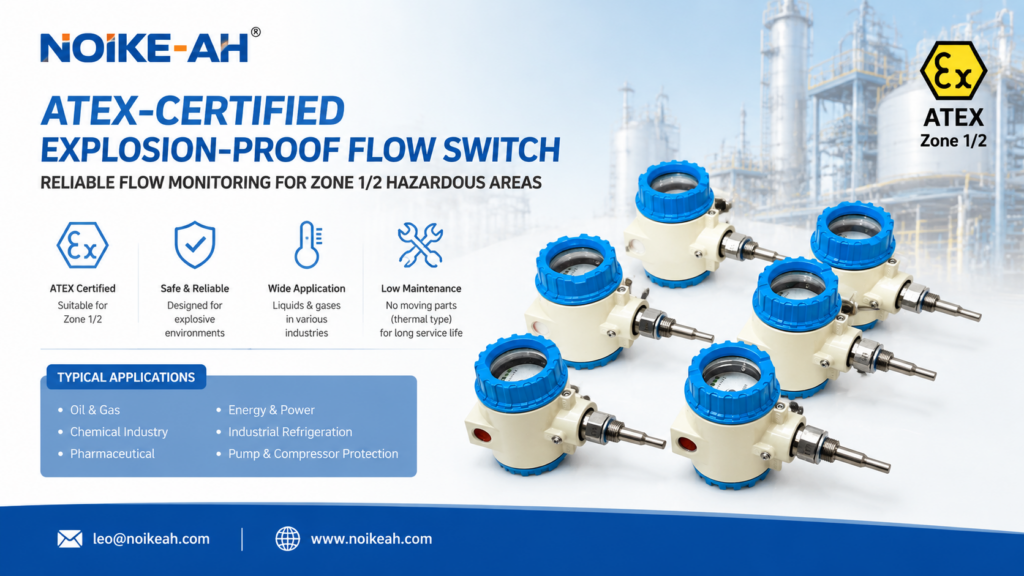
For installations in Zone 1 and Zone 2 hazardous areas, selecting an ATEX-certified explosion-proof flow switch requires careful consideration of certification level, protection concept, process conditions, electrical parameters, and application requirements.
This article explains the key factors engineers should evaluate when choosing an ATEX-certified flow switch for hazardous environments.
1. Understanding ATEX Certification and Hazardous Zone Classification
What is ATEX Certification?
ATEX is a European regulatory framework that defines requirements for equipment used in potentially explosive atmospheres.
The name comes from the French phrase:
ATmosphères EXplosibles
ATEX certification ensures that electrical and mechanical equipment is designed and manufactured to minimize the risk of ignition when operating in explosive environments.
Equipment used in hazardous areas must comply with relevant ATEX requirements, including:
- Protection against ignition sources
- Temperature limitation
- Electrical safety design
- Mechanical protection
- Manufacturing quality control
For industrial users, ATEX certification provides confidence that the equipment is suitable for operation in classified explosive atmospheres.
Understanding Zone 1 and Zone 2
Hazardous areas are classified according to the probability and duration of an explosive atmosphere being present.
Zone 1
Zone 1 refers to an area where an explosive gas atmosphere is likely to occur during normal operation.
Typical applications include:
- Chemical processing equipment
- Fuel handling systems
- Gas processing facilities
- Solvent production areas
- Oil and gas equipment rooms
Equipment installed in Zone 1 requires a higher level of explosion protection because explosive gases may exist regularly.
Zone 2
Zone 2 refers to an area where an explosive gas atmosphere is not likely to occur during normal operation, but may exist temporarily due to abnormal conditions such as leakage or equipment failure.
Typical applications include:
- Gas storage areas
- Compressor rooms
- Pump stations
- Industrial boiler areas
Although the risk level is lower than Zone 1, certified explosion-proof equipment is still required.
2. Choosing the Correct ATEX Protection Level
When selecting an explosion-proof flow switch, the first step is confirming that the certification matches the hazardous area classification.
An ATEX marking normally contains several important identification elements, including:
- Equipment category
- Gas group
- Temperature class
- Protection type
A typical explosion-proof classification may include information such as:
II 2G Ex db IIC T6 Gb
Each part represents a specific protection requirement.
Equipment Category
For gas hazardous areas:
Category 1G
Suitable for Zone 0 applications.
Provides the highest protection level.
Category 2G
Suitable for Zone 1 applications.
Designed to maintain safety even under foreseeable equipment faults.
Category 3G
Suitable for Zone 2 applications.
Designed for normal operation conditions.
For Zone 1/2 applications, Category 2G or Category 3G equipment is generally selected depending on the installation requirements.
Gas Group Classification
Explosive gases have different ignition characteristics.
Common gas groups include:
IIA
Lower ignition sensitivity gases.
Examples:
- Propane
- Methane
IIB
More demanding environments.
Examples:
- Ethylene
IIC
The highest protection requirement.
Examples:
- Hydrogen
- Acetylene
If a facility handles multiple gases, selecting a higher gas group rating provides wider application compatibility.
Temperature Class
The maximum surface temperature of equipment must remain below the ignition temperature of the surrounding gas.
Temperature classes include:
| Temperature Class | Maximum Surface Temperature |
|---|---|
| T1 | ≤450°C |
| T2 | ≤300°C |
| T3 | ≤200°C |
| T4 | ≤135°C |
| T5 | ≤100°C |
| T6 | ≤85°C |
For hazardous environments, engineers should select a temperature class according to the process medium and surrounding atmosphere.
A lower temperature class number represents a stricter temperature limitation.
3. Selecting the Appropriate Flow Detection Technology
Explosion-proof certification alone is not enough. The flow detection technology must also match the application.
Different flow switch principles provide different advantages.
Thermal Dispersion Flow Switch
Thermal flow switches operate by measuring heat transfer between a heated sensor and the flowing medium.
Advantages:
- No moving parts
- Long service life
- Suitable for low flow monitoring
- Suitable for gas and liquid applications
- Low maintenance requirements
Typical applications:
- Cooling water monitoring
- Pump protection
- Air compressor systems
- Process equipment protection
Thermal flow switches are widely used where reliability and maintenance-free operation are important.
Mechanical Flow Switch
Mechanical flow switches use a moving element such as a paddle or piston to detect flow changes.
Advantages:
- Simple operating principle
- Direct switching output
- Easy adjustment
- Cost-effective
Typical applications:
- HVAC systems
- Water circulation systems
- Industrial equipment
However, because mechanical designs contain moving components, engineers should consider wear, vibration, and installation orientation.
4. Important Technical Parameters for ATEX Flow Switch Selection
Before selecting an explosion-proof flow switch, the following technical parameters should be carefully reviewed.
4.1 Medium Compatibility
The flow switch must be compatible with the process medium.
Common industrial media include:
- Water
- Cooling fluids
- Oil
- Hydraulic fluids
- Compressed air
- Inert gases
- Chemical liquids
Important considerations:
- Chemical corrosion resistance
- Material compatibility
- Seal material selection
- Operating temperature
For aggressive chemical environments, stainless steel wetted parts are often preferred.
4.2 Operating Temperature Range
The flow switch must withstand both:
- Medium temperature
- Ambient temperature
For example:
A cooling system may have a relatively low process temperature but operate outdoors where ambient temperature changes significantly.
Always confirm:
- Maximum medium temperature
- Minimum operating temperature
- Ambient temperature range
4.3 Pressure Rating
Pipeline pressure directly affects sensor safety.
Important parameters include:
- Maximum working pressure
- Pressure resistance
- Connection type
The selected flow switch pressure rating should always exceed the maximum system operating pressure.
4.4 Electrical Output Requirements
Explosion-proof flow switches are commonly integrated into control systems.
Typical output options include:
Relay Output
Suitable for:
- Pump control
- Alarm systems
- Equipment protection
Transistor Output
Suitable for:
- PLC systems
- Automated control systems
Analog Output
Used when continuous flow monitoring is required.
The electrical parameters must match the control system requirements.
5. Installation Considerations in Zone 1/2 Areas
Correct installation is essential to maintain explosion protection.
Pipeline Installation
Before installation:
- Confirm correct flow direction
- Ensure sufficient straight pipe length
- Avoid excessive vibration
- Prevent mechanical stress on the sensor
Incorrect installation may affect measurement stability.
Cable Connection
For hazardous locations:
- Use certified cable glands
- Ensure proper sealing
- Follow grounding requirements
- Maintain enclosure protection rating
The electrical installation should comply with local explosion-proof installation regulations.
Maintenance Requirements
Explosion-proof equipment should not be modified without authorization.
Regular inspection should include:
- Housing condition
- Cable entry sealing
- Mechanical damage inspection
- Connection reliability
Maintenance procedures should follow manufacturer instructions and site safety regulations.
6. Common Mistakes When Selecting Explosion-Proof Flow Switches
Mistake 1: Choosing Certification Only Based on Price
A lower-cost standard flow switch may not provide sufficient explosion protection.
The certification level must always match:
- Hazardous zone
- Gas group
- Temperature class
Mistake 2: Ignoring Process Conditions
A flow switch suitable for water applications may fail in:
- High-temperature oil systems
- Corrosive chemicals
- High-pressure pipelines
Material and operating conditions must be evaluated together.
Mistake 3: Selecting the Wrong Switching Range
A flow switch should be selected according to:
- Minimum required flow
- Normal operating flow
- Maximum flow condition
Incorrect range selection may cause false alarms or missed protection signals.
7. Applications of ATEX Explosion-Proof Flow Switches
ATEX-certified flow switches are commonly used in:
Oil & Gas Industry
Applications:
- Cooling systems
- Fuel circulation monitoring
- Pump protection
Chemical Industry
Applications:
- Reaction equipment
- Chemical transfer systems
- Process cooling
Pharmaceutical Industry
Applications:
- Temperature-controlled systems
- Clean process equipment
Energy Industry
Applications:
- Power generation cooling systems
- Auxiliary equipment protection
Industrial Refrigeration
Applications:
- Compressor protection
- Cooling water monitoring
- Condenser systems
Conclusion: How to Make the Right Choice
Selecting an ATEX-certified explosion-proof flow switch for Zone 1/2 applications requires more than checking the explosion-proof label.
A reliable selection process should consider:
- Hazardous area classification
- ATEX protection level
- Gas group and temperature class
- Flow detection technology
- Medium compatibility
- Pressure and temperature requirements
- Electrical connection requirements
- Installation environment
For critical industrial applications, choosing a properly certified and application-matched flow switch can significantly improve system safety, reduce unexpected downtime, and ensure reliable operation in hazardous environments.
A professional explosion-proof flow switch is not only a flow monitoring device — it is an important safety component for protecting industrial processes.
NOIKE-AH Linkedin->
How to Select an ATEX-Certified Explosion-Proof Flow Switch for Zone 1/2



