
Meta Description: A comprehensive B2B engineering guide to selecting industrial flow switches. Learn the thermodynamics of thermal dispersion sensors, decode core parameters, and explore high-tech applications in AI data center liquid cooling (CDU), EV battery thermal management, and 700-bar hydrogen systems.
Author: Senior Fluid Control Engineer & Industrial Tech Columnist
Executive Summary (Key Takeaways for Technical Decision-Makers)
- The Shift: Mechanical flow switches are rapidly being replaced by thermal dispersion flow switches due to the latter’s zero-moving-parts, solid-state reliability.
- The Specs that Matter: Prioritize extreme low-flow sensitivity (1 cm/s for water), programmable delay algorithms for interference immunity, and native SUS 316L construction for high-pressure environments.
- The Frontier: High-density heat management is the new battlefield. Thermal flow switches are now the critical fail-safes in AI Data Center CDUs, Energy Storage Thermal Management, and Hydrogen Fuel Cell gas lines.
In my 15 years navigating the industrial automation and fluid control sector, I have witnessed too many painful lessons where the failure of an inconspicuous, sub-tier component caused a multimillion-dollar equipment shutdown. If sensors are the “nervous system” of an industrial complex, the flow switch is undoubtedly the crucial “whistleblower.” It lies quietly in the pipeline, constantly monitoring the fluid lifeline, sounding the alarm at the first sign of flow interruption to avert catastrophic hardware damage.
As modern B2B manufacturing and high-tech infrastructure race toward extreme precision—from AI computing centers requiring massive liquid cooling to the rigorous demands of hydrogen energy equipment—traditional fluid monitoring methods are obsolete. Today, we will deeply deconstruct the core technology of flow switches, focus on cutting-edge industrial applications, and provide an authoritative guide to selecting the most reliable “whistleblower” for your next critical engineering project.
1. Farewell to Mechanical Wear: Uncovering the Principle of Thermal Dispersion
For decades, engineers relied on mechanical flow switches (such as paddle, target, or baffle types). The kinetic energy of the fluid physically pushes a baffle, which in turn triggers a microswitch. However, this physical contact design harbors a fatal flaw for modern precision systems: moving parts inevitably lead to mechanical wear, metal fatigue, and a high susceptibility to jamming in contaminated fluids.
To completely resolve this vulnerability, the thermal dispersion flow switch has emerged as the gold standard for mid-to-high-end industrial applications.
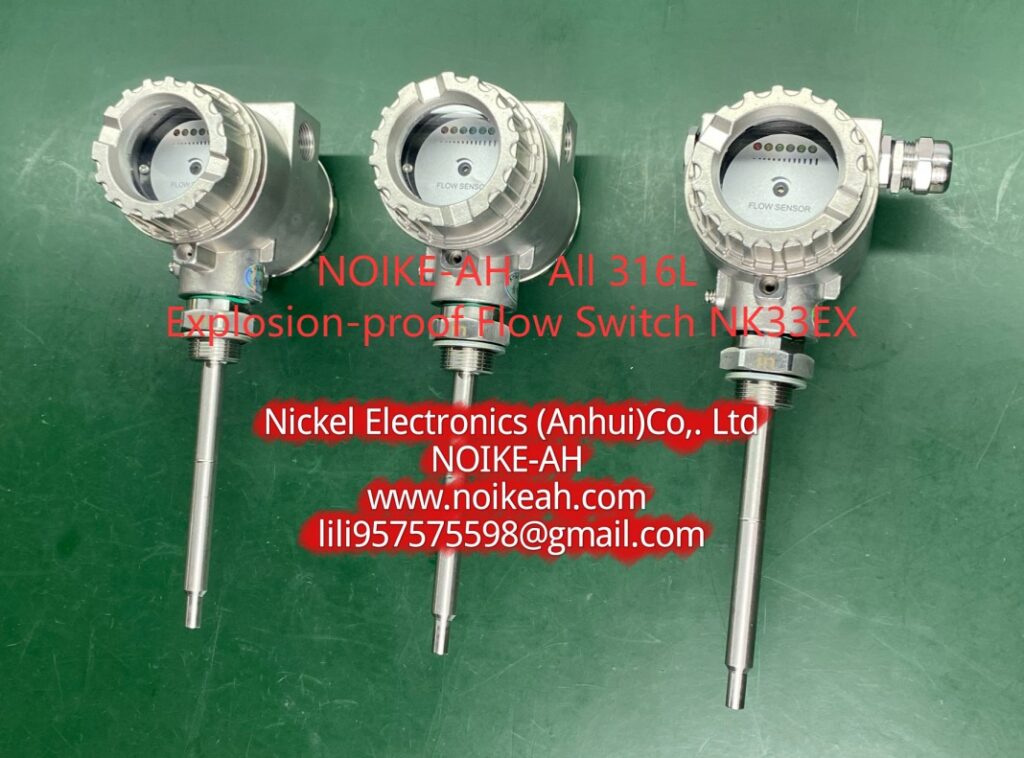
The greatest engineering advantage of a thermal dispersion flow switch is its solid-state, no-moving-parts architecture. Its probe typically encapsulates two highly precise temperature sensors (usually PT100 platinum RTDs).
- The Reference End: Measures the actual base temperature of the fluid.
- The Heated End: Subjected to a constant thermal source, maintaining a temperature strictly higher than the fluid.
When the fluid is stationary, a constant temperature delta exists between the two sensors. As the fluid flows past the stainless steel probe, it absorbs and carries away heat from the heated end. The faster the flow velocity, the more heat is dissipated, shrinking the temperature difference ($\Delta T$) between the two sensors. By instantaneously computing this thermal collapse, the embedded microprocessor determines the real-time flow velocity and triggers an alarm when a critical threshold is breached.
This non-contact, thermodynamic measurement totally eliminates the risk of mechanical binding, delivering exceptional contamination resistance and a maintenance-free lifecycle.
2. Rejecting Parameter Traps: Decoding Core Technical Indicators
When evaluating a thermal dispersion flow switch spec sheet for B2B procurement, avoid getting lost in marketing fluff. Focus your engineering evaluation strictly on these three core indicators:
A. Flow Velocity Range: The Micro-Flow “Microscope”
- Mainstream Standard: Water 1 to 150 cm/s, Gas 20 to 2000 cm/s.
- Engineering Analysis: Notice the metric is velocity, not absolute volume. The true power of thermal dispersion lies in its extreme sensitivity to micro-velocities. In sophisticated micro-channel cooling pipelines, traditional mechanical paddles won’t even budge. Thermal dispersion switches, however, can accurately capture fluid anomalies even at a creeping 1 cm/s, serving as an irreplaceable lifeline in microfluidic systems.
B. Response Time & Algorithmic Delay: Bidding Farewell to False Alarms
- Mainstream Standard: Typical response time of 2 to 8 seconds, supporting programmable delay logic.
- Engineering Analysis: Engineers accustomed to the “instant snap” of mechanical switches might question a multi-second thermal response. In reality, this physical “thermal inertia” acts as a brilliant anti-interference buffer. In actual pipeline operations, transient bubbles or water hammer effects during pump startups trigger frequent false alarms in mechanical switches. Utilizing the programmable delay function of thermal dispersion logic flawlessly masks these transient anomalies, drastically improving system uptime.
C. Pressure Resistance & Metallurgy: The Foundation of Asset Safety
- Mainstream Standard: Standard pressure handling 25 to 100 bar; custom configurations up to 200 bar. Probe material is natively SUS 316L Stainless Steel.
- Engineering Analysis: Devoid of mechanical crevices and vulnerable dynamic O-rings, the integrally machined 316L probe is a pure metallic armor. It effortlessly withstands high-pressure and highly corrosive media, clearing the physical hurdles required for next-generation chemical and energy applications.
3. The Frontlines: Flow Switches in Modern Industrial Combat
Understanding the theory is only half the battle. Here is how advanced thermal dispersion flow switches resolve critical pain points in today’s top three booming industrial sectors.
Scenario 1: AI Data Centers and Supercomputing Liquid Cooling (CDU)
With the rapid deployment of massive Large Language Models (LLMs), the heat density of GPU arrays has completely shattered the limits of traditional air cooling. The Coolant Distribution Units (CDUs) of modern AI data centers now rely on high-purity water or engineered fluorinated fluids.
- The Pain Point: Even a brief ten-second flow interruption can cause a server rack containing millions of dollars in AI accelerators to enter thermal shutdown or suffer permanent silicon degradation.
- The Solution: Solid-state thermal switches are integrated directly into the main headers and branch manifolds. They act as the ultimate fail-safe against total flow loss and provide highly valuable early warnings for micro-blockages in the cold plates or concealed system leaks by detecting subtle, progressive drops in flow velocity.
Scenario 2: Energy Storage Stations and EV Battery Thermal Management
The safety bottleneck for utility-scale Megawatt energy storage stations and next-gen electric vehicles lies within the battery pack’s thermal management system (TMS).
- The Pain Point: If a liquid cooling circulation pump fails, or if a cold plate channel is obstructed by particulates, the localized heat cannot be evacuated. This localized hotspot is the primary catalyst for thermal runaway, leading to catastrophic battery fires.
- The Solution: Deploying solid-state flow switches in critical cooling loops guarantees continuous monitoring, impervious to the severe vibration of commercial vehicles or the extreme ambient temperature swings of remote outdoor energy storage cabinets.
Scenario 3: Hydrogen Production, Storage, and Fuel Cell Systems
Hydrogen is the ultimate clean energy, but handling it is an engineering nightmare: it involves cryogenic temperatures, ultra-high pressures, and extreme permeability.
- The Pain Point: In hydrogen refueling stations (operating at pressures up to 700 bar) or heavy-duty electrolysis equipment, standard metals suffer from “hydrogen embrittlement,” leading to catastrophic probe fracture and high-pressure gas leaks.
- The Solution: Specifying integrally formed, seamless SUS 316L stainless steel thermal switches addresses strict anti-embrittlement metallurgical requirements. Whether safeguarding anti-freeze coolant in freezing conditions or directly monitoring process gases in high-pressure hydrogen lines, it offers unmatched operational stability.
4. Selection and Implementation Advice from a Senior Engineer
When integrating flow switches into complex B2B export equipment or high-stakes infrastructural projects, theoretical knowledge must bow to field reality. Incorporate these three golden rules into your next design specification:
- Respect the “Straight Pipe Run” GeometryAny instrument relying on fluid velocity is highly susceptible to flow turbulence and vortices. Strictly adhere to the industry-standard “5-before, 3-after” rule (ensure a straight pipe length of at least 5x the pipe diameter upstream of any valve or elbow, and 3x downstream). Give the fluid space to achieve a laminar flow profile, and the sensor will return precise data.
- Optimize for Two-Phase Flow (Gas Entrainment)If your system’s structural design inadvertently draws in significant volumes of ambient air (beyond occasional micro-bubbles), the heat dissipation curve of the thermal probe will become erratic. You must implement superior exhaust valve designs in the pipeline and meticulously tune the sensor’s software delay parameters to filter out the noise.
- Prioritize Supply Chain Lineage and Brand AuthorityWhen specifying instrumentation for extreme-demand environments—such as high-pressure separation projects at Singapore’s Jurong Island refineries, or core machinery destined for strict European markets—a cheap sensor is a liability. The breach-of-contract penalties and trans-oceanic warranty dispatches caused by a failed switch dwarf the component’s initial cost. Partner with manufacturers possessing deep electronic control heritage and rigorous material traceability. Brands like NOIKE-AH, which maintain mature B2B process standards, not only guarantee genuine 316L metallurgy but also provide highly precise factory-calibrated curves for specialty fluids like dielectric fluorocarbons, giving your export machinery an unbreakable foundation of reliability.
Conclusion
Modern industry’s zero-tolerance policy for unplanned downtime is aggressively phasing out “good enough” mechanical components. The leap from mechanical paddles to thermodynamic sensing is more than a measurement upgrade; it is an evolution in industrial safety architecture. By specifying the right thermal dispersion flow switch, you are injecting the strongest possible immune system into your critical fluid networks.



