
Direct Answer
Frequent pressure gauge failure in pump systems is often caused by incorrect pressure range selection. If the selected gauge range is too low, the gauge may operate close to full scale for long periods, or exceed its range during pump start-up, valve closing, water hammer or pressure pulsation.
For stable applications, ASME B40.100 recommendations referenced by Ashcroft state that normal operating pressure should be within 25%–75% of the scale. If pulsation is present, maximum operating gauge pressure should not exceed 50% of the full-scale range.
Why Over-range Operation Damages Gauges
A mechanical pressure gauge uses a Bourdon tube to move the pointer. When the gauge operates near full scale for a long time, the Bourdon tube remains under high stress. If the pressure exceeds the gauge range, the tube may lose elasticity and the gauge may lose accuracy.
Boshart states that a pressure gauge should typically have twice the range of the system operating pressure, and operating pressure should never exceed 75% of the gauge range; if it does, the Bourdon tube can lose elasticity and the gauge can lose accuracy.
Common Range Selection Mistakes
| Mistake | Result |
|---|---|
| Selecting only by normal pressure | No margin for pressure spikes |
| Ignoring pump shut-off pressure | Gauge may exceed range during low-flow operation |
| Ignoring water hammer | Sensor or gauge may be damaged by overpressure |
| Using steady-pressure rules for pulsating systems | Gauge wears out quickly |
| Choosing an excessively large range | Reading resolution becomes poor |
| Ignoring sensor overload pressure | Transmitter diaphragm may be damaged |
How to Select the Correct Range
1. Confirm normal operating pressure
For steady pressure, keep normal operating pressure in the middle portion of the gauge range where possible.
2. Confirm maximum pressure
Check maximum discharge pressure, valve closing pressure, check valve impact, filter blockage pressure, relief valve setting and pump shut-off pressure.
3. Consider pressure pulsation
In pulsating applications, use a larger margin. Ashcroft’s gauge selection guide states that if pulsation is present, maximum operating gauge pressure should not exceed 50% of full scale.
4. Consider pressure spikes and water hammer
WIKA notes that pressure sensors in fluid piping systems are often destroyed by overpressure. Damage analysis often shows that a much higher pressure than the system’s nominal pressure caused the failure, frequently due to water hammer.
5. Use protection devices when needed
Use pressure limiting valves, snubbers, pulsation dampeners or surge suppressors when pressure peaks are expected.
NOIKE-AH Application Solution
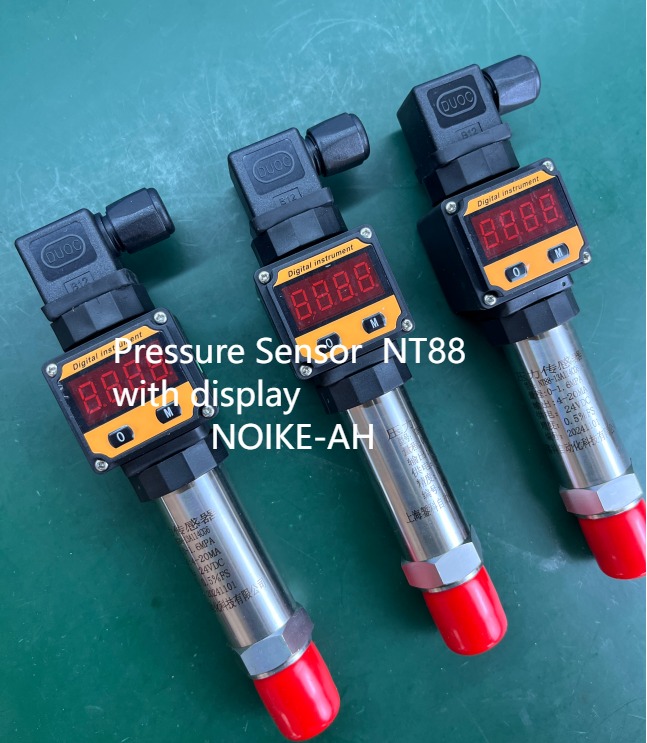
NOIKE-AH pressure products can be applied to pump systems for local pressure display, continuous monitoring and high / low pressure protection. The NOIKE-AH product line includes pressure sensors and transmitters with 4–20mA / HART / Modbus output capabilities. (Noike-AH)
Recommended approach:
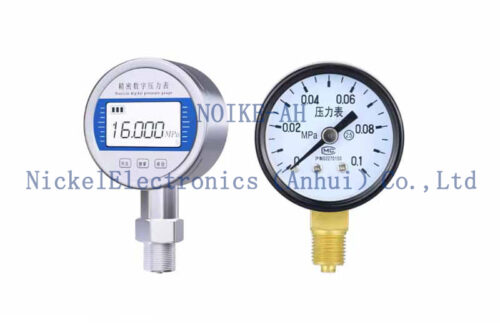
- use a digital pressure gauge for local pressure display;
- use a pressure transmitter for continuous pressure feedback to PLC / VFD / control panel;
- use an intelligent pressure switch for high / low pressure alarm;
- add a snubber or pressure limiting device when water hammer or pulsation is present.
Product Combination
| Application | Recommended Solution | Function |
|---|---|---|
| Local pressure reading | Digital Pressure Gauge | On-site display |
| Pump discharge monitoring | Pressure Transmitter | Continuous pressure signal |
| High pressure alarm | Intelligent Pressure Switch | Overpressure alarm and interlock |
| Pulsating pressure | Gauge / Transmitter + snubber | Protect the instrument |
| Water hammer | Instrument + pressure limiting device | Reduce overpressure damage |
| High-reliability pump set | Transmitter + Switch + Digital Gauge | Monitoring, alarm and display |
Conclusion
Incorrect pressure range selection is a common reason why pressure gauges operate over range and fail early in pump systems. Proper selection requires more than knowing the normal operating pressure. It should also include maximum pressure, pulsation, water hammer, pump shut-off pressure, valve action and relief valve settings.
NOIKE-AH recommends using a digital pressure gauge for local display, a pressure transmitter for continuous pressure monitoring and an intelligent pressure switch for alarm and protection. In systems with water hammer or pressure pulsation, a snubber, pulsation dampener or pressure limiting device should be added to reduce instrument damage and after-sales misjudgment.



