
Pressure Gauges Direct Answer
Reciprocating pumps, diaphragm pumps, plunger pumps and metering pumps generate periodic pressure pulsation during operation. When a standard mechanical pressure gauge is installed directly at these pulsating pressure points, the pointer moves rapidly, and the internal movement, gears, Bourdon tube and connections are repeatedly stressed. Over time, the gauge may become inaccurate, fail to return to zero, lose the pointer, suffer Bourdon tube fatigue or fail completely.
WIKA explains that pressure pulsation causes a standard Bourdon tube gauge pointer to flutter wildly, making readings difficult. If a gauge undergoes prolonged pulsation, internal components wear down from constant movement, shortening instrument life; in severe cases, the pointer breaks or detaches.
Why These Pumps Create Pulsating Pressure
Unlike centrifugal pumps, reciprocating, diaphragm, plunger and metering pumps discharge liquid in repeated cycles. Each piston stroke, diaphragm movement or plunger discharge creates a pressure rise and fall at the outlet.
| Equipment | Pulsation Source | Effect on Gauge |
|---|---|---|
| Reciprocating pump | Piston movement | Periodic pressure fluctuation |
| Diaphragm pump | Diaphragm discharge cycle | Fast pointer flutter |
| Plunger pump | High-pressure plunger discharge | Pressure peaks and pulses |
| Metering pump | Small-flow high-frequency discharge | Unstable reading and fatigue |
| Compressor system | Compression and unloading | Repeated pressure impact |
| Hydraulic system | Valve shifting and pump pressure changes | Signal jumping and gauge wear |
WIKA lists pulsation, mechanical vibration, pressure spikes, overpressure, corrosion and clogging as common causes of pressure gauge failure.
Why Standard Gauges Fail Quickly
A standard mechanical pressure gauge includes a Bourdon tube, movement, gears, pointer and dial. Under stable pressure, these components work normally. Under pulsating pressure, they are forced to move rapidly and repeatedly.
Typical failure modes include:
- severe pointer flutter;
- unreadable pressure value;
- movement and gear wear;
- Bourdon tube fatigue;
- pointer shift or failure to return to zero;
- repeated gauge replacement;
- output instability if a sensor is installed at the same point.
Ashcroft notes that pulsation and vibration can cause pointer flutter, difficult readings and gauge movement damage. If pointer movement reaches 5% or more of full-scale range, corrective action should be considered.
How to Identify Pulsation-related Gauge Failure
| Field Symptom | Likely Cause |
|---|---|
| Pointer moves rapidly back and forth | Cyclic pressure pulsation |
| Pointer oscillates within a pressure range | Pump discharge rhythm affects reading |
| Gauge does not return to zero | Internal movement or Bourdon tube fatigue |
| New gauges fail quickly | The application, not just the gauge, is the issue |
| Reading is only a rough range | Standard mechanical gauge is unsuitable |
| Pointer jumps during pump start-stop | Pulsation plus water hammer |
| 4–20mA pressure signal jumps | Pulsation affects the transmitter signal |
If the mechanical gauge, digital gauge and PLC pressure value all fluctuate together, the system pressure is actually pulsating. If only the mechanical pointer shakes, the local gauge needs vibration damping or digital display improvement.
How to Extend Gauge Service Life
Add a snubber or pulsation dampener
In pulsating applications, the first step is not simply replacing the gauge. A pressure snubber, pulsation dampener or restrictor should be installed before the gauge or sensor.
A pulsation dampener protects measuring instruments from sudden pressure increases and fluctuations, stabilizing readings and extending service life.
Use a liquid-filled or vibration-resistant gauge
For vibration and light pulsation, liquid-filled gauges or dampened movement gauges can improve readability. WIKA notes that liquid filling or dampened movement helps minimize pointer oscillation in applications with vibration and pulsation.
However, in severe pulsation, liquid filling alone may not fully protect the Bourdon tube from fatigue. A snubber or pulsation dampener is still recommended.
Select the right range and overload capacity
Gauge range should not be selected only according to normal operating pressure. Pressure peaks, start-stop shocks and transient overpressure must also be considered.
Avoid the strongest pulsation point
Avoid installing the gauge directly after pump discharge, valves, elbows or check valves when a more stable tapping point is available. Remote mounting or capillary connection can help reduce direct vibration and pulsation.
Use a pressure transmitter for control
For pump control panels and automated pump systems, a pressure transmitter should provide continuous pressure feedback to PLC / VFD / control panel. The control system can apply filtering, trend monitoring and alarm logic.
NOIKE-AH Application Solution
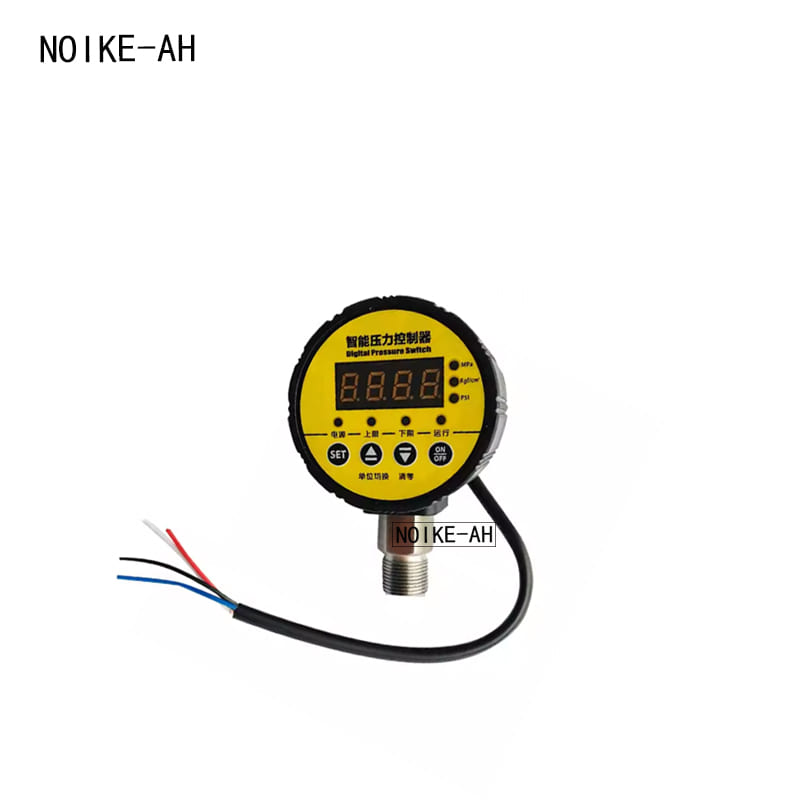
NOIKE-AH pressure products can be applied in pulsating pump systems for local indication, continuous pressure monitoring and pressure alarm.
NOIKE-AH’s Pressure Series includes pressure gauges, pressure switches, pressure sensors, pressure transmitters and differential pressure transmitters. The company also states that its pressure sensors and transmitters can support outputs such as 4–20mA / HART / Modbus. (Noike-AH)
For pulsating pressure applications:
- use a digital pressure gauge for local display;
- use a pressure transmitter for continuous pressure feedback;
- use an intelligent pressure switch for high / low pressure alarm;
- add a snubber or pulsation dampener before instruments in severe pulsation.
Product Combination
| Application | Recommended Solution | Function |
|---|---|---|
| Short gauge life | Digital pressure gauge + snubber | Improve readability and reduce shock |
| Diaphragm / metering pump outlet | Gauge + pulsation dampener | Reduce cyclic pressure impact |
| Plunger / high-pressure pump outlet | Transmitter + snubber | Protect diaphragm and stabilize signal |
| Control panel feedback | Pressure transmitter + PLC filtering | Continuous trend monitoring |
| High / low pressure alarm | Intelligent pressure switch + delay | Avoid false switching |
| High-reliability pump set | Transmitter + switch + digital gauge + dampener | Monitoring, alarm, display and protection |
Conclusion
In reciprocating pump, diaphragm pump and plunger pump applications, standard pressure gauges often fail early because they are exposed to repeated pressure pulsation and continuous pointer movement. Replacing the same type of gauge usually does not solve the root cause.
The correct approach is:
- confirm whether pressure pulsation exists;
- inspect failure signs such as zero shift, pointer damage or internal wear;
- install a snubber, pulsation dampener or restrictor;
- select a vibration-resistant gauge, digital gauge or pressure transmitter with suitable overload capacity;
- avoid the strongest pulsation point;
- use pressure transmitter feedback for trend monitoring.
NOIKE-AH recommends using a pressure transmitter for continuous pressure monitoring, an intelligent pressure switch for high / low pressure alarm and a digital pressure gauge for local display. In severe pulsation, a snubber or pulsation dampener should be added to reduce gauge damage, pressure signal fluctuation and after-sales misjudgment.



