
Electromagnetic vs. Vortex Flow Meter: How to Choose the Right Technology
Direct Answer
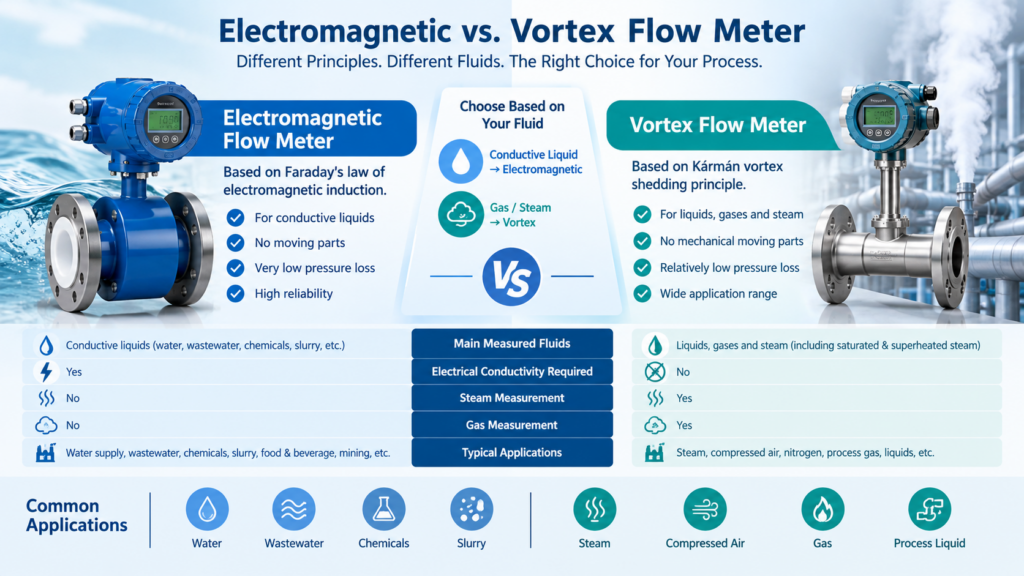
Electromagnetic and vortex flow meters are designed for different measurement conditions. An electromagnetic flow meter is generally the better choice for electrically conductive liquids, especially water, wastewater, chemicals, slurries, and other liquid applications where low pressure loss and no moving parts are important. A vortex flow meter is more versatile across liquids, gases, and steam, making it particularly useful for compressed air, natural gas, saturated steam, and superheated steam applications.
The most important selection factors are fluid state, electrical conductivity, flow range, temperature and pressure, installation conditions, and the required measurement output. The best flow meter is therefore determined by the process—not simply by accuracy or price.
Key Takeaways
- Electromagnetic flow meters require an electrically conductive fluid because their measurement principle is based on Faraday’s law of electromagnetic induction.
- Vortex flow meters can measure liquids, gases, and steam, making them suitable for a broader range of fluid types.
- Electromagnetic flow meters have no obstruction or moving parts inside the measuring tube, resulting in very low pressure loss.
- Vortex flow meters use a shedder bar to generate Kármán vortices and determine flow velocity from vortex frequency.
- For water, wastewater, conductive chemicals, and slurry, electromagnetic measurement is often a strong choice.
- For steam, compressed air, gas, and other non-conductive fluids, vortex technology is often more appropriate.
- Installation requirements, particularly straight pipe length and flow conditioning, should be evaluated before selecting either technology.
What Is an Electromagnetic Flow Meter?
An electromagnetic flow meter, also called a magnetic flow meter or magmeter, measures the flow velocity of electrically conductive fluids using Faraday’s law of electromagnetic induction.
When a conductive liquid passes through a magnetic field generated inside the flow tube, an electromotive force is induced. Electrodes detect this voltage, and the transmitter converts the signal into a flow-rate measurement. The induced voltage is proportional to the velocity of the conductive fluid.
Because the measuring tube does not require a mechanical rotor or turbine, electromagnetic flow meters can provide a relatively unobstructed flow path and very low pressure loss. This makes them particularly useful in applications where pressure loss and maintenance are concerns.
Typical Electromagnetic Flow Meter Applications
Electromagnetic flow meters are commonly considered for:
- Water supply
- Wastewater treatment
- Cooling water
- Process water
- Conductive chemicals
- Pulp and paper processes
- Slurry applications
- Food and beverage processes
- Mining and mineral processing
The key requirement is that the measured liquid must have sufficient electrical conductivity for the particular meter design. As one example, Endress+Hauser describes electromagnetic measurement for conductive liquids above 5 μS/cm, while Emerson specifies conductivity requirements that can vary by instrument configuration. Therefore, the manufacturer’s actual minimum conductivity specification should always be checked for the selected model.
What Is a Vortex Flow Meter?
A vortex flow meter measures flow by detecting the vortices generated when fluid passes a specially designed shedder bar installed in the flow path.
As fluid flows around the shedder bar, alternating vortices are generated downstream. This phenomenon is known as a Kármán vortex street. The frequency of vortex generation is related to fluid velocity, allowing the flow meter to calculate volumetric flow rate.
Unlike electromagnetic flow meters, vortex flow meters do not depend on the electrical conductivity of the fluid.
This allows vortex technology to be applied to:
- Industrial water
- Process liquids
- Compressed air
- Nitrogen and other gases
- Fuel gases
- Saturated steam
- Superheated steam
Vortex flow meters are therefore particularly useful when one plant needs to measure several different fluid categories, including liquid, gas, and steam.
Electromagnetic vs. Vortex Flow Meter: Key Differences
| Parameter | Electromagnetic Flow Meter | Vortex Flow Meter |
|---|---|---|
| Measurement principle | Faraday’s law | Kármán vortex shedding |
| Main measured fluids | Conductive liquids | Liquids, gases, steam |
| Electrical conductivity required | Yes | No |
| Steam measurement | No | Yes |
| Gas measurement | No | Yes |
| Moving parts | No | No mechanical moving parts |
| Internal obstruction | Measuring tube is unobstructed | Shedder bar is installed in flow path |
| Pressure loss | Very low | Relatively low |
| Slurry capability | Often suitable, depending on design | Application-dependent |
| Typical applications | Water, wastewater, chemicals, slurry | Steam, gas, compressed air, liquids |
| Main selection concern | Conductivity and liner/electrode compatibility | Flow velocity, Reynolds number and installation |
| Typical installation consideration | Grounding and flow profile | Straight pipe and flow conditioning |
The table provides a general technology comparison. Actual performance, accuracy, minimum flow, pressure rating, temperature range and installation requirements depend on the specific manufacturer’s model.
How Does an Electromagnetic Flow Meter Work?
The electromagnetic measurement process can be simplified into four steps:
1. A magnetic field is generated
Coils inside the flow meter generate a magnetic field across the measuring tube.
2. Conductive liquid passes through the field
When the conductive liquid moves through the magnetic field, an electrical voltage is induced.
3. Electrodes detect the voltage
Electrodes positioned in the measuring tube detect the induced signal.
4. The transmitter calculates flow rate
The measured electrical signal is processed and converted into a flow-rate output.
The basic relationship comes from Faraday’s law: the induced voltage is proportional to fluid velocity under the measurement conditions.
Because there is no rotating mechanical element, electromagnetic flow meters are well suited to many continuous industrial liquid-flow applications.
How Does a Vortex Flow Meter Work?
The operating process is different.
1. Fluid enters the measuring tube
The process fluid flows through the meter.
2. The fluid passes the shedder bar
A specially designed obstruction disturbs the flow.
3. Alternating vortices are generated
The disturbance creates alternating vortices downstream of the shedder bar.
4. The sensor detects the vortex signal
The sensor detects the resulting pressure or force changes associated with vortex shedding.
5. The transmitter calculates flow rate
The vortex frequency is converted into fluid velocity and then flow rate.
The fundamental principle is that the vortex frequency is related to flow velocity.
Which Flow Meter Is Better for Water?
For conductive water applications, an electromagnetic flow meter is often an excellent choice.
This is especially true for:
- Municipal water
- Industrial process water
- Cooling water
- Wastewater
- Conductive chemical solutions
The reason is straightforward: water applications usually fit the operating principle of electromagnetic measurement, and the absence of a mechanical obstruction through the measuring tube results in very low pressure loss.
However, conductivity should still be confirmed rather than assumed. Very low-conductivity liquids may require a different measurement technology or a specially designed electromagnetic meter.
Which Flow Meter Is Better for Steam?
For steam measurement, a vortex flow meter is generally the more appropriate choice between these two technologies.
Electromagnetic flow meters depend on electrical conductivity and are designed primarily for conductive liquids. Vortex flow meters, on the other hand, can measure both saturated and superheated steam.
Vortex technology is therefore widely used for:
- Boiler steam
- Process steam
- Steam distribution
- Energy management
- Steam consumption monitoring
- Utility systems
For steam applications, the engineer should evaluate pressure, temperature, flow velocity, steam condition, pipe size, and installation configuration before selecting the meter.
Which Flow Meter Is Better for Gas?
A vortex flow meter is generally the appropriate option for gas applications.
Examples include:
- Compressed air
- Nitrogen
- Fuel gas
- Process gas
- Industrial gases
Electromagnetic flow meters are not suitable for ordinary gas-flow measurement because their measurement principle requires a conductive fluid passing through the magnetic field. Vortex meters, by contrast, can measure gases because the measurement is based on vortex generation rather than electrical conductivity.
What About Slurry and Dirty Liquids?
This is an important area where application conditions matter.
Electromagnetic flow meters are often considered for slurry because the measuring tube can be designed without a rotating element or mechanical obstruction. Different liner and electrode materials can also be selected according to the process fluid.
However, electromagnetic measurement is not automatically immune to process disturbances. Bubbles, solids, sudden conductivity changes, and electrode coating can affect the measurement signal in certain applications.
Vortex meters can measure some liquid applications, but the presence of a shedder bar and the need to generate a stable vortex signal mean that the application must be evaluated carefully, particularly where solids, multiphase flow, strong pulsation, or severe flow disturbance are present.
For difficult slurry applications, do not select a flow meter based only on whether the meter is advertised as “suitable for slurry.” Check the actual fluid composition, solids concentration, particle size, viscosity, conductivity, velocity and manufacturer’s application limits.
Installation Considerations
Choosing the measurement principle is only the first step. Installation can have a major effect on measurement performance.
Electromagnetic Flow Meter Installation
The flow profile should be considered when installing an electromagnetic flow meter.
A commonly referenced installation arrangement is to provide straight pipe upstream and downstream of the meter. Emerson, for example, identifies five pipe diameters upstream and two downstream as a standard installation guideline for many magnetic flow meter applications, while specific products may permit different configurations.
Grounding is another important consideration.
If the adjacent pipe does not provide an adequate electrical connection to the process fluid—for example, with lined or non-conductive piping—grounding rings or a grounding electrode may be required depending on the meter design.
Therefore, an electromagnetic flow meter installation should consider:
- Upstream and downstream piping
- Pipe material
- Liner material
- Fluid conductivity
- Grounding method
- Electrode material
- Fluid temperature
- Fluid pressure
Vortex Flow Meter Installation
Vortex meters are particularly sensitive to the flow conditions required to generate a stable vortex pattern.
Elbows, valves, reducers, pumps and other disturbances can distort the velocity profile and influence vortex formation. Manufacturers therefore specify straight-pipe requirements according to the meter design and upstream disturbance.
Yokogawa specifically notes that an unbalanced velocity distribution and turbulence can disturb Kármán vortices and affect measurement accuracy.
When installing a vortex flow meter, check:
- Upstream straight pipe
- Downstream straight pipe
- Elbow orientation
- Valve location
- Reducer/expander configuration
- Pump location
- Flow velocity
- Fluid density
- Pipe diameter
Always follow the installation requirements of the selected flow meter rather than applying a universal straight-pipe number to every model.
How to Choose Between Electromagnetic and Vortex Flow Meter
A practical selection process can start with the following questions.
Step 1: What is the fluid?
Conductive liquid → Electromagnetic is usually a strong candidate.
Steam → Vortex is usually the more appropriate choice.
Gas → Vortex is usually the more appropriate choice.
Non-conductive liquid → Vortex or another technology may be considered.
Step 2: Is the liquid electrically conductive?
If yes, electromagnetic measurement becomes a strong option.
If no, an electromagnetic flow meter may not be suitable unless the selected instrument specifically supports the required conductivity range.
Step 3: Is pressure loss important?
If minimizing pressure loss is a major requirement, electromagnetic technology has an advantage because its measuring tube does not require a shedder bar or similar flow obstruction.
Step 4: Do you need to measure steam or gas?
If the answer is yes, vortex technology should be considered first among these two technologies.
Step 5: What is the operating flow range?
The meter must be sized according to the actual minimum, normal and maximum flow conditions.
For vortex meters, the flow velocity and Reynolds-number-related operating range are particularly important. Manufacturer sizing data should be used rather than selecting the meter only according to nominal pipe diameter.
Step 6: Check temperature and pressure
For high-temperature steam, high-pressure gas or other demanding applications, verify:
- Maximum operating temperature
- Maximum operating pressure
- Process connection
- Meter body material
- Sensor construction
- Environmental temperature
- Applicable standards
These values are model-specific and should not be generalized across all electromagnetic or vortex flow meters.
Quick Selection Guide
| Application | Recommended Starting Point |
|---|---|
| Conductive water | Electromagnetic |
| Wastewater | Electromagnetic |
| Conductive chemical liquid | Electromagnetic |
| Conductive slurry | Electromagnetic, subject to application review |
| Compressed air | Vortex |
| Nitrogen gas | Vortex |
| Process gas | Vortex |
| Saturated steam | Vortex |
| Superheated steam | Vortex |
| Non-conductive liquid | Vortex or another suitable technology |
| Application requiring very low pressure loss | Electromagnetic is often advantageous |
This is a technology-selection guide, not a substitute for instrument sizing.
Common Selection Mistakes
Mistake 1: Choosing by pipe size alone
A DN50 pipe does not automatically mean a DN50 meter is the correct selection.
The actual flow range and operating velocity must be considered.
Mistake 2: Ignoring fluid conductivity
A magnetic flow meter cannot simply be used for every liquid. Conductivity must meet the requirements of the selected instrument.
Mistake 3: Assuming all vortex meters work the same
Vortex meters differ in sensor design, minimum measurable flow, temperature range, pressure rating, accuracy specification and installation requirements.
Mistake 4: Ignoring upstream disturbances
Elbows, valves, pumps and reducers can affect the velocity profile.
This is particularly important for vortex measurement because stable vortex formation is fundamental to the measurement principle.
Mistake 5: Selecting accuracy before checking the process
A highly accurate instrument is not necessarily the right instrument if the measurement principle does not match the fluid.
Fluid compatibility should come first.
Recommended Instrument Selection Logic
For engineers selecting a flow meter, the following logic provides a practical starting point:
Conductive liquid?
→ Yes → Consider an electromagnetic flow meter
→ No → Continue evaluating other technologies
Gas or steam?
→ Yes → Consider a vortex flow meter
Liquid with very low conductivity?
→ Review vortex, ultrasonic, Coriolis or other applicable technologies depending on the process.
Slurry or abrasive liquid?
→ Evaluate electromagnetic technology and confirm liner/electrode compatibility, solids concentration and velocity.
The final selection should always be based on the complete process data rather than fluid name alone.
FAQ
Is an electromagnetic flow meter better than a vortex flow meter?
Neither technology is universally better. Electromagnetic flow meters are particularly suitable for conductive liquids, while vortex flow meters offer broader fluid compatibility and can measure liquids, gases and steam.
Can a vortex flow meter measure water?
Yes. Vortex flow meters can measure liquids, including water, provided the operating conditions meet the requirements of the selected meter.
Can an electromagnetic flow meter measure steam?
Generally, no. Conventional electromagnetic flow meters require a conductive fluid and are primarily used for liquid applications. Steam is normally not an appropriate application for electromagnetic measurement.
Can an electromagnetic flow meter measure oil?
Conventional electromagnetic flow meters are generally not suitable for non-conductive oils because the measurement principle requires sufficient electrical conductivity. A different flow measurement technology may be more appropriate.
Can a vortex flow meter measure gas?
Yes. Vortex flow meters can be used for various gases, including compressed air, nitrogen and fuel gas, when the operating conditions fall within the meter’s specified range.
Which flow meter has lower pressure loss?
An electromagnetic flow meter generally has very low pressure loss because there is no flow obstruction or moving element inside the measuring tube. Vortex meters also have relatively low pressure loss compared with throttling devices such as orifice plates, but they contain a shedder bar in the flow path.
Which flow meter is better for steam measurement?
A vortex flow meter is generally the better choice between these two technologies because vortex meters are designed to measure liquid, gas and steam, including saturated and superheated steam.
What information is needed to select an electromagnetic or vortex flow meter?
At minimum, provide:
- Fluid name
- Minimum/normal/maximum flow rate
- Pipe size
- Operating pressure
- Operating temperature
- Fluid density where relevant
- Fluid viscosity where relevant
- Conductivity for electromagnetic measurement
- Steam pressure and temperature for steam applications
- Installation conditions
- Required output signal
More complete process information allows the flow meter to be sized and configured more reliably.
Conclusion
The choice between an electromagnetic flow meter and a vortex flow meter should begin with the process fluid.
For conductive liquids, electromagnetic technology provides a strong combination of no moving parts, very low pressure loss and broad industrial applicability. For gas and steam, vortex technology provides a more suitable measurement principle and can also be applied to many liquid-flow applications.
The key question is therefore not:
“Which flow meter is better?”
It is:
“Which measurement principle is better suited to my fluid and operating conditions?”
By evaluating fluid type, conductivity, flow range, temperature, pressure, pipe size and installation conditions before selecting the meter, engineers can reduce the risk of measurement instability and avoid choosing a technology that is fundamentally unsuitable for the application.
Need Help Selecting the Right Flow Meter?
If you are comparing an electromagnetic flow meter vs. vortex flow meter for an industrial project, prepare your process data—including fluid, flow range, pipe size, pressure and temperature—and consult a professional flow measurement supplier for model selection and sizing.
NOIKE-AH provides industrial flow measurement solutions for flow, temperature, pressure and level applications.
For OEM/ODM requirements, customized flow measurement projects or technical selection support:
Contact the NOIKE-AH team with your process conditions to discuss the appropriate flow measurement solution.



