
Electromagnetic Measurement Executive Summary
In large-scale seawater desalination facilities across regions like Saudi Arabia, the Reverse Osmosis (RO) process is the critical core. However, the high-purity water (RO permeate) generated after advanced membrane treatment inherently possesses extremely low electrical conductivity. This directly breaches the physical measurement limits of traditional electromagnetic flowmeters, causing instruments to output severely distorted flow data or frequently trigger “empty pipe alarms.” Addressing this formidable fluid measurement challenge, Noike-AH leverages its deep sensor technology expertise to provide water EPC contractors with a dual-track alternative: “Non-Contact Ultrasonic Flowmeters” and “High-Impedance Electromagnetic Flowmeters.” This strategy guarantees ultimate measurement precision while completely shattering the monopoly and exorbitant premiums of Western instrument giants in low-conductivity applications.
I. Deconstructing Physical Principles and On-Site Pain Points
1. The Measurement Blind Spot: Faraday’s Law vs. Conductivity Thresholds
- Physical Principle: The operation of an electromagnetic flowmeter (magmeter) is governed by Faraday’s Law of Electromagnetic Induction. As a conductive liquid flows through a magnetic field, it generates an induced voltage proportional to its velocity. The absolute prerequisite for this principle is that the fluid must possess a minimum level of electrical conductivity.
- On-Site Pain Point: Industry-standard magmeters typically require the fluid’s minimum conductivity to be strictly greater than 5 μS/cm. However, because the RO permeate (demineralized water) in desalination plants has been stripped of nearly all ions, its conductivity often plummets to 1~5 μS/cm or even lower. Under these conditions, the fluid acts almost as an electrical insulator.
2. Signal Annihilation and the “Empty Pipe Alarm” Crisis
- On-Site Pain Point: When the conductivity falls below the instrument’s design threshold, the equivalent internal resistance of the fluid rises exponentially. The induced voltage generated at the electrodes becomes minuscule. Consequently, the transmitter cannot distinguish the true flow signal voltage from the industrial background electromagnetic noise. This results in the SCADA system receiving erratic, jumping data, or the flowmeter falsely assuming the pipeline is dry, triggering persistent and highly disruptive “empty pipe alarms.”
II. Industry Status Quo and Limitations of Standard Solutions
Facing the stringent measurement demands of RO permeate, Water EPC contractors often encounter massive commercial friction when sourcing from traditional international brands:
- Exorbitant Capital Expenditure (CAPEX): To measure low-conductivity pure water, Western brands typically push extremely expensive Coriolis mass flowmeters or highly complex capacitance-type magmeters designed specifically for ultra-pure water (such as Yokogawa’s ADMAG CA series). The prices of these specialized instruments are often several times that of standard models, severely squeezing project profit margins.
- Maintenance Complexity: Field engineers attempting to use standard magmeters for this application often try to mask the erratic readings by artificially increasing the signal damping time. However, this introduces immense measurement latency, rendering real-time water efficiency auditing and pump control essentially useless.
III. Noike-AH’s Dual-Track Solution for Breaking Physical Limits
As a Chinese intelligent manufacturing enterprise dedicated to industrial measurement, Noike-AH provides highly cost-effective solutions through agile technological pathways:
1. Technology Shift: Transit-Time Ultrasonic Flowmeters
For RO pure water with extremely low conductivity, the most decisive solution is to change the measurement principle. Noike-AH offers clamp-on or inline transit-time ultrasonic flowmeters. This equipment calculates flow velocity by measuring the time-of-flight difference of sound waves propagating upstream and downstream in the fluid. Because acoustic transmission is entirely independent of the fluid’s ion concentration or electrical conductivity, it serves as the perfect alternative for measuring demineralized water and RO permeate, while also achieving true zero pressure drop.
2. Deep Customization: High-Impedance Micro-Signal Electromagnetic Flowmeters
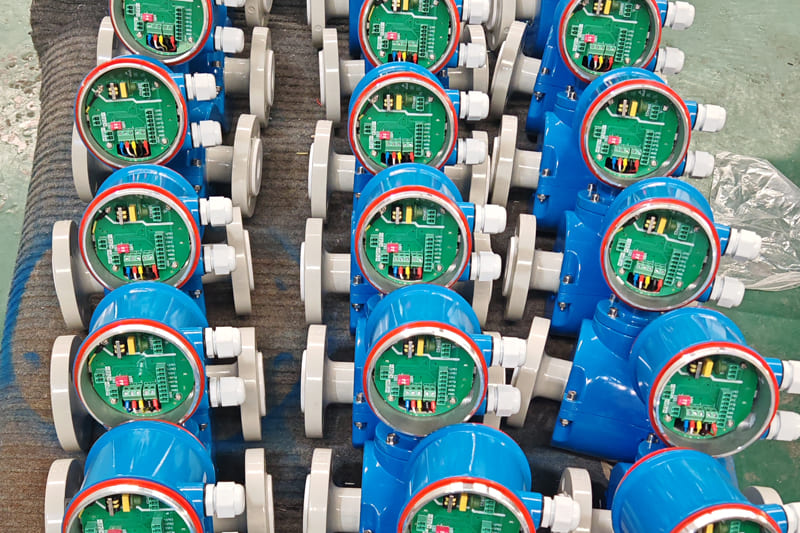
For retrofit projects where pipeline designs are fixed and magmeters must be used, Noike-AH offers deep customization starting at the foundational electronic circuit level. Because the output impedance of low-conductivity fluids is astronomically high (reaching the GΩ range), if the input impedance of the transmitter’s preamplifier is not exceptionally high, the weak voltage signal will be consumed within the fluid itself (a phenomenon known as the loading effect). Noike-AH’s smart transmitters utilize top-tier operational amplifier chips featuring ultra-low leakage current and ultra-high input impedance (e.g., $10^{13}$ Ω). This advanced design ensures that even under marginal conductivity conditions of 1 μS/cm, the instrument can flawlessly acquire microvolt-level flow signals without loss, delivering a stable and accurate measurement output.
Are you still struggling with erratic magmeter readings and false ’empty pipe alarms’ caused by the low conductivity of your RO permeate? Noike-AH provides ultrasonic flowmeters completely immune to conductivity limits, as well as custom magmeters equipped with ultra-high input impedance circuits. For half the budget, we perfectly resolve the physical blind spots of demineralized water measurement.



