How to Choose a Flow Meter for Low-Flow Applications: A Practical Selection Guide
Direct Answer
Choosing a flow meter for low-flow applications requires matching the instrument’s measurement principle and calibrated range to the actual minimum, normal, and maximum flow rates. Fluid properties, required accuracy, turndown ratio, pressure drop, operating pressure, temperature, and installation conditions must also be considered.
For low-flow liquid measurement, Coriolis mass flow meters and positive displacement meters, including micro gear flow meters, may be suitable depending on the required accuracy, viscosity, and flow range. For low-flow gas measurement, thermal mass flow meters and other dedicated low-flow gas instruments may be appropriate. No single technology is suitable for every application, so selection should be based on verified operating conditions and the manufacturer’s technical specifications.
Key Takeaways
- Start with the actual flow range: Specify minimum, normal, and maximum flow rather than selecting a meter based only on pipe diameter.
- Match the measurement principle to the medium: Liquid and gas applications often require different technologies.
- Evaluate low-end accuracy: A meter’s headline accuracy does not necessarily represent its performance near the minimum measurable flow.
- Check pressure drop: Small-bore meters and internal measuring elements can affect the available process pressure, particularly in low-flow dosing systems.
- Verify the complete operating conditions: Fluid compatibility, viscosity, temperature, pressure, installation, signal output, and calibration requirements all influence the final selection.
1. What Is a Low-Flow Flow Meter?
A low-flow flow meter is an instrument designed to measure relatively small quantities of liquid or gas passing through a process line over a specified period.
Low-flow measurement is common in applications where the process requires controlled dosing, precise material consumption monitoring, small-volume transfer, or continuous measurement of gas supplied at a low rate.
There is no universal flow-rate threshold that defines every low-flow application. A flow rate considered low for a large industrial pipeline may be normal for a laboratory instrument or a microfluidic system. The appropriate measurement range depends on the medium, measuring principle, instrument size, and process requirements.
Typical application areas include:
- Chemical additive and reagent dosing
- Lubricating oil and hydraulic system monitoring
- Fuel consumption measurement
- Pharmaceutical and laboratory fluid delivery
- Small-scale production and pilot plants
- Compressed gas and specialty gas monitoring
- Cooling and circulation systems with low flow rates
- OEM equipment requiring compact flow measurement components
In these applications, an unsuitable meter can produce unstable readings, excessive measurement error, delayed control responses, or insufficient resolution.
The objective is not simply to find a meter with a small nominal size. It is to select an instrument that can reliably measure the required flow range under the actual process conditions.
2. Why Is Low-Flow Measurement Challenging?
Measuring low flow can be more demanding than measuring moderate or high flow because small changes in the process or measuring system can represent a significant proportion of the measured value.
2.1 The measurement signal may be small
Some flow meters rely on flow velocity, differential pressure, rotor movement, or another physical effect to generate a measurement signal. At low flow rates, that signal may approach the instrument’s detection or operating threshold.
For example, differential-pressure flow measurement relies on a pressure difference generated by a primary element. Under the applicable measurement conditions, differential pressure is approximately proportional to the square of flow rate. As flow decreases, the pressure signal decreases rapidly, making low-end measurement more challenging.
Other technologies have different limitations. A turbine meter may become less reliable when rotor friction becomes significant relative to the driving force, while a vortex meter may not generate a sufficiently stable detectable vortex signal below its specified operating range.
2.2 Small absolute errors can become large relative errors
Consider a dosing system with a target flow of 10 mL/min.
An absolute measurement error of 0.5 mL/min represents 5% of the target flow. The same absolute error at 100 mL/min represents only 0.5%.
This illustrates why the error specification must be evaluated at the intended operating point rather than by considering the headline accuracy alone.
2.3 Fluid properties can affect performance
Viscosity, density, conductivity, temperature, and gas content influence different flow measurement technologies in different ways.
For example:
- High viscosity can increase pressure drop through a small-bore meter.
- Entrained gas can disturb liquid flow measurement and affect some meter types more than others.
- Changes in gas composition may affect the calibration basis of thermal mass flow meters.
- Temperature changes can alter fluid density and viscosity and may affect the meter’s zero stability or calibration.
The relevant effects depend on the measuring principle and the specific instrument design.
2.4 Installation and process stability matter
At low flow, pulsating pumps, partially closed valves, trapped air, leakage, vibration, and unstable supply pressure can make the measured flow fluctuate.
A flow meter cannot automatically compensate for every process disturbance. Before replacing an instrument, engineers should distinguish between a meter limitation and an actual instability in the process.
3. Which Flow Meter Is Best for Low-Flow Applications?
The best choice depends primarily on whether the medium is liquid or gas, the required flow range, and the measurement objective.
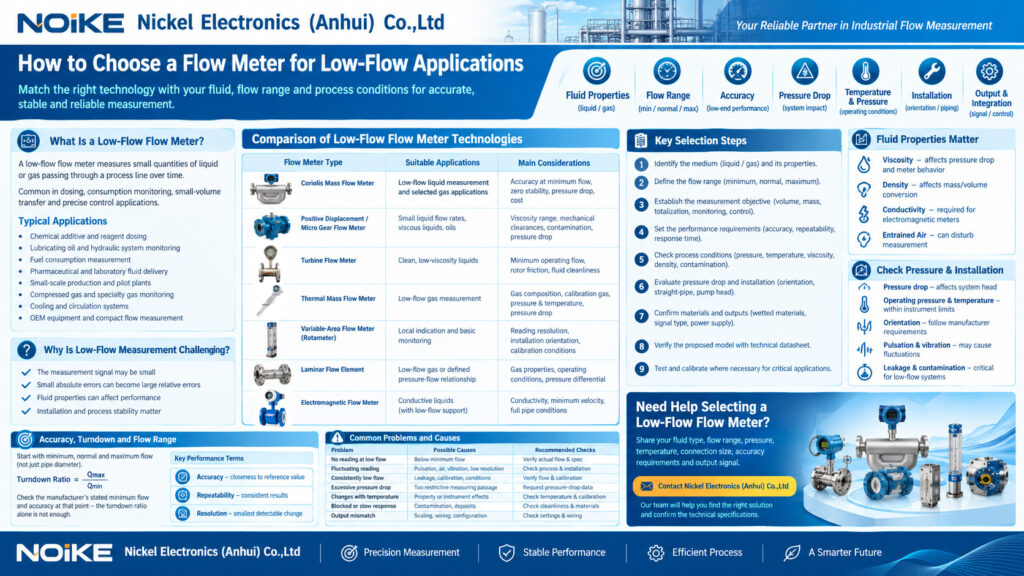
The following comparison is intended as a preliminary selection guide. Actual performance must be confirmed using the specifications of the proposed instrument.
| Flow meter type | Suitable applications | Main considerations |
|---|---|---|
| Coriolis mass flow meter | Low-flow liquid measurement and selected gas applications requiring direct mass measurement | Accuracy at the minimum flow, zero stability, pressure drop, cost |
| Positive displacement or micro gear flow meter | Small liquid flow rates, particularly compatible oils and other viscous liquids | Viscosity range, mechanical clearances, contamination, pressure drop |
| Low-flow turbine flow meter | Clean, relatively low-viscosity liquids within the calibrated range | Minimum operating flow, rotor friction, fluid cleanliness |
| Thermal mass flow meter | Low-flow gas measurement | Gas composition, calibration gas, operating pressure and temperature |
| Variable-area flow meter | Local indication and basic monitoring of compatible liquid or gas flows | Reading resolution, installation orientation, calibration conditions |
| Laminar flow element or dedicated laminar-flow meter | Selected low-flow gas measurement and applications requiring a defined pressure-flow relationship | Gas properties, operating conditions, pressure differential and calibration |
| Electromagnetic flow meter | Electrically conductive liquids, provided the selected model supports the required low flow | Conductivity, minimum measurable velocity, full-pipe conditions |
3.1 Coriolis mass flow meters
A Coriolis flow meter measures mass flow using the interaction between flowing fluid and vibrating measuring tubes.
It can be a strong candidate when an application requires accurate mass-flow measurement, repeatable dosing, or measurement that is less dependent on fluid density changes than a purely volumetric measurement.
Potential applications include chemical dosing, liquid ingredient delivery, and selected small-flow process systems.
However, not every Coriolis meter is suitable for every low-flow application. Engineers should check the specified minimum flow, zero stability, accuracy at the required operating point, pressure drop, fluid compatibility, and installation requirements.
For very small flow rates, the instrument’s zero stability may be particularly important because a fixed zero-related error can become a substantial proportion of the measured flow.
3.2 Positive displacement and micro gear flow meters
Positive displacement meters measure fluid by repeatedly separating and counting defined volumes. Micro gear flow meters use rotating gear elements to measure small quantities of liquid.
They may be suitable for compatible lubricating oils, hydraulic fluids, fuel-related applications, and other liquids where the viscosity and cleanliness fall within the instrument’s specified limits.
Advantages can include good repeatability and suitability for certain viscous liquids.
Selection considerations include:
- Minimum and maximum flow rate
- Fluid viscosity at operating temperature
- Wetted-material compatibility
- Maximum operating pressure and temperature
- Permissible contamination and particle size
- Pressure drop across the meter
- Required output signal and calibration
Viscosity does not affect every positive displacement design in the same way. Internal leakage, mechanical friction, and pressure drop can change with operating conditions. The manufacturer’s specified viscosity range and calibration conditions must therefore be checked.
A micro gear flow meter should not be assumed to be suitable for water, corrosive chemicals, or particle-laden liquids without confirming the design requirements.
3.3 Low-flow turbine meters
Turbine flow meters use a rotor driven by the flowing medium. Rotor movement is converted into an electrical signal related to flow rate.
They can be considered for clean, relatively low-viscosity liquids when the flow remains within the meter’s calibrated operating range.
At low flow, rotor friction and the meter’s starting threshold become important. If the flow is below the specified minimum, the rotor may not respond consistently, potentially causing under-registration or unstable readings.
Turbine meters are therefore not automatically the best option just because they offer a compact design or a relatively low purchase cost.
3.4 Thermal mass flow meters for gases
Thermal mass flow meters determine gas flow from heat transfer between a heated sensor and the moving gas, with the precise implementation depending on the instrument design.
They are often considered for low-flow gas measurement, including compressed air and selected industrial gases.
Important selection factors include:
- Gas type and composition
- Required flow units and reference conditions
- Operating pressure and temperature
- Minimum detectable flow
- Calibration gas and gas-property compensation
- Pressure drop and installation requirements
A thermal mass flow meter calibrated for one gas should not automatically be assumed to provide the same accuracy for another gas. Gas composition and thermal properties can affect the measurement.
For applications involving changing gas mixtures, wet gas, or gases containing contaminants, the manufacturer’s compatibility and performance requirements must be reviewed carefully.
3.5 Variable-area flow meters
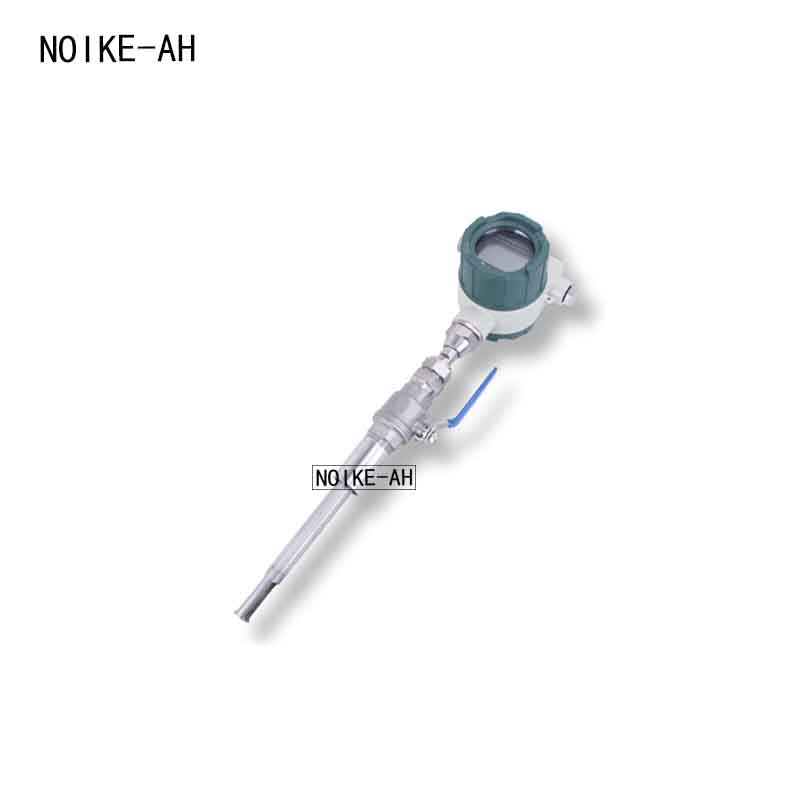
Variable-area flow meters, commonly called rotameters, measure flow through the position of a float within a tapered measuring tube.
They are useful for local indication and straightforward monitoring where the required accuracy and reading resolution are compatible with the selected instrument.
However, scale readings depend on the specified fluid and operating conditions. Changes in gas density, liquid properties, pressure, or temperature may require an appropriate scale or correction.
For applications requiring automated control, data logging, or remote monitoring, confirm whether the selected model includes a suitable electrical output or whether an additional device is needed.
4. How to Select a Flow Meter by Flow Range
Flow range is one of the most important parameters in low-flow instrument selection.
Before contacting a supplier, identify three operating points:
- Minimum flow: The lowest flow the system must measure reliably.
- Normal flow: The typical operating flow under routine conditions.
- Maximum flow: The highest expected flow during operation, including relevant operating variations.
For example, a dosing process might require a normal flow of 20 mL/min, with operation ranging from 5 to 30 mL/min. These values are illustrative only and do not represent a universal instrument specification.
The selected meter must support the entire required range while meeting the accuracy and repeatability requirements at the normal and minimum operating points.
4.1 Understand turndown ratio
Turndown ratio, also called rangeability in some contexts, describes the ratio between the maximum and minimum flow rates over which a meter can operate under a defined performance specification.
It is calculated as:
[
\text{Turndown Ratio}=\frac{Q_{\max}}{Q_{\min}}
]
For example, a specified operating range of 5 to 50 L/h has a nominal turndown ratio of 10:1.
However, a quoted turndown ratio is useful only when its performance conditions are understood. The meter may not maintain the same accuracy, repeatability, or response characteristics across the entire range.
Always verify the manufacturer’s stated minimum flow and accuracy at that flow. Do not infer low-end performance from the turndown ratio alone.
4.2 Avoid oversizing and undersizing
An oversized meter may operate too close to its lower measurement threshold during normal operation. An undersized meter may exceed its maximum flow capacity or create unacceptable pressure drop.
The appropriate meter size is therefore determined by the required flow range and process conditions, not simply by matching the nominal pipe diameter.
For a small-flow process line, a meter with a smaller measuring passage may be appropriate, but the pressure loss and maximum operating flow must also be checked.
5. How Accurate Does a Low-Flow Meter Need to Be?
The required accuracy should be determined by the process objective.
For example, an instrument used to confirm that coolant is flowing may have different requirements from one used to dispense a costly chemical ingredient or verify a small fuel consumption rate.
Three performance specifications should be distinguished.
Accuracy describes how close a measurement is to the reference value under specified conditions.
Repeatability describes how consistently the instrument produces the same result when measuring the same condition under comparable circumstances.
Resolution describes the smallest change in the measured value that the instrument can display or distinguish.
A meter may have a display with many decimal places without providing equivalent measurement accuracy.
5.1 Check the accuracy specification carefully
Manufacturers may express accuracy as a percentage of reading, a percentage of full scale, or a combination of terms, depending on the instrument.
These expressions are not interchangeable.
For example, an error specified as a percentage of full scale can represent a much larger percentage of the actual reading when the meter operates near the bottom of its range.
Before selecting a meter, verify:
- The stated accuracy basis
- The specified measurement range
- The minimum flow at which the accuracy applies
- Repeatability and response time, where relevant
- Zero stability for technologies where it is significant
- Calibration conditions and any applicable limitations
For critical dosing applications, a calibration or verification procedure that reflects the actual operating range may be necessary.
6. How Fluid Properties Affect Low-Flow Meter Selection
The properties of the measured medium influence both compatibility and measurement performance.
6.1 Liquid viscosity
Viscosity is particularly important in low-flow liquid systems.
A viscous liquid flowing through a small passage can produce a higher pressure drop than a less viscous liquid under comparable conditions. Viscosity can also affect the behavior of mechanical measuring elements and internal leakage in positive displacement meters.
For oil, grease-compatible fluids, resins, or other viscous media, confirm the viscosity range at the actual operating temperature rather than relying on a room-temperature value.
6.2 Fluid density
Density is important when converting between mass flow and volumetric flow:
[
\dot{m}=\rho Q
]
Where:
- (\dot{m}) is mass flow rate.
- (\rho) is fluid density.
- (Q) is volumetric flow rate.
If density changes with temperature, pressure, or composition, the relationship between mass flow and volumetric flow also changes.
This distinction matters when a process specification is expressed in kg/h but the instrument measures volume, or when volumetric readings must be converted to mass.
6.3 Electrical conductivity
Electromagnetic flow meters require an electrically conductive liquid. They are not suitable for gas measurement and are generally unsuitable for nonconductive liquids such as many oils.
Even for conductive liquids, the selected model must support the required low-flow conditions and maintain reliable measurement under the actual installation conditions.
6.4 Entrained air and gas bubbles
Air or gas bubbles in a liquid line can disturb the measurement and may affect different technologies in different ways.
In dosing systems, verify whether the liquid is fully filled, whether air can enter the line, and whether the pump introduces pulsation or gas entrainment.
Where necessary, investigate air removal, pump selection, and piping arrangements before assuming the meter itself is defective.
7. Check Pressure Drop and Operating Pressure
Low-flow systems frequently use small pumps, narrow tubing, precision dosing equipment, or pressure-sensitive process lines. The flow meter’s pressure drop can therefore be a significant selection factor.
Pressure drop is the difference in pressure across the instrument under a given flow condition.
The allowable pressure drop depends on the available pump head, upstream pressure, downstream pressure, fluid properties, and the operating requirements of the process.
When evaluating a meter, request pressure-drop data at both normal and maximum flow, using the relevant fluid properties where available.
Also verify:
- Maximum allowable operating pressure
- Minimum and maximum operating temperature
- Pressure rating of the meter body and connections
- Compatibility of seals and wetted materials
- Whether pulsation or pressure fluctuations affect the intended measurement
A meter that meets the nominal flow requirement may still be unsuitable if it causes excessive pressure loss or cannot withstand the required operating pressure.
8. Installation Requirements for Low-Flow Measurement
Correct installation is essential for obtaining reliable measurements.
The required installation arrangement depends on the measuring principle and the manufacturer’s instructions.
8.1 Install the meter in the correct orientation
Some meters can operate in multiple orientations, while others have specific mounting requirements.
For liquid service, ensure the meter is installed in a way that supports the manufacturer’s requirements for a full measuring passage and helps prevent unwanted gas accumulation.
For gas service, check whether the installation orientation affects drainage, contamination exposure, or sensor performance.
8.2 Consider pump pulsation and flow stability
Positive displacement pumps, dosing pumps, and other equipment can create pulsating flow.
If the meter measures instantaneous flow, the displayed value may fluctuate even when the average delivered quantity is acceptable.
Where pulsation is present, assess whether the process requires a pulsation dampener, suitable control logic, signal filtering, or a measurement technology compatible with the operating pattern.
Any additional component must be checked for compatibility with the fluid, pressure, and response requirements.
8.3 Follow straight-pipe requirements where applicable
Some flow meters require specified upstream and downstream straight-pipe lengths to reduce the effects of disturbed flow profiles.
Other technologies may have different or less restrictive requirements.
Do not apply a single straight-pipe rule to every meter. Follow the installation guidance for the selected model, especially where valves, elbows, reducers, pumps, or other disturbances are close to the measuring point.
8.4 Check for leakage and contamination
In very low-flow systems, a small leak can represent a significant proportion of the intended flow. Contamination can also obstruct small passages or affect moving components.
Before commissioning, verify connection integrity, fluid cleanliness requirements, and any filtration requirements specified for the instrument.
9. Output Signals and System Integration
A flow meter must provide information in a format that the connected control or monitoring system can use.
Depending on the model, available outputs may include:
- Analog current output, such as 4–20 mA
- Pulse or frequency output
- Digital communication, such as RS485 with a supported protocol
- Local display
- Switching output for flow monitoring or alarm functions
These are possible output types, not features available on every low-flow meter.
For low-flow applications, verify the relationship between the flow range and the output scaling. For example, an analog output configured for a large full-scale flow may provide insufficient useful resolution for a process that normally operates at a small fraction of that range.
Also confirm whether the application requires instantaneous flow, totalized quantity, flow status, or closed-loop control.
If a controller uses the flow signal to regulate a dosing pump or valve, consider the instrument’s response time, signal filtering, and the dynamics of the complete process.
10. Common Low-Flow Measurement Problems and Their Causes
| Observed problem | Possible causes | Recommended checks |
|---|---|---|
| No reading at very low flow | Flow below the instrument’s minimum operating threshold | Verify actual flow and specified minimum flow |
| Reading fluctuates continuously | Pump pulsation, unstable pressure, entrained gas, vibration, or insufficient measurement resolution | Check process stability, installation, and instrument suitability |
| Measured flow is consistently low | Leakage, unsuitable calibration, operating conditions outside the specified range, or technology-specific limitations | Verify the flow independently and review the calibration basis |
| Excessive pressure drop | Measuring passage too restrictive for the flow and fluid conditions | Request pressure-drop data and reassess meter sizing |
| Reading changes with temperature | Changes in fluid properties or instrument characteristics | Verify operating temperature, calibration conditions, and compensation requirements |
| Meter becomes blocked or responds slowly | Contamination, deposits, unsuitable fluid compatibility, or restricted passages | Inspect fluid cleanliness requirements and wetted materials |
| Output does not match the displayed value | Incorrect output scaling, configuration, wiring, or signal interpretation | Check the configured range, wiring, and control-system settings |
These symptoms do not necessarily indicate a defective meter. Reliable troubleshooting begins with confirming the actual process flow and checking whether the instrument is being operated within its specified conditions.
11. Recommended Selection Process for Low-Flow Applications
Use the following sequence to narrow down the appropriate instrument.
Step 1: Identify the medium. Determine whether the process involves liquid, gas, or another phase. Record the fluid name and relevant properties.
Step 2: Define the flow range. Specify minimum, normal, and maximum flow rates, including the units.
Step 3: Establish the measurement objective. Decide whether the application requires volumetric flow, mass flow, totalized quantity, monitoring, or dosing control.
Step 4: Set the performance requirements. Define acceptable accuracy, repeatability, response time, and low-end measurement performance.
Step 5: Check the process conditions. Record pressure, temperature, viscosity, density where relevant, and any known contamination or gas entrainment.
Step 6: Evaluate pressure drop and installation. Confirm available pump head, pipe connections, mounting orientation, and required straight-pipe lengths.
Step 7: Confirm materials and outputs. Verify wetted-material compatibility, sealing materials, power supply, signal type, and control-system integration.
Step 8: Verify the proposed model. Compare the manufacturer’s technical datasheet with all required operating conditions. Request application-specific confirmation if the minimum flow, accuracy, or fluid compatibility is unclear.
Step 9: Validate performance where necessary. For critical dosing or process control, consider testing under representative operating conditions and establishing an appropriate calibration or verification procedure.
12. Which Low-Flow Meter Should You Choose?
The following recommendations provide a starting point for selecting a technology.
- For accurate low-flow liquid dosing: Consider a suitably sized Coriolis mass flow meter or a compatible positive displacement meter. The final choice depends on the accuracy requirement, fluid properties, pressure drop, and budget.
- For low-flow viscous liquids: Consider a micro gear or other positive displacement meter when the fluid is compatible with the measuring mechanism and its viscosity falls within the specified range.
- For clean, low-viscosity liquids: A low-flow turbine meter may be appropriate if the minimum operating flow and required performance are satisfied.
- For low-flow gas measurement: Consider a thermal mass flow meter or a dedicated low-flow gas instrument based on gas composition, operating pressure, calibration, and the required flow range.
- For local visual monitoring: A variable-area flow meter may be suitable where its reading resolution and accuracy meet the process requirements.
- For conductive liquid monitoring: An electromagnetic flow meter may be suitable if the selected model supports the required flow rate and installation conditions.
These are technology-level recommendations rather than model-specific approvals. A final selection requires verification against the actual process data and manufacturer specifications.
Frequently Asked Questions
1. What is the best flow meter for low-flow applications?
There is no single best flow meter for all low-flow applications. Coriolis meters and positive displacement meters are candidates for low-flow liquids, while thermal mass meters are commonly considered for low-flow gases. The appropriate choice depends on the fluid, flow range, accuracy, pressure drop, and operating conditions.
2. How do I select the correct size for a low-flow meter?
Start with the minimum, normal, and maximum required flow rates rather than the pipe diameter alone. Confirm that the normal operating point falls within the meter’s specified performance range and that the maximum flow does not create unacceptable pressure drop or exceed the instrument’s capacity.
3. Why is my flow meter inaccurate at low flow rates?
Possible causes include operating below the meter’s minimum specified flow, unsuitable meter sizing, inadequate resolution, zero-related error, calibration mismatch, pump pulsation, entrained gas, leakage, or incorrect installation. The cause should be established by checking the actual flow and reviewing the instrument’s technical specifications.
4. Can a micro gear flow meter measure water?
Suitability depends on the specific meter design, water properties, required flow range, and calibration. A meter designed primarily for viscous oils should not automatically be assumed to perform equally well with water. Confirm the manufacturer’s specified fluid compatibility, minimum flow, and accuracy.
5. Are thermal mass flow meters suitable for liquids?
Thermal mass flow meters designed for gas measurement should not be assumed to be suitable for liquids. Liquid flow measurement requires an instrument specifically designed and calibrated for the intended medium.
6. What is the difference between mass flow and volumetric flow?
Volumetric flow describes the volume of fluid passing a measurement point per unit time. Mass flow describes the mass passing that point per unit time. The two are related through fluid density, so the relationship can change when density changes.
7. Does a smaller flow meter always provide better low-flow accuracy?
No. A smaller meter may improve the operating position within the measurement range, but it can also increase pressure drop or introduce other limitations. The correct size must satisfy the required flow range, accuracy, pressure rating, fluid compatibility, and installation conditions.
8. What information should I provide when requesting a low-flow meter quotation?
Provide the fluid name, minimum/normal/maximum flow, operating pressure, temperature, viscosity where relevant, pipe size, connection type, required accuracy, wetted-material requirements, output signal, and installation conditions. Also state whether the process requires mass flow, volumetric flow, totalization, or automated control.
Conclusion
Selecting a flow meter for low-flow applications requires more than choosing an instrument with a small nominal size. Reliable performance depends on matching the measurement principle, calibrated flow range, fluid properties, pressure drop, accuracy requirements, and installation conditions.
Coriolis mass flow meters, micro gear flow meters, turbine meters, thermal mass flow meters, and variable-area instruments each have potential applications, but their suitability must be confirmed against the actual process requirements.
For engineers and equipment manufacturers, the most effective approach is to define the operating conditions first and then evaluate the available technologies using verified technical specifications.
Need Help Selecting a Low-Flow Flow Meter?
NOIKE-AH provides industrial flow measurement solutions for different process and equipment requirements. To identify a suitable configuration, share your fluid type, required flow range, operating pressure and temperature, connection size, accuracy requirements, and output signal.
Contact the NOIKE-AH team to discuss your application and confirm the relevant technical specifications before selecting a flow meter.