How to Choose a Flow Meter for Corrosive Liquids: A Practical Selection Guide
Direct Answer
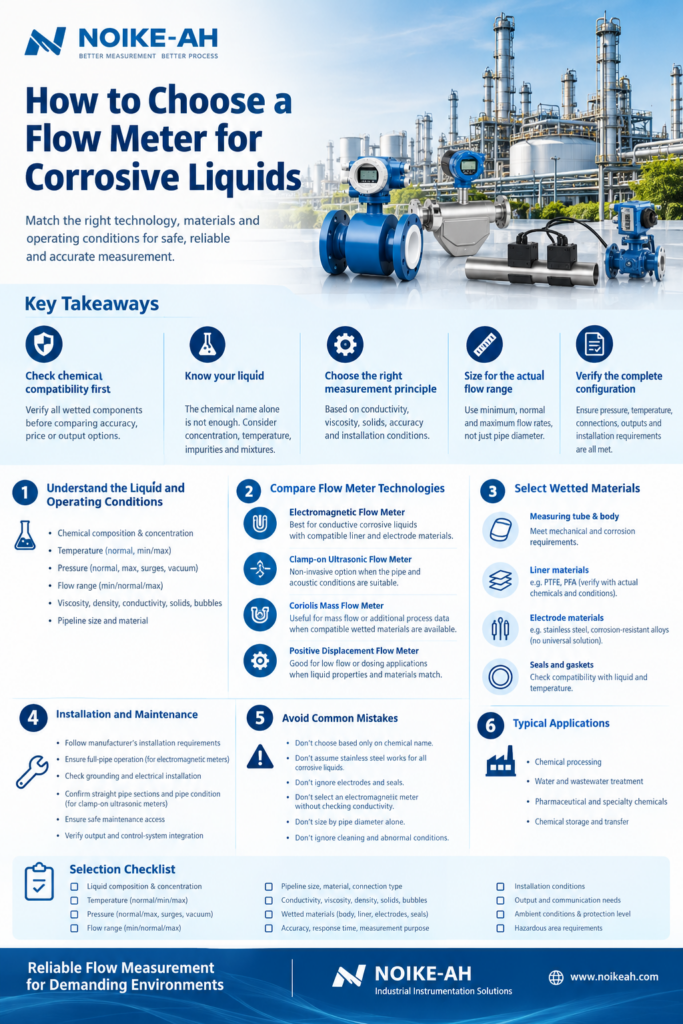
Choosing a flow meter for corrosive liquids requires matching the meter’s measuring principle and wetted materials to the chemical composition, concentration, operating temperature, pressure, and flow characteristics of the liquid. Chemical compatibility should be verified before comparing accuracy, price, or output options.
Electromagnetic flow meters are often suitable for electrically conductive corrosive liquids when the liner and electrode materials are compatible with the process medium. Clamp-on ultrasonic flow meters may be an alternative when non-invasive measurement is preferred, provided the pipe and fluid conditions support reliable ultrasonic transmission. Other technologies, including Coriolis and positive displacement flow meters, may be appropriate for specific applications after their wetted materials and operating limits have been confirmed.
Key Takeaways
- Check chemical compatibility first: Evaluate every wetted component, including the measuring tube, liner, electrodes, seals, gaskets, and fittings.
- Identify the liquid’s actual properties: Chemical name alone is insufficient. Concentration, temperature, impurities, and mixtures can significantly affect material compatibility.
- Select the appropriate measuring principle: Conductivity, viscosity, solids content, required accuracy, and installation conditions determine which technology is suitable.
- Size the meter using the actual flow range: Confirm minimum, normal, and maximum flow rates rather than selecting solely by pipeline diameter.
- Verify the complete configuration: Pressure and temperature ratings, connections, output signals, and installation requirements must all match the application.
1. Why Is Flow Meter Selection Difficult for Corrosive Liquids?
Corrosive liquids are used in chemical processing, water treatment, wastewater treatment, pharmaceutical production, and other industrial processes. Depending on their properties, they can attack metal surfaces, damage polymer components, degrade sealing materials, or cause deposits that affect measurement performance.
Selecting a flow meter for these applications involves two separate engineering questions:
- Can the measuring principle reliably measure this particular liquid?
- Can every component exposed to the liquid withstand the actual process conditions?
A meter may provide excellent measurement performance under normal conditions but fail prematurely if its wetted materials are chemically incompatible.
Potential consequences include:
- Corrosion, pitting, swelling, or degradation of wetted components.
- Leakage at connections or seals.
- Unstable or inaccurate readings caused by deposits, electrode problems, or unsuitable operating conditions.
- Increased maintenance costs and unplanned production interruptions.
For this reason, material compatibility and measurement suitability must be evaluated together.
2. Identify the Liquid and Its Operating Conditions
Before selecting a flow meter, establish the process conditions as accurately as possible.
2.1 Chemical composition and concentration
Identify the specific chemical or mixture being measured. For example, hydrochloric acid, sulfuric acid, sodium hydroxide, and sodium hypochlorite have different compatibility requirements.
Concentration can also change the corrosion behavior of a chemical. A material suitable for a dilute solution may not be suitable for a concentrated solution of the same chemical.
If the liquid contains multiple chemicals, impurities, suspended solids, or cleaning agents, include these in the assessment.
2.2 Operating temperature
Temperature affects chemical reaction rates and the performance of many materials.
A liner, seal, or electrode that is suitable at ambient temperature may not be suitable at an elevated process temperature. Temperature fluctuations, cleaning cycles, and short-term temperature excursions should also be considered.
2.3 Operating and design pressure
Confirm the normal operating pressure, maximum expected pressure, and any relevant pressure surges or vacuum conditions.
The meter body, lining, connections, seals, and other pressure-containing components must be suitable for the specified conditions. For lined meters, the effects of vacuum and pressure changes on liner integrity must also be checked against the manufacturer’s design limits.
2.4 Flow range and liquid properties
Record the following:
- Minimum, normal, and maximum flow rates.
- Pipeline diameter and material.
- Liquid viscosity and density, where relevant to the selected technology.
- Electrical conductivity, especially when considering electromagnetic measurement.
- Suspended solids, gas bubbles, or entrained air.
- Required measurement accuracy and response time.
These details provide the basis for selecting and sizing the meter.
3. Compare Different Flow Meter Technologies
There is no single flow meter that is suitable for every corrosive liquid. The following comparison provides an initial selection framework.
3.1 Electromagnetic Flow Meter
An electromagnetic flow meter measures the flow of an electrically conductive liquid using electromagnetic induction. It is widely used in water treatment and chemical processes where the liquid’s conductivity and the meter’s material configuration meet the application requirements.
Advantages
- No moving parts in the measuring tube.
- Suitable for many conductive aqueous acids, alkalis, and chemical solutions when compatible materials are selected.
- Can provide continuous flow measurement with appropriate signal output options.
- Does not introduce the same type of moving-element wear associated with turbine meters.
Limitations
- The liquid must meet the instrument’s minimum conductivity requirement.
- It is generally unsuitable for non-conductive liquids such as many hydrocarbon-based solvents.
- Liner and electrode materials must be selected for the specific chemical and operating conditions.
- The installation must satisfy the manufacturer’s requirements for grounding, full-pipe conditions, and flow profile.
When to consider it: Continuous measurement of a conductive corrosive liquid when suitable liner, electrode, seal, and connection materials are available.
3.2 Clamp-On Ultrasonic Flow Meter
A clamp-on ultrasonic flow meter mounts on the outside of a pipe and measures flow without direct contact between its transducers and the process liquid.
Because the instrument does not require wetted sensing components, it can reduce the need to select flow-meter internal materials for chemical compatibility.
Advantages
- Non-invasive installation.
- No additional pressure drop from an in-line measuring element.
- Can be useful for existing pipelines where cutting the pipe or interrupting production is undesirable.
- Avoids direct chemical contact with the flow-meter transducers.
Limitations
- Measurement performance depends on pipe material, wall thickness, pipe condition, installation quality, and ultrasonic signal transmission.
- Pipe lining, deposits, air bubbles, suspended solids, and the liquid’s acoustic properties may affect performance, depending on the measurement method.
- The pipe must be suitable for the selected installation arrangement.
- It may not provide reliable results in every corrosive-liquid application.
When to consider it: Existing pipelines where non-invasive measurement is preferred and the pipe and liquid conditions are suitable for ultrasonic measurement.
3.3 Coriolis Mass Flow Meter
A Coriolis flow meter measures mass flow using the effect of fluid motion on vibrating measuring tubes. Depending on the instrument, it can also provide density and temperature measurements.
Advantages
- Direct mass-flow measurement.
- Useful when mass-based dosing, batching, or process control is required.
- Can provide additional fluid-property measurements depending on the model.
Limitations
- Wetted tube and connection materials must be chemically compatible.
- Pressure drop, line size, vibration, flow rate, and installation conditions require evaluation.
- Cost and configuration may be less attractive for some large-pipeline applications.
When to consider it: Corrosive-liquid applications requiring mass-flow measurement or additional process information, provided a compatible construction is available.
3.4 Positive Displacement Flow Meter
Positive displacement meters measure flow by repeatedly capturing and transferring defined volumes of liquid.
Some designs are suitable for relatively viscous liquids and small-volume dosing applications, but their suitability depends on the specific meter design.
Advantages
- Can be useful for accurately metering compatible liquids at relatively low flow rates.
- Certain designs perform well with viscous liquids.
- Suitable for selected dosing and transfer applications.
Limitations
- Internal moving parts may be vulnerable to wear, deposits, or chemical attack.
- Wetted materials, clearances, seals, and lubrication arrangements must be checked.
- Suspended particles may affect performance or damage internal components, depending on the design.
When to consider it: Low-flow or dosing applications where the liquid properties, required accuracy, and material compatibility match the selected meter.
Technology comparison
| Technology | Main selection condition | Important limitation |
|---|---|---|
| Electromagnetic | Electrically conductive liquid | Conductivity and liner/electrode compatibility must be confirmed |
| Clamp-on ultrasonic | Suitable pipe and acoustic conditions | Installation and signal quality affect measurement |
| Coriolis | Mass-flow measurement or additional fluid data required | Compatible wetted construction, pressure drop, and cost |
| Positive displacement | Suitable flow rate and liquid properties, including some viscous liquids | Moving parts, seals, and clearances require evaluation |
This comparison is a preliminary guide, not a substitute for application-specific verification.
4. How to Select Wetted Materials for Corrosive Liquids
Material selection is one of the most important steps in specifying an in-line flow meter.
The term “wetted materials” refers to all components that come into contact with the process liquid during normal operation or relevant operating cycles.
4.1 Measuring tube and body
The body and pressure-containing components must meet the mechanical requirements of the application. However, a corrosion-resistant liner does not automatically make every part of a meter chemically compatible.
Confirm which surfaces are exposed to the liquid and which are protected by the liner.
4.2 Liner materials
For lined electromagnetic flow meters, the liner separates the process liquid from the underlying metal measuring tube.
PTFE and PFA are examples of fluoropolymer materials used in certain chemically aggressive applications. Their suitability depends on the exact chemical, concentration, temperature, pressure, and instrument construction.
Other liner materials may be appropriate for different combinations of chemical exposure, abrasion, and mechanical requirements.
Do not select a liner solely because it is described as chemically resistant. Confirm its compatibility with the actual medium and the manufacturer’s operating limits.
4.3 Electrode materials
Electrodes in an electromagnetic flow meter contact the liquid and detect the measurement signal.
Common material options across industrial meter designs include stainless steel and selected corrosion-resistant alloys or metals. No electrode material is universally resistant to all acids, alkalis, salts, or oxidizing agents.
The final selection should be based on the specific chemical environment, including concentration, temperature, impurities, and the possibility of deposits or erosion.
4.4 Seals and gaskets
Seals and gaskets are sometimes overlooked during material selection. However, chemical incompatibility can cause swelling, hardening, cracking, loss of elasticity, or leakage.
Confirm the compatibility of each seal and gasket with the process liquid and its operating temperature. Where relevant, also consider cleaning chemicals and intermittent exposure conditions.
4.5 A practical material-verification procedure
Before approving a meter configuration:
- Identify the exact chemical composition and concentration.
- Define the normal and maximum operating temperatures.
- List all wetted components in the proposed configuration.
- Check chemical-resistance data for each material under the specified conditions.
- Confirm pressure, vacuum, and temperature limits with the manufacturer.
- Request written confirmation when the chemical is highly aggressive, the mixture is unusual, or the application is safety-critical.
Chemical-resistance charts are useful screening tools. For demanding applications, final approval should be based on the manufacturer’s technical data and application-specific review.
5. Size the Flow Meter Correctly
Selecting a corrosion-resistant material is not enough. The meter must also operate within a suitable measuring range.
5.1 Establish the actual flow range
Provide the minimum, normal, and maximum flow rates. A meter selected only from the nominal pipe diameter may not perform well at the lowest operating flow or may be unsuitable at the maximum flow.
5.2 Check the operating velocity
For in-line meters, liquid velocity is an important sizing consideration. Excessive velocity may increase pressure loss or erosion risk in certain applications, while very low velocity may reduce measurement performance depending on the technology.
The appropriate velocity range must be determined from the selected meter’s specifications and the process requirements.
5.3 Consider pressure loss
Different measurement technologies introduce different amounts of pressure loss. If the process is sensitive to pressure drop, compare the expected loss for the proposed meter at the normal and maximum flow rates.
5.4 Verify the complete operating envelope
The selected model must accommodate the required flow range, pressure, temperature, chemical compatibility, and installation conditions simultaneously.
Do not assume that a model’s maximum flow capacity guarantees suitable accuracy throughout the entire range.
6. Consider Installation and Maintenance Requirements
Installation conditions can influence measurement reliability and maintenance costs.
Before finalizing the specification, review the following factors.
Pipeline arrangement: Confirm the available straight pipe sections and follow the meter manufacturer’s installation instructions. Disturbances from valves, elbows, pumps, and reducers may affect some measurement technologies.
Pipe condition: For clamp-on ultrasonic meters, verify the pipe material, wall thickness, diameter, lining, and external surface condition.
Full-pipe operation: Many in-line electromagnetic flow meters require the measuring tube to remain full. Consider the installation point and process arrangement to avoid partially filled conditions.
Grounding and electrical installation: Electromagnetic flow meters require an appropriate grounding arrangement and correct electrical installation for the pipe and fluid conditions.
Maintenance access: Ensure that the meter can be inspected or replaced safely without exposing personnel to uncontrolled chemical release.
Output and control-system integration: Confirm whether the application requires local indication, a 4–20 mA output, pulse output, relay signals, or a digital communication interface. Availability must be checked against the selected model.
For hazardous chemical service, also assess the required enclosure protection, electrical approvals, and applicable plant safety requirements.
7. Common Mistakes to Avoid
Mistake 1: Choosing a meter based only on the chemical name
The same chemical may have different compatibility requirements at different concentrations and temperatures.
Better approach: Specify the actual process composition and operating conditions before selecting wetted materials.
Mistake 2: Assuming stainless steel is suitable for every corrosive liquid
Stainless steel can be unsuitable for particular chemical environments, especially where aggressive corrosion mechanisms are present.
Better approach: Verify the specific grade against the actual chemical and conditions rather than assuming general corrosion resistance is sufficient.
Mistake 3: Checking the liner but ignoring the electrodes and seals
A suitable liner does not guarantee that the electrodes, gaskets, or other wetted parts will withstand the liquid.
Better approach: Review the complete wetted-material list for the exact meter configuration.
Mistake 4: Selecting an electromagnetic flow meter without checking conductivity
An electromagnetic flow meter requires sufficient liquid conductivity to generate a usable measurement signal.
Better approach: Confirm the liquid’s conductivity and the selected model’s minimum requirement before ordering.
Mistake 5: Selecting the meter by pipeline size alone
The nominal diameter does not establish whether the expected minimum and maximum flows are within the meter’s suitable operating range.
Better approach: Size the meter using the actual flow range and the manufacturer’s sizing guidance.
Mistake 6: Ignoring cleaning and abnormal operating conditions
Cleaning agents, flushing liquids, temperature excursions, and pressure surges may impose conditions different from normal operation.
Better approach: Include relevant cleaning and abnormal conditions in the application review.
8. Industrial Applications
Flow meters for corrosive liquids are used in several types of industrial processes. The appropriate solution depends on the actual fluid and operating requirements.
Chemical processing
Acids, alkalis, and chemical solutions may require corrosion-resistant wetted components. Electromagnetic flow meters are candidates for conductive liquids when compatible liner and electrode materials are available.
Water and wastewater treatment
Chemical dosing, treatment processes, and wastewater lines may involve corrosive liquids or mixtures. Conductivity, solids content, deposits, and cleaning requirements should be considered when selecting the measuring technology.
Pharmaceutical and specialty chemical production
Material compatibility, cleanability, process repeatability, and the required measurement performance may all influence the selection. Any sanitary or regulatory requirements must be specified separately and verified for the proposed configuration.
Chemical storage and transfer
For transfer lines, the main requirements may include reliable continuous measurement, compatibility with the chemical, safe installation, and integration with the plant control system.
In each application, the final choice should be based on the actual process specification rather than the industry name alone.
9. Recommended Selection Checklist
Before requesting a quotation, prepare the following information.
- Liquid: Chemical name, composition, concentration, and impurities.
- Temperature: Normal, minimum, and maximum process temperature.
- Pressure: Normal and maximum pressure, including relevant pressure surges or vacuum.
- Flow: Minimum, normal, and maximum flow rate, with units.
- Pipeline: Nominal diameter, pipe material, and connection type.
- Fluid properties: Conductivity, viscosity, density, solids, and bubbles where relevant.
- Materials: Required compatibility information for the body, liner, electrodes, seals, and gaskets.
- Performance: Required accuracy, response time, and measurement purpose.
- Installation: Available space, straight pipe sections, shutdown constraints, and maintenance access.
- Output: Display, analog signal, pulse output, relay, or communication requirements.
- Environment: Ambient conditions, enclosure protection, and any hazardous-area requirements.
Providing this information helps the manufacturer assess the application and recommend an appropriate configuration.
10. Frequently Asked Questions
Q1: Which flow meter is best for corrosive liquids?
There is no universally best flow meter for every corrosive liquid. Electromagnetic flow meters are often suitable for conductive corrosive liquids with compatible liners and electrodes. Clamp-on ultrasonic meters may be appropriate when non-invasive installation is preferred. Coriolis or positive displacement meters may be suitable for other process requirements when their wetted materials and operating limits are verified.
Q2: Can an electromagnetic flow meter measure acid?
Yes, an electromagnetic flow meter can measure many electrically conductive acid solutions. Suitability depends on the liquid’s conductivity, chemical composition, concentration, temperature, and the compatibility of the liner, electrodes, seals, and other wetted components.
Q3: Can stainless steel be used for corrosive liquids?
Sometimes, but not universally. The suitability of a stainless steel grade depends on the specific chemical environment and operating conditions. A material assessment should be completed before the meter is specified.
Q4: Is a PTFE-lined flow meter suitable for all corrosive chemicals?
No. PTFE offers broad chemical resistance, but it should not be assumed to be suitable for every chemical, concentration, temperature, pressure condition, or mechanical duty. The complete meter configuration must be checked against the manufacturer’s specifications.
Q5: Can a clamp-on ultrasonic flow meter measure corrosive liquids without contacting them?
The transducers of a clamp-on meter are installed outside the pipe, so they do not directly contact the process liquid. However, reliable measurement still depends on the pipe construction, installation conditions, and the ability of the ultrasonic signal to travel through the pipe and liquid.
Q6: What information is needed to select a flow meter for acid or alkali solutions?
At minimum, provide the exact chemical, concentration, operating temperature, pressure, minimum and maximum flow rates, pipe diameter, and required output. Conductivity and suspended solids should also be identified where relevant.
Q7: How can the service life of a flow meter in corrosive service be improved?
Start with verified material compatibility and correct sizing. Follow the manufacturer’s installation requirements, keep operating conditions within the specified limits, and inspect the meter for signs of corrosion, deposits, seal deterioration, or abnormal measurement behavior according to the maintenance plan.
Conclusion
Selecting a flow meter for corrosive liquids requires more than choosing a meter with a high accuracy specification or a corrosion-resistant label. The measuring principle, chemical compatibility of every wetted component, flow range, operating conditions, and installation requirements must all be evaluated together.
For many conductive corrosive liquids, an appropriately configured electromagnetic flow meter is a practical option. Where direct contact with the liquid should be avoided, a clamp-on ultrasonic meter may be worth evaluating if the pipe and acoustic conditions are suitable. Other technologies can be considered when their measurement capabilities and material configurations meet the process requirements.
The most reliable selection starts with the actual process data and ends with confirmation of the complete meter configuration.
Need Help Selecting a Flow Meter for Corrosive Liquids?
NOIKE-AH provides industrial instrumentation solutions for flow measurement and related process applications. To help evaluate a suitable flow meter configuration, please prepare your liquid composition, concentration, operating temperature, pressure, flow range, pipeline size, and output requirements.
Visit https://www.noikeah.com/ to learn more about NOIKE-AH instrumentation solutions.
For application-specific recommendations, please contact the NOIKE-AH team for further technical consultation.