1. Direct Answer
The appropriate level meter for an oil tank depends on the oil properties, tank structure, operating conditions, required measurement accuracy, and installation environment. Common options include non-contact radar level meters, guided wave radar level transmitters, hydrostatic level transmitters, and float-type level instruments.
For continuous level measurement with minimal direct contact with the oil, a non-contact radar level meter is often a good option to evaluate first. Guided wave radar may be suitable when a guided probe can be installed and maintained properly. Hydrostatic level transmitters can be considered for applications where liquid pressure provides a reliable indication of level, provided that oil density and tank pressure conditions are taken into account.
There is no single level meter that is ideal for every oil tank. The final selection should be based on the actual application requirements.
2. Key Takeaways
- Non-contact radar level meters are worth evaluating for continuous oil tank level measurement, particularly when minimizing contact with the medium is important.
- Guided wave radar level transmitters measure level using a probe installed inside the tank. Probe installation, oil properties, and possible buildup should be evaluated.
- Hydrostatic level transmitters determine liquid level from hydrostatic pressure. Measurement accuracy can be affected by changes in liquid density and pressure conditions.
- Float-type level instruments and level switches may be suitable for simple level indication or high- and low-level alarms.
- Correct selection requires information about the oil, tank dimensions, pressure, temperature, output signal, installation conditions, and any hazardous-area requirements.
3. Why Is Oil Tank Level Measurement Important?
Oil tank level measurement is used in industrial storage, lubrication systems, hydraulic equipment, fuel storage, and process systems. Reliable level information helps operators monitor liquid inventory, manage filling and discharge operations, and implement level alarms where required.
Different oils and tank configurations can create different measurement challenges. For example, diesel storage, lubricating oil tanks, hydraulic oil reservoirs, and high-viscosity oil tanks may have different requirements for installation, maintenance, and measurement performance.
Before selecting a level meter, it is important to distinguish between three measurement objectives:
- Continuous level measurement: Provides ongoing information about the liquid level.
- Point-level detection: Indicates whether the liquid has reached a specified level.
- Inventory monitoring: Uses level information to help estimate the quantity of oil stored in the tank.
These applications may require different instrument designs and configurations.
4. Common Types of Level Meters for Oil Tanks
4.1 Non-Contact Radar Level Meter
A non-contact radar level meter measures the distance between the instrument and the liquid surface using electromagnetic waves. The measured distance is then used to determine the liquid level based on the configured tank reference and measuring range.
Advantages
- Does not require a probe to be immersed in the oil.
- Minimizes direct contact between the measuring instrument and the medium.
- Can be considered for continuous level measurement in a variety of industrial tanks.
- May reduce concerns associated with mechanical contact with the liquid.
Selection considerations
- Tank height and required measuring range.
- Nozzle dimensions and installation position.
- Internal structures that may interfere with the radar signal.
- Oil surface conditions and the instrument’s measurement capability.
- Tank pressure, temperature, and environmental requirements.
- Required output signal and control-system compatibility.
For continuous measurement in oil storage tanks, non-contact radar is often a useful starting point for technical evaluation. However, the instrument’s suitability must be confirmed against the actual tank geometry and operating conditions.
4.2 Guided Wave Radar Level Transmitter
A guided wave radar level transmitter sends electromagnetic pulses along a probe installed inside the tank. The instrument analyzes the reflected signal to determine the liquid level.
Advantages
- Uses a probe to guide the measuring signal.
- Can be considered for applications where guided-wave measurement is appropriate for the tank configuration.
- May be suitable for certain challenging installation conditions, depending on the instrument design and application.
Selection considerations
- Whether the probe can be installed at the required measuring position.
- Probe length and tank dimensions.
- Compatibility between the probe materials and the oil.
- Potential buildup, deposits, or contamination on the probe.
- Internal tank structures and possible interference.
- Pressure and temperature requirements.
For oil tanks, guided wave radar should be evaluated according to the specific medium and probe configuration. If the oil may cause deposits or buildup on the probe, the maintenance requirements should be considered before selection.
4.3 Hydrostatic Level Transmitter
A hydrostatic level transmitter measures the pressure generated by the liquid column. For a liquid with a known density under suitable conditions, the liquid level can be calculated from the hydrostatic pressure.
The relationship is commonly expressed as:
[
P=\rho gh
]
Where:
- (P) = hydrostatic pressure
- (\rho) = liquid density
- (g) = gravitational acceleration
- (h) = liquid column height
Advantages
- Uses pressure measurement to determine liquid level.
- Can be considered for compatible tank and process configurations.
- May provide a practical solution where a suitable pressure measurement point is available.
Selection considerations
- Oil density and the extent to which it varies with operating conditions.
- Tank pressure and whether the tank is vented or pressurized.
- Pressure range and required measuring span.
- Compatibility of wetted materials with the oil.
- Installation position and pressure connection.
- Temperature and environmental conditions.
A hydrostatic level transmitter should not be selected based on tank height alone. Changes in liquid density can affect the relationship between pressure and level. For pressurized tanks, the pressure reference and measurement configuration must also be evaluated.
4.4 Float-Type Level Meter and Level Switch
Float-type instruments use a float that moves with the liquid level. Depending on the design, the instrument may provide level indication, switching output, or another form of level detection.
Advantages
- Can be considered for relatively straightforward level indication or point-level detection.
- May be suitable for high- or low-level alarms when the instrument’s design meets the application requirements.
- Can provide a simple solution for certain tanks and reservoirs.
Selection considerations
- Oil density and the float’s required buoyancy.
- Oil viscosity and the possibility of deposits.
- Mechanical movement and available installation space.
- Required switching points or indication range.
- Pressure, temperature, and material compatibility.
- Maintenance access and the possibility of mechanical wear.
Float-type level instruments are not interchangeable with all continuous level transmitters. The required function—continuous measurement or point-level detection—should be confirmed before choosing a model.
4.5 Magnetostrictive Level Transmitter
A magnetostrictive level transmitter determines level by detecting the position of a magnetic float along a sensing element. Its suitability depends on the instrument design and the required measurement configuration.
Selection considerations
- Whether the tank and installation arrangement support the sensing assembly.
- Float compatibility with the oil’s density and properties.
- Required measurement range and performance.
- Mechanical installation space and maintenance access.
- Process pressure, temperature, and material compatibility.
This technology may be considered for applications requiring continuous level measurement, but its suitability for a particular oil tank should be verified against the manufacturer’s specifications.
5. How to Choose a Level Meter for Different Oil Tank Applications
The following table provides preliminary selection directions. These are not universal rules; the final choice depends on the actual operating conditions and the instrument’s verified specifications.
| Oil tank application | Technologies to evaluate | Key considerations |
|---|---|---|
| Diesel storage tank | Non-contact radar; other suitable continuous level technologies | Tank dimensions, installation, measurement range, and storage requirements |
| Lubricating oil tank | Non-contact radar or guided wave radar | Oil properties, tank structure, probe requirements, and maintenance |
| Hydraulic oil reservoir | Radar, hydrostatic, or float-type instruments | Reservoir dimensions, oil density, installation space, and required output |
| High-viscosity oil tank | Non-contact radar or another technology verified for the medium | Deposits, buildup, surface conditions, and maintenance access |
| High- or low-level alarm | Suitable level switch, including compatible float-type designs | Alarm set point, switching requirements, and process conditions |
| Oil-water interface measurement | A technology specifically suitable for interface measurement | Oil and water properties, interface conditions, and instrument capability |
| Pressurized oil tank | A pressure-rated radar or other suitable level instrument | Maximum operating pressure, process temperature, and installation connection |
| Large oil storage tank | Non-contact radar or another technology suitable for the tank | Measuring range, tank geometry, installation location, and required performance |
Important: Oil level measurement and oil-water interface measurement are different applications. A level meter designed to measure the overall liquid surface should not automatically be assumed to measure the interface between two liquids. Confirm that the selected instrument supports the required measurement function.
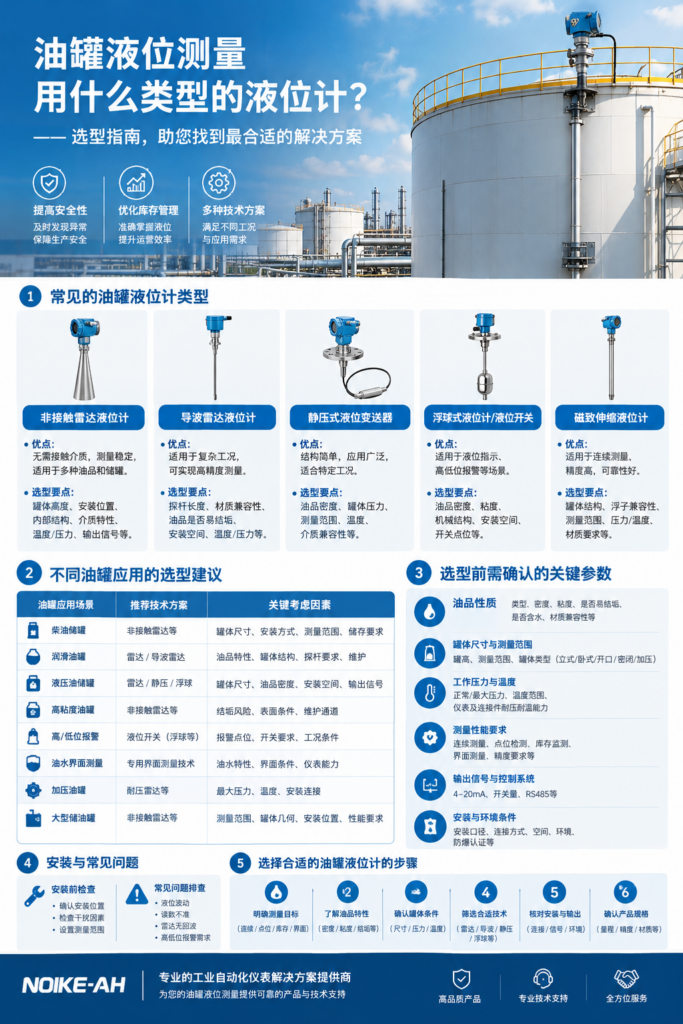
6. Key Parameters to Confirm Before Selection
To select a suitable oil tank level meter, collect the following information.
6.1 Oil Properties
Confirm the type of oil, such as diesel, lubricating oil, hydraulic oil, or another industrial oil.
Where relevant, also identify:
- Density or specific gravity.
- Viscosity and its operating-temperature dependence.
- Whether deposits or buildup may occur.
- Whether water or another liquid may be present.
- Chemical compatibility requirements for wetted materials.
These properties help determine which measurement technologies and instrument materials should be evaluated.
6.2 Tank Dimensions and Measuring Range
Provide the tank height, the required measuring range, and the normal operating level range.
Also identify whether the tank is vertical, horizontal, open, closed, or pressurized. The tank shape and internal structure may affect installation and measurement performance.
6.3 Operating Pressure and Temperature
Confirm the normal and maximum operating pressure, along with the expected process temperature range.
The selected instrument, process connection, probe, and wetted materials must be suitable for these conditions. Do not assume that all level meters support the same pressure or temperature limits.
6.4 Required Measurement Performance
Clarify whether the application requires:
- Continuous level measurement.
- Local level indication.
- High- or low-level alarms.
- Remote monitoring.
- Inventory estimation.
- Oil-water interface measurement.
Specify the required accuracy or measurement tolerance where applicable. The actual achievable performance must be confirmed from the selected model’s specifications.
6.5 Output Signal and Control System
Identify the signal and communication requirements, such as:
- 4–20 mA.
- Switching output for point-level detection.
- RS485 or another supported communication interface.
- Connection to a PLC, DCS, display, or remote monitoring system.
These are possible requirements, not standard features of every level meter. Confirm output availability for the specific model.
6.6 Installation and Environmental Requirements
Check the available installation opening, nozzle size, mounting arrangement, electrical connection, ambient conditions, and maintenance access.
If the tank is located in a hazardous area, determine the applicable area classification and required certification before choosing an instrument.
7. Installation Considerations for Oil Tank Level Meters
Correct installation is essential for reliable measurement. Follow the manufacturer’s installation instructions for the selected instrument.
7.1 Non-Contact Radar Installation
- Confirm that the installation position provides a suitable measuring path to the liquid surface.
- Evaluate the effects of tank walls, internal structures, and other possible sources of signal interference.
- Check that the nozzle and mounting arrangement are compatible with the instrument.
- Configure the tank reference, measuring range, and relevant setup parameters according to the instrument manual.
7.2 Guided Wave Radar Installation
- Confirm that the probe length and mounting arrangement are suitable for the tank.
- Check the probe’s compatibility with the oil and operating conditions.
- Evaluate whether deposits or buildup could affect long-term performance.
- Ensure that the probe can be installed and maintained safely.
7.3 Hydrostatic Level Transmitter Installation
- Confirm the correct pressure measurement point and reference.
- Verify the relationship between the liquid density and the required level calculation.
- For pressurized tanks, assess how tank pressure is handled by the measurement arrangement.
- Ensure that the pressure connection and wetted materials are suitable for the operating conditions.
For all technologies, commissioning should include checking the installation, configuring the instrument, and comparing its readings with an appropriate reference where practical.
8. Common Oil Tank Level Measurement Problems
Problem 1: The Level Reading Fluctuates
Possible causes include liquid-surface movement, process disturbances, an unsuitable installation position, signal interference, or instrument configuration issues.
Recommended checks:
- Observe whether the oil surface is moving during filling, discharge, or operation.
- Check the installation position and possible interference sources.
- Review the instrument’s configuration and output signal.
- Determine whether the fluctuation is caused by actual level changes or by the measurement system.
Do not assume that every fluctuating reading indicates a defective level meter.
Problem 2: The Displayed Level Does Not Match the Actual Level
Potential causes depend on the technology being used. Examples include an incorrect tank reference, an improperly configured measuring range, changes in oil density affecting hydrostatic measurement, or installation-related measurement errors.
Recommended checks:
- Confirm the tank reference and configured range.
- Compare the reading with a suitable independent reference.
- Review the instrument’s installation and configuration.
- For hydrostatic measurement, verify the density assumptions and pressure reference.
Problem 3: A Radar Level Meter Cannot Obtain a Stable Echo
Possible causes include an unsuitable mounting position, interference from internal tank structures, or other conditions that affect the measuring signal.
Recommended checks:
- Inspect the mounting position and measuring path.
- Check for nearby obstructions or reflective structures.
- Review the manufacturer’s setup and diagnostic instructions.
- Confirm that the instrument is suitable for the tank and process conditions.
The actual cause should be determined from the installation and instrument diagnostics rather than assumed in advance.
Problem 4: High- and Low-Level Alarms Are Required
If the requirement is simply to detect whether the oil has reached a specified point, a compatible level switch may be more appropriate than a continuous level transmitter.
If both continuous measurement and independent high- or low-level protection are required, evaluate the functions separately. Confirm the switching points, electrical interface, process compatibility, and any applicable safety requirements.
9. How to Select the Right Oil Tank Level Meter: A Practical Workflow
Use the following sequence to narrow down the options:
- Define the measurement objective. Determine whether continuous measurement, point-level detection, inventory monitoring, or interface measurement is required.
- Identify the oil properties. Confirm the oil type, density, viscosity, and any relevant contamination or buildup conditions.
- Confirm the tank conditions. Collect the tank dimensions, measuring range, pressure, temperature, and installation arrangement.
- Shortlist suitable technologies. Evaluate non-contact radar, guided wave radar, hydrostatic measurement, float-type instruments, or other applicable technologies.
- Check the installation requirements. Confirm mounting space, process connections, probe requirements, and maintenance access.
- Verify electrical and environmental compatibility. Check the required output, control-system interface, enclosure protection, and hazardous-area requirements.
- Confirm the model specifications. Verify the measurement range, accuracy, pressure and temperature limits, materials, and available outputs before placing an order.
Following this process helps avoid choosing an instrument based only on the tank height or the name of the oil.
10. Frequently Asked Questions (FAQ)
Q1: What is the best level meter for an oil tank?
There is no single best solution for every oil tank. Non-contact radar is often worth evaluating first for continuous measurement, while guided wave radar, hydrostatic transmitters, and float-type instruments may be suitable for specific applications. The final selection depends on the oil properties, tank conditions, installation, and measurement requirements.
Q2: Can a radar level meter measure diesel or lubricating oil?
Radar level measurement can be considered for diesel and lubricating oil tanks, subject to the instrument’s design and application limits. Tank geometry, installation position, operating conditions, and the required measuring range must be checked before selection.
Q3: Which level meter is suitable for high-viscosity oil?
The selection depends on the oil’s properties, the likelihood of deposits or buildup, tank conditions, and the measurement objective. Non-contact radar may be worth evaluating because its measuring element does not need to be immersed in the oil. However, its suitability must be verified for the actual application.
Q4: Can a hydrostatic level transmitter be used in an oil tank?
Yes, a hydrostatic level transmitter can be considered when the pressure measurement arrangement is suitable. Oil density, tank pressure, measurement range, and installation conditions must be evaluated because these factors affect the relationship between pressure and liquid level.
Q5: Can an oil tank level transmitter provide a 4–20 mA output?
Some level transmitters are available with a 4–20 mA output, but this is not guaranteed for every model. Confirm the output signal, power requirements, wiring, and compatibility with the receiving control system before ordering.
Q6: What should be considered when measuring oil in a hazardous area?
Confirm the hazardous-area classification, the applicable certification requirements, and the instrument’s suitability for the installation. Do not assume that every model or configuration is approved for hazardous locations.
Q7: How should the measuring range be selected?
The measuring range should cover the required operating levels and the tank’s usable measurement span. Consider the installation reference, normal operating level, and required alarm points. The final range should be confirmed against the selected instrument’s specifications and installation arrangement.
11. Conclusion
Choosing a level meter for an oil tank requires more than identifying the type of oil or the height of the tank. The most suitable solution depends on the measurement objective, oil properties, tank geometry, operating pressure and temperature, installation conditions, and required signal output.
For continuous oil level measurement, non-contact radar is often a useful technology to evaluate. Guided wave radar and hydrostatic level transmitters may also be suitable when their operating principles and installation requirements match the application. Float-type instruments can be considered for point-level detection and certain level indication tasks.
A systematic assessment of the actual working conditions helps ensure that the selected instrument meets the application’s measurement and operational requirements.
12. Request Oil Tank Level Measurement Support from NOIKE-AH
To help evaluate a suitable level measurement solution, please provide the following information:
- Medium: Diesel, lubricating oil, hydraulic oil, or another type of oil.
- Tank height and measuring range: The total tank height and required level measurement span.
- Operating pressure: Normal and maximum pressure, and whether the tank is vented or pressurized.
- Operating temperature: Expected process temperature range.
- Tank type: Vertical, horizontal, open, closed, or another configuration.
- Measurement objective: Continuous measurement, high-/low-level alarm, inventory monitoring, or interface measurement.
- Output requirements: 4–20 mA, switching output, RS485, or another required interface.
- Installation conditions: Mounting opening, connection type, available space, and environmental requirements.
- Special requirements: Material compatibility, hazardous-area certification, or other application-specific needs.
NOIKE-AH can help evaluate potential instrument options based on the actual operating conditions and verified product specifications.
For detailed product specifications and selection recommendations, please contact the NOIKE-AH team for consultation.