
Vortex Flowmeter for Steam Measurement
Vortex flowmeters are widely used for steam measurement because they have no moving parts and can measure both liquid and gas-phase fluids. For steam service, however, accurate measurement depends heavily on correct sizing, pressure and temperature conditions, installation, and flow velocity. This guide explains how to select and install a vortex flowmeter for reliable steam measurement.
What Is a Vortex Flowmeter?
A vortex flowmeter is an inferential flow measurement device that determines fluid flow rate by detecting vortices generated when a fluid passes around a bluff body, also called a shedder bar, installed inside the flow tube.
As steam flows around the bluff body, alternating vortices are generated downstream. The frequency of vortex shedding is related to the flow velocity over the normal operating range of the meter. An electronic sensor detects these pressure or velocity fluctuations and converts the detected vortex frequency into a flow-rate signal.
For steam applications, vortex flowmeters are particularly useful because the measurement principle does not require moving mechanical components. This can reduce mechanical wear and make the technology suitable for continuous industrial service.
However, vortex measurement is not simply a matter of installing the meter into a steam pipe. Steam pressure, temperature, density, pipe size, flow velocity, Reynolds number, steam quality, and installation conditions all affect measurement performance.
For saturated steam, pressure and temperature are closely related, so the process conditions should be properly defined during meter selection. For superheated steam, pressure and temperature conditions are especially important because steam density changes with operating conditions.
When mass flow is required, the vortex flowmeter may need pressure and temperature compensation, or an external flow computer, depending on the instrument configuration.
Key Specifications to Consider
When selecting a vortex flowmeter for steam, the most important specifications are not limited to nominal pipe size. The actual operating conditions should be evaluated first.
| Parameter | Why It Matters | Selection Consideration |
|---|---|---|
| Fluid Type | Determines measurement conditions | Saturated steam, superheated steam, or other gas/liquid |
| Flow Rate | Determines required measuring range | Specify minimum, normal and maximum flow |
| Pressure | Directly affects steam density | Provide operating and maximum pressure |
| Temperature | Affects density and instrument temperature limits | Specify normal and maximum temperature |
| Pipe Size | Affects velocity through the meter | Meter size should be selected based on actual flow conditions, not pipe size alone |
| Flow Velocity | Vortex shedding requires an appropriate velocity range | Verify minimum and maximum velocity against manufacturer limits |
| Steam Quality | Wet steam can affect measurement stability | Avoid excessive condensate and unstable two-phase flow |
| Accuracy | Determines measurement uncertainty | Check the manufacturer’s accuracy specification for steam service |
| Pressure Loss | Important for steam systems | Confirm pressure loss at maximum operating flow |
| Output | Determines integration with control systems | Common options include pulse/frequency and 4–20 mA; digital communication may also be available |
| Connection | Determines mechanical compatibility | Flanged, wafer, threaded or other connection depending on model |
| Material | Must withstand process conditions | Select wetted materials according to pressure, temperature and steam conditions |
How to Size a Vortex Flowmeter for Steam
Correct sizing should begin with the actual operating flow range, not simply the existing pipe diameter.
The basic principle is:
Steam mass flow = Steam density × Volumetric flow
Because steam density changes significantly with pressure and temperature, a volumetric flow rate cannot be evaluated independently of process conditions.
For this reason, the following information should ideally be available before selecting the meter:
- Minimum steam flow
- Normal steam flow
- Maximum steam flow
- Operating pressure
- Operating temperature
- Maximum allowable pressure and temperature
- Pipe nominal diameter and schedule
- Steam type: saturated or superheated
- Required output signal
- Required measurement accuracy
- Whether mass flow or volumetric flow is required
A meter that is too large may operate at insufficient velocity during low-flow conditions, while a meter that is too small may create excessive velocity and pressure loss at maximum flow.
The objective is to select a meter size that keeps the expected operating range within the manufacturer’s specified measurement limits.
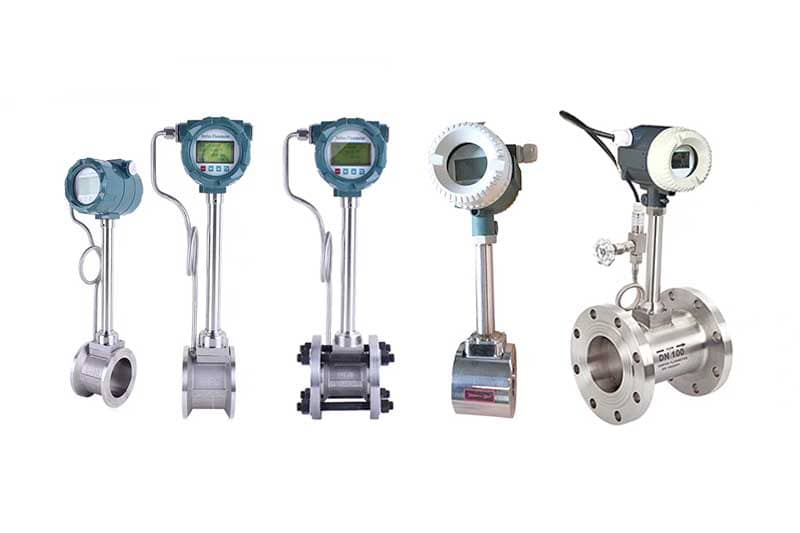
NOIKE-AH Vortex Flowmeter for Steam Measurement
Vortex Flowmeter vs. Differential Pressure Flowmeter for Steam
Both vortex and differential-pressure technologies are widely used for industrial steam measurement, but their installation requirements and measurement principles are different.
| Criterion | Vortex Flowmeter | Differential Pressure Flowmeter |
|---|---|---|
| Measurement Principle | Measures vortex shedding frequency | Measures pressure difference across a primary element |
| Moving Parts | No moving parts in the flow path | Typically no moving parts in the primary element |
| Steam Measurement | Suitable for saturated and superheated steam within specified conditions | Widely used for steam when properly engineered |
| Pressure Measurement | Basic vortex measurement does not inherently measure pressure | Differential pressure is the primary measurement variable |
| Density Compensation | Required when converting to compensated mass flow | Required for accurate mass-flow calculation as well |
| Permanent Pressure Loss | Generally lower than many restriction-based primary elements | Depends strongly on primary element |
| Installation | Requires suitable straight pipe and flow conditioning | Requires primary element plus impulse piping or associated components |
| Maintenance | Generally low mechanical maintenance | Impulse lines and pressure components may require additional maintenance |
| Turndown | Depends on meter design and operating conditions | Depends on primary element and transmitter configuration |
| Best Fit | Steam distribution and process flow measurement where appropriate velocity exists | Applications requiring established DP measurement infrastructure or specific engineering standards |
Neither technology is universally better. The correct choice depends on the steam system, required accuracy, pressure-loss requirements, maintenance conditions, and available instrumentation.
Top 5 Applications for Steam Vortex Flowmeters
1. Industrial Steam Distribution
Steam distribution networks often require measurement at boilers, main headers, branch lines and process areas. A vortex flowmeter can provide continuous steam flow information without mechanical moving components.
For plant-level energy management, the measured flow may be combined with pressure and temperature data to calculate compensated mass flow or energy consumption. Correct sizing is particularly important because steam demand can vary substantially between different production areas.
2. Boiler and Steam Generation Systems
Steam flow measurement can be used to monitor steam production and support boiler-system performance analysis.
In these applications, the meter must be selected according to the actual steam pressure, temperature and flow range. Installation should also consider vibration, upstream disturbances and condensate management.
The flowmeter should not be treated as a standalone device when accurate energy accounting is required. Pressure and temperature measurements may also be necessary for compensation and system calculations.
3. Process Heating
Many manufacturing processes use steam for heating tanks, heat exchangers, dryers and other thermal equipment.
A vortex flowmeter can be installed on steam supply lines to monitor how much steam is delivered to a process. This information can help operators identify changes in production demand and investigate abnormal steam consumption.
Stable flow conditions are important. Sudden two-phase flow or excessive condensate can compromise measurement stability and should be addressed through proper steam-system design.
4. HVAC and District Heating Systems
Steam is used in some heating systems for building heating, heat exchangers and centralized thermal distribution.
Flow measurement can provide information about steam consumption and distribution between heating zones. For these applications, selecting the meter based on actual minimum and maximum flow conditions helps prevent poor low-flow performance or excessive velocity at peak demand.
Where billing or energy allocation is involved, the complete measurement system—including pressure, temperature and calculation methods—should be engineered according to the required accuracy.
5. Food, Chemical and Pharmaceutical Processes
Steam is commonly used for process heating, sterilization and cleaning applications. Vortex technology can be considered when the process conditions fall within the meter’s specified pressure, temperature and velocity range.
Material compatibility, hygienic requirements, steam quality and installation environment should be evaluated before selection.
For critical processes, the measurement accuracy requirement should be established first rather than selecting a flowmeter solely based on nominal pipe diameter.
Installation & Wiring Guide
Correct installation is essential for vortex flowmeter performance. The exact straight-pipe requirements vary by meter design and upstream disturbance, so the manufacturer’s installation manual should always take priority.
Step 1: Confirm the Installation Location
Select a section of pipe where the flow is reasonably stable and where sufficient straight pipe is available.
Avoid placing the meter immediately downstream of strong flow disturbances such as:
- Elbows
- Tees
- Valves
- Reducers
- Expanders
- Pumps or other major disturbances
The required straight lengths depend on the flowmeter design and the type of upstream disturbance.
Step 2: Check Pipe Alignment
The flowmeter should be installed concentrically with the pipeline.
Pipe misalignment, internal gaskets protruding into the flow path, or sudden changes in internal diameter can disturb the flow profile and affect vortex formation.
Step 3: Consider Steam Condensation
Steam systems require particular attention to condensate.
For steam service, the pipeline should be designed to minimize unwanted liquid accumulation. Poor drainage can result in unstable two-phase flow, which is not the same measurement condition as dry steam.
The meter orientation should follow the manufacturer’s instructions and the specific steam-system design.
Step 4: Install According to Flow Direction
Check the arrow marked on the flowmeter body and ensure that it matches the actual steam-flow direction.
Incorrect orientation can prevent the instrument from operating correctly.
Step 5: Complete Electrical Wiring
The wiring depends on the specific transmitter configuration.
Typical industrial configurations may include:
- Power supply
- 4–20 mA output
- Pulse/frequency output
- Digital communication, when supported
Always follow the terminal diagram supplied with the specific flowmeter. Do not assume that all vortex flowmeters use the same terminal assignment or power requirements.
Step 6: Commission the System
After mechanical and electrical installation:
- Check all pipe connections.
- Verify the flow direction.
- Confirm power-supply requirements.
- Configure the engineering unit.
- Enter the appropriate process parameters if compensation is used.
- Check the measured value against expected operating conditions.
- Inspect the system for abnormal vibration or unstable readings.
Common Mistakes to Avoid
Mistake 1: Selecting the Meter Only by Pipe Size
A DN50 or 2-inch pipe does not automatically require a DN50 or 2-inch vortex meter.
The meter must be evaluated against actual minimum, normal and maximum flow conditions.
Mistake 2: Ignoring Steam Pressure and Temperature
Steam density depends strongly on thermodynamic conditions. Providing only the pipe diameter and flow rate may not be sufficient for proper selection.
Mistake 3: Installing Too Close to a Flow Disturbance
An elbow, valve or reducer immediately upstream can disturb the velocity profile.
Always check the manufacturer’s recommended straight-pipe requirements for the specific installation.
Mistake 4: Ignoring Condensate
Wet or unstable two-phase flow can create measurement problems. Steam-system drainage and installation orientation therefore deserve careful attention.
Mistake 5: Assuming Basic Vortex Measurement Directly Provides Accurate Mass Flow
Vortex frequency is related to volumetric flow under the meter’s operating conditions. When accurate steam mass flow is required, pressure and temperature compensation may be necessary.
FAQ
1. Can a vortex flowmeter measure steam?
Yes. Vortex flowmeters are commonly used for industrial steam measurement, provided that the pressure, temperature, flow velocity, steam condition and other process parameters are within the instrument’s specified operating range.
2. Can one vortex flowmeter measure both saturated and superheated steam?
A suitable vortex flowmeter can be used for either saturated or superheated steam, but the application must be configured and selected according to the actual process conditions.
The calculation of mass flow also differs because steam density depends on pressure and temperature.
3. How do I select the correct vortex flowmeter size for steam?
Start with the minimum, normal and maximum steam flow, together with operating pressure and temperature. Then verify the resulting velocity, measurement range and pressure loss against the manufacturer’s specifications.
Do not select the meter based only on the nominal pipe diameter.
4. Does a steam vortex flowmeter require pressure and temperature compensation?
Not necessarily for every application. If the requirement is accurate mass-flow measurement, pressure and temperature compensation may be required because steam density changes with thermodynamic conditions.
The exact configuration depends on the flowmeter and measurement system.
5. What straight pipe length is required?
There is no single universal straight-pipe value that applies to every vortex flowmeter and every piping configuration.
The required length depends on the meter design and upstream disturbance. Always follow the manufacturer’s specified installation requirements.
Why Choose NOIKE-AH?
For industrial flow measurement projects, choosing the right flowmeter involves more than selecting a nominal diameter. NOIKE-AH focuses on flow measurement and industrial instrumentation solutions, with product selection based on application conditions rather than a one-size-fits-all approach.
For steam applications, customers can provide the required process information—including pipe size, steam type, flow range, pressure, temperature, connection requirements and output requirements—so the appropriate flowmeter configuration can be evaluated.
For OEM and ODM projects, technical requirements can also be discussed before production to reduce the risk of selecting an unsuitable configuration.
The goal is simple: provide a flow measurement solution that matches the actual process conditions and installation environment.
Conclusion
A vortex flowmeter can be an effective solution for industrial steam measurement, but correct sizing and installation are essential to achieving reliable results.
The most important selection factors include minimum and maximum flow, operating pressure, temperature, steam type, flow velocity, pipe size, required accuracy and output configuration. During installation, straight-pipe requirements, flow disturbances, pipe alignment and condensate management should be carefully considered.
For applications requiring accurate steam mass-flow measurement, pressure and temperature compensation should also be evaluated.
Do not select a vortex flowmeter simply because its connection size matches the existing pipe. Select it based on the actual steam operating conditions.



