
How to Select a High Pressure Gear Flowmeter for Viscous Oil Measurement
Accurate measurement of high-viscosity oil under high-pressure conditions is a critical requirement in industries such as hydraulic systems, petroleum processing, lubrication equipment, chemical manufacturing, fuel transfer, and industrial automation.
Unlike water or low-viscosity fluids, high-viscosity oils have unique flow characteristics, including high resistance, strong temperature dependence, and potential pressure fluctuations. These factors make many conventional flow measurement technologies unsuitable for reliable measurement.
A gear flowmeter (positive displacement flowmeter) is one of the most suitable solutions for measuring high-viscosity oils because it directly measures fluid volume through precision gear rotation. With excellent repeatability, high accuracy, and strong viscosity adaptability, gear flowmeters are widely used in applications requiring stable oil flow measurement.
For demanding applications where operating pressure can reach 70 MPa (700 bar), selecting the correct gear flowmeter requires careful evaluation of pressure rating, materials, viscosity range, flow capacity, temperature conditions, and output requirements.
This guide explains the key factors engineers should consider when selecting a high-pressure gear flowmeter for viscous oil applications.
1. What Is a Gear Flowmeter and How Does It Work?
A gear flowmeter is a type of positive displacement flow meter designed to measure the actual volume of liquid passing through the meter.
Unlike velocity-based flowmeters, such as turbine or vortex flowmeters, gear flowmeters do not calculate flow based on fluid speed. Instead, they use precision mechanical displacement chambers to measure a fixed amount of liquid during each rotation.
Inside the flowmeter, two precision-machined gears rotate as oil passes through the measuring chamber. Each rotation transfers a known volume of liquid. The rotational movement is detected by sensors and converted into electrical signals such as:
- Pulse output
- Frequency output
- 4–20 mA analog signal
- Digital communication signals
The basic measuring principle is:
Flow Rate = Displacement Volume × Gear Rotation Speed
Because the measurement is based on actual liquid displacement, gear flowmeters provide excellent performance for liquids with high viscosity.
2. Why Choose a Gear Flowmeter for High Viscosity Oil?
2.1 Direct Volume Measurement Instead of Velocity Measurement
High-viscosity oils often create laminar flow conditions, where velocity-based flowmeters may experience reduced accuracy.
For example:
Turbine Flowmeters
Potential limitations:
- High viscosity increases mechanical resistance
- Turbine rotation speed decreases
- Measurement accuracy may decrease at low flow rates
Electromagnetic Flowmeters
Limitations:
- Require conductive liquids
- Cannot normally measure insulating oils
Ultrasonic Flowmeters
Potential limitations:
- Signal attenuation in certain viscous fluids
- Measurement stability depends on fluid properties
Gear Flowmeters
Advantages:
- Direct volumetric measurement
- Excellent low-flow performance
- Suitable for viscous liquids
- High repeatability
Therefore, gear flowmeters are commonly selected for oil measurement applications.
3. Key Factors for Selecting a High Pressure Gear Flowmeter
3.1 Working Pressure: Is the Flowmeter Rated for 70 MPa?
For high-pressure oil systems, pressure capability is the first selection criterion.
A system operating at 70 MPa (700 bar) requires a flowmeter designed with:
- High-strength pressure-resistant housing
- Reliable sealing structure
- Precision-machined internal components
- Suitable pressure-rated connections
Common materials include:
Stainless Steel Meter Body
Advantages:
- High mechanical strength
- Excellent corrosion resistance
- Suitable for demanding industrial environments
Typical materials:
- 304 stainless steel
- 316 stainless steel
High Strength Internal Components
Gear and shaft materials may include:
- Stainless steel
- Hardened alloy steel
- Wear-resistant materials
These materials improve:
- Mechanical durability
- Wear resistance
- Long-term measurement stability
When selecting a flowmeter, always confirm:
- Maximum operating pressure
- Pressure fluctuation conditions
- Safety margin requirements
4. How to Select a Gear Flowmeter Based on Oil Viscosity
Viscosity is one of the most important parameters when selecting a gear flowmeter.
Common viscosity units include:
- mPa·s
- cP
- cSt (mm²/s)
High-viscosity oil applications may involve:
- Hydraulic oil
- Gear oil
- Lubricating oil
- Heavy fuel oil
- Silicone oil
- Resin
- Adhesive liquids
Engineers should evaluate:
Minimum Operating Viscosity
The lowest viscosity usually occurs when oil temperature increases.
Lower viscosity may increase internal leakage.
Maximum Operating Viscosity
The highest viscosity often occurs during cold startup.
Higher viscosity may cause:
- Increased pressure loss
- Higher pump load
- Reduced flow response
The selected gear flowmeter should cover the complete viscosity range during actual operation.
5. Flow Range Selection: Avoid Oversizing the Flowmeter
Selecting the correct flow range is essential for measurement accuracy.
The selection should consider:
- Minimum flow rate
- Normal operating flow rate
- Maximum flow rate
The ideal operating point should normally be within the middle range of the meter capacity.
For example:
Required application flow:
- Minimum: 2 L/min
- Normal: 10 L/min
- Maximum: 20 L/min
A flowmeter with a range close to:
0.5–25 L/min
may provide better measurement performance compared with a larger meter designed for:
10–100 L/min
because low-flow accuracy can be improved.
6. Accuracy Requirements of Gear Flowmeters
Gear flowmeters are widely used in applications where accurate oil measurement is required.
Typical applications include:
- Hydraulic testing systems
- Oil filling equipment
- Fuel measurement
- Lubrication control
- Chemical dosing systems
Accuracy depends on several factors:
- Gear machining precision
- Internal clearance design
- Fluid viscosity
- Temperature stability
- Calibration conditions
Common accuracy levels include:
- ±0.5% FS
- Higher accuracy options depending on design and calibration requirements
7. Temperature Effects on High Viscosity Oil Measurement
Oil viscosity changes significantly with temperature.
When temperature decreases:
- Oil becomes more viscous
- Pressure loss increases
- Pump load increases
When temperature increases:
- Oil viscosity decreases
- Internal leakage may increase
Therefore, engineers should consider:
- Medium temperature range
- Ambient temperature
- Seal material compatibility
Common sealing materials:
- NBR
- FKM (Viton)
- PTFE
The selected material must match the oil type and operating temperature.
8. Material Selection for High Pressure Oil Flow Measurement
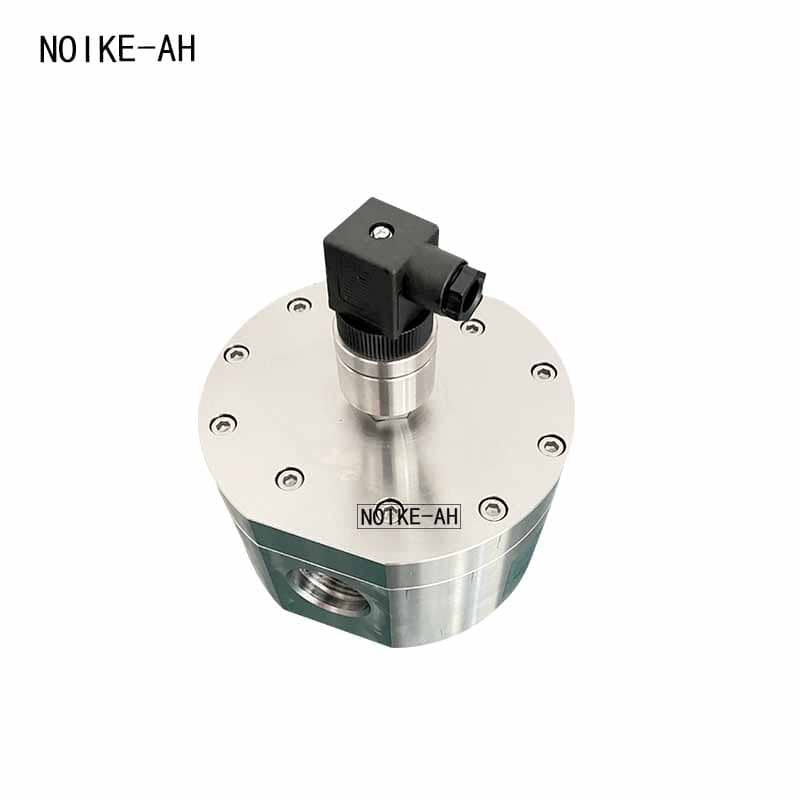
Flowmeter Body Material
Aluminum Alloy
Advantages:
- Lightweight
- Cost-effective
Suitable for:
- General lubrication applications
Not recommended for:
- Extreme pressure applications
Stainless Steel
Advantages:
- High pressure resistance
- Excellent corrosion resistance
- Suitable for harsh industrial environments
Recommended for:
- High-pressure oil systems
- Chemical liquids
- Industrial applications
Gear Material
The internal gears operate continuously under pressure.
Important requirements:
- Wear resistance
- High mechanical strength
- Precision machining accuracy
Suitable materials include:
- Stainless steel
- Hardened alloy steel
9. Installation Guidelines for High Pressure Gear Flowmeters
Install Proper Filtration
Because gear flowmeters contain precision mechanical components, contamination may cause:
- Gear wear
- Increased clearance
- Accuracy reduction
A suitable filtration system is recommended.
Prevent Air Entrapment
Air bubbles may affect measurement stability.
Possible causes:
- Pump cavitation
- Leakage
- Improper suction conditions
Recommended solutions:
- Improve pipeline sealing
- Maintain proper pump operation
- Use air separation equipment when required
Consider Pressure Loss
High viscosity oil naturally produces higher resistance.
Before installation, evaluate:
- Oil viscosity
- Flow rate
- Pressure drop
- Pump capacity
10. Output Signal Options for Industrial Applications
Pulse Output
Suitable for:
- PLC control
- Flow monitoring
- Batch measurement
Advantages:
- Simple
- Reliable
- High response speed
4–20 mA Output
Advantages:
- Industrial standard signal
- Suitable for long-distance transmission
- Compatible with automation systems
Digital Communication
Advanced gear flowmeters may support:
- RS485
- Modbus RTU
- HART communication
Suitable for:
- Smart factories
- Industrial IoT systems
- Remote monitoring
11. Typical Applications of High Pressure Gear Flowmeters
Hydraulic Systems
Applications:
- Hydraulic test benches
- Injection molding equipment
- Hydraulic power units
Requirements:
- High pressure resistance
- Stable oil measurement
- Fast response
Oil Transfer Systems
Applications:
- Lubricating oil filling
- Fuel transfer
- Industrial oil distribution
Requirements:
- Accurate volume measurement
- Long-term reliability
Chemical and Resin Processing
Applications:
- Resin dosing
- Adhesive measurement
- Coating production
Requirements:
- High viscosity capability
- Chemical compatibility
12. Common Mistakes When Selecting a Gear Flowmeter
Mistake 1: Selecting Only According to Pipe Size
Pipeline diameter does not determine the correct flowmeter size.
Important parameters are:
- Actual flow rate
- Viscosity
- Pressure
- Temperature
Mistake 2: Ignoring Maximum Pressure
A flowmeter rated for lower pressure cannot safely replace a 70 MPa model.
Always check:
- Maximum working pressure
- Pressure peaks
- Safety requirements
Mistake 3: Ignoring Cold Startup Conditions
Cold oil may have much higher viscosity than normal operation.
The flowmeter must be selected according to the most demanding operating condition.
Frequently Asked Questions (FAQ)
Q1: Can a gear flowmeter measure high viscosity oil?
Yes. Gear flowmeters are specifically suitable for high-viscosity liquids because they use positive displacement measurement rather than relying on fluid velocity.
Q2: What pressure can a high-pressure gear flowmeter handle?
The pressure capability depends on the specific design and materials. High-pressure versions can be designed for demanding applications up to 70 MPa (700 bar).
Q3: Are gear flowmeters suitable for hydraulic oil?
Yes. Gear flowmeters are commonly used in hydraulic systems because they provide stable measurement performance for lubricating and hydraulic oils.
Q4: What information is needed to select a gear flowmeter?
The main selection parameters include:
- Medium type
- Viscosity range
- Flow range
- Working pressure
- Temperature
- Required accuracy
- Output signal
Conclusion: Selecting the Right Gear Flowmeter for 70 MPa High Viscosity Oil Applications
A gear flowmeter is one of the most reliable solutions for measuring high-viscosity oil under demanding industrial conditions. Its positive displacement measurement principle provides excellent accuracy, repeatability, and viscosity adaptability.
For applications up to 70 MPa, engineers should carefully evaluate:
- Pressure rating
- Oil viscosity range
- Flow capacity
- Temperature conditions
- Material compatibility
- Accuracy requirements
- Signal output
A properly selected high-pressure gear flowmeter can provide stable long-term operation in hydraulic systems, oil transfer equipment, lubrication systems, and industrial automation applications.
For accurate model selection, users should provide complete operating conditions, including oil type, viscosity, pressure, temperature, flow range, and required accuracy, ensuring the selected flowmeter matches the actual application requirements.



