
Air compressors that frequently start and stop don’t always have a mechanical failure.
In many industrial compressed air systems, short cycling is caused by an improperly adjusted pressure switch differential, rather than a faulty compressor. However, air leaks, undersized receiver tanks, unstable air demand, excessive filter pressure drop, and control system issues can produce similar symptoms.
This guide explains why frequent compressor cycling happens, how to identify the real cause, and which pressure and flow instruments can help monitor your compressed air system more effectively.
What Is Pressure Switch Differential?
An air compressor pressure switch controls when the compressor starts and stops based on system pressure.
There are three important settings:
- Cut-in Pressure – the pressure at which the compressor starts.
- Cut-out Pressure – the pressure at which the compressor stops.
- Pressure Differential – the difference between cut-out and cut-in pressure.
For example:
- Cut-out: 0.80 MPa
- Cut-in: 0.60 MPa
- Differential: 0.20 MPa
The pressure differential determines how much the receiver tank pressure is allowed to drop before the compressor restarts.
If this difference is too small, the compressor may restart almost immediately after stopping.
Why Does a Small Pressure Differential Cause Frequent Cycling?
Imagine the following settings:
- Cut-out Pressure: 0.80 MPa
- Cut-in Pressure: 0.75 MPa
The pressure only needs to drop by 0.05 MPa before the compressor starts again.
When combined with:
- a small receiver tank,
- fluctuating air consumption,
- or minor system leaks,
the compressor may continuously start and stop throughout the day.
This condition is commonly known as short cycling, which increases wear on motors, contactors, and pressure switch contacts while also increasing energy consumption.
Common Signs of Air Compressor Short Cycling
If your compressor is cycling too frequently, you may notice one or more of the following symptoms:
- The compressor restarts only a few seconds or minutes after stopping.
- The magnetic contactor operates repeatedly.
- Receiver tank pressure drops rapidly.
- Downstream pressure becomes unstable.
- Pressure switch contacts chatter.
- Motor overload protection trips.
- Pneumatic tools lose stable operating pressure.
These symptoms don’t automatically mean the pressure switch is defective—they simply indicate that the pressure control system should be inspected.
How to Troubleshoot Frequent Air Compressor Cycling
Instead of replacing components immediately, follow a systematic troubleshooting process.
1. Measure the Actual Cut-in Pressure
Record the pressure where the compressor starts.
2. Measure the Actual Cut-out Pressure
Record the pressure where the compressor stops.
3. Calculate the Pressure Differential
Compare the measured differential with the manufacturer’s recommended setting.
4. Observe Pressure Decay
After the compressor stops, monitor how quickly the receiver pressure decreases.
Rapid pressure loss usually indicates leakage somewhere in the system.
5. Check for Air Leaks
Inspect:
- Pipeline joints
- Drain valves
- Check valves
- Hose connections
- Downstream equipment
6. Verify Receiver Tank Capacity
A receiver tank that is too small cannot provide sufficient air storage, causing pressure to fluctuate rapidly.
7. Evaluate Air Consumption
Large and sudden air demand changes can trigger unnecessary compressor restarts.
8. Measure Filter and Dryer Pressure Drop
Blocked filters or dryers may reduce downstream pressure even though compressor pressure remains normal.
Increasing pressure switch settings will not solve this problem and may simply increase operating costs.
9. Inspect the Pressure Switch
Check for:
- Incorrect adjustment
- Worn contacts
- Blocked pressure ports
- Mechanical damage
10. Review the Control System
Finally, verify the compressor controller, PLC logic, timers, and start/stop sequence.
Three Common Field Examples
Case 1: Pressure Differential Is Too Small
A compressor is configured with:
- Cut-out: 0.80 MPa
- Cut-in: 0.76 MPa
Because the differential is only 0.04 MPa, the compressor restarts almost immediately after stopping.
Case 2: Air Leakage Is Mistaken for Pressure Switch Failure
If receiver pressure drops rapidly after shutdown, the real cause may be:
- Pipe leakage
- Drain valve leakage
- Check valve leakage
- Downstream air leakage
Replacing the pressure switch will not eliminate the pressure loss.
Case 3: Dryer or Filter Pressure Drop Causes Low System Pressure
Operators sometimes increase compressor pressure because downstream pressure is low.
In reality, excessive pressure loss across filters or dryers is often the actual problem.
Correcting the pressure drop is usually more effective than increasing compressor pressure.
Recommended Instruments for Compressed Air Monitoring
Reliable monitoring helps identify problems before they lead to downtime.
Recommended measurement points include:
- Receiver Tank Pressure — Pressure Gauge or Pressure Transmitter
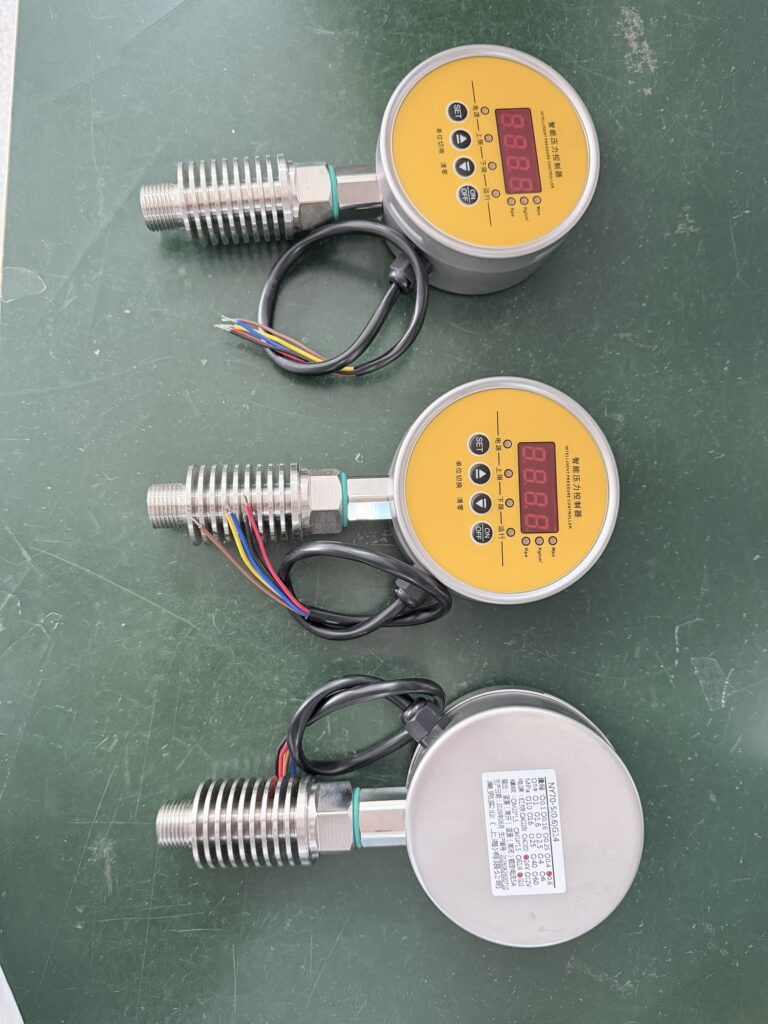
- Compressor Control Pressure — Pressure Switch or Intelligent Pressure Switch
- Dryer Inlet and Outlet Pressure — Pressure Gauge or Pressure Transmitter
- Filter Differential Pressure — Differential Pressure Switch or Differential Pressure Transmitter
- End-Use Pressure — Digital Pressure Gauge or Pressure Transmitter
- Air Flow Monitoring — Flow Switch or Flow Meter
Together, these instruments provide a complete picture of compressed air system performance.
How NOIKE-AH Supports Compressed Air Systems
NOIKE-AH provides a complete range of pressure and flow measurement solutions for industrial compressed air applications, including:
- Pressure Gauges
- Digital Pressure Gauges
- Pressure Switches
- Intelligent Pressure Switches
- Pressure Transmitters
- Differential Pressure Switches
- Differential Pressure Transmitters
- Flow Switches
- Flow Meters
These products are widely used in:
- Air Compressors
- Air Receiver Tanks
- Compressed Air Dryers
- Air Filters
- Air Treatment Equipment
- Industrial Compressed Air Networks
Whether you need local indication, automatic compressor control, or remote pressure monitoring, the right combination of instruments can significantly improve system reliability and energy efficiency.
Conclusion
Frequent air compressor cycling is not always caused by a faulty pressure switch.
A proper diagnosis should always begin with the actual operating conditions:
Cut-in Pressure → Cut-out Pressure → Pressure Differential → Pressure Decay → Leak Inspection → Receiver Tank Capacity → Air Demand → Filter/Dryer Pressure Drop → Pressure Switch → Control Logic
By identifying the root cause instead of simply replacing parts, maintenance teams can reduce equipment wear, lower energy consumption, and improve the long-term stability of compressed air systems.



