
Gear Flow Meters
In industrial fluid processing, not all liquids behave like water. When process engineers are tasked with measuring heavy lubricants, hydraulic oils, liquid resins, or dense fuels, the physical rules of fluid dynamics change drastically. These high-viscosity fluids introduce severe challenges that render standard flow measurement technologies completely ineffective.
Attempting to measure thick fluids with the wrong instrumentation leads to massive data errors, severe pressure drops, and frequent mechanical failures. NOIKE-AH (臬克) explores the unique physics of high-viscosity measurement and explains why Positive Displacement (PD) gear flow meters are the non-negotiable standard for these demanding applications.
1. The Physics of Thick Fluids: Why Standard Meters Fail
To understand why gear meters are required, we must first understand why velocity-based meters (like turbine or ultrasonic meters) and electromagnetic meters fail when handling heavy oils.
- The Laminar Flow Problem: High viscosity dampens fluid turbulence, resulting in a strict “laminar” flow profile (a very low Reynolds number). In laminar flow, the fluid travels much faster in the center of the pipe than at the edges. Velocity-based meters rely on a predictable, symmetrical flow profile to calculate volume. When exposed to the bullet-shaped profile of viscous laminar flow, their accuracy degrades significantly.
- The Conductivity Barrier: Electromagnetic flowmeters are heavily favored in water treatment, but they require the fluid to be electrically conductive. Oils, lubricants, and hydrocarbon-based fuels are natural insulators. A magmeter attempting to measure hydraulic oil will simply read zero.
- Cavitation and Drag: High-viscosity fluids exert immense drag on standard mechanical impellers (like those in water meters or standard turbines), requiring excessive force to turn the blades, which causes severe pressure loss and non-linear measurement errors.
2. The Oval Gear Solution: Positive Displacement Mechanics
An Oval Gear Flow Meter operates on the Positive Displacement (PD) principle. It does not infer flow from velocity; instead, it physically isolates and counts precise volumes of fluid.
Inside the measuring chamber, two tightly toleranced, precisely machined oval gears interlock. As the pressurized fluid enters the chamber, it forces the gears to rotate. With every single 360-degree rotation, a fixed, unchanging volume of fluid is “swept” from the inlet to the outlet. By placing a magnetic sensor outside the chamber to count these rotations, the exact volumetric flow rate is calculated.
The “Viscosity Paradox”: Why Thicker is Better
In a counter-intuitive twist of physics, oval gear meters actually become more accurate as the fluid gets thicker.
In low-viscosity fluids (like water), a minuscule amount of fluid can bypass the gears through the microscopic clearances between the gears and the chamber wall—a phenomenon known as “slippage.” However, when measuring high-viscosity fluids like gear oil or resin, the thick fluid naturally acts as a hydrodynamic seal, completely blocking these clearances. Slippage drops to near zero, driving the meter’s volumetric accuracy to its theoretical maximum.
3. Extreme Applications: Hydraulic Test Benches and Heavy Industry
High-viscosity measurement often goes hand-in-hand with extreme operating pressures, particularly in heavy machinery and automotive testing.
- Hydraulic Test Benches: When testing the performance of hydraulic pumps, cylinders, or heavy-duty valves, the system pressure can easily exceed 400 bar. Standard flow meters will rupture or leak under these conditions.
- Fuel Consumption Monitoring: In marine engines or large industrial generators, precisely measuring the consumption of heavy fuel oil (HFO) or diesel requires exceptional turndown ratios and immunity to engine vibration.
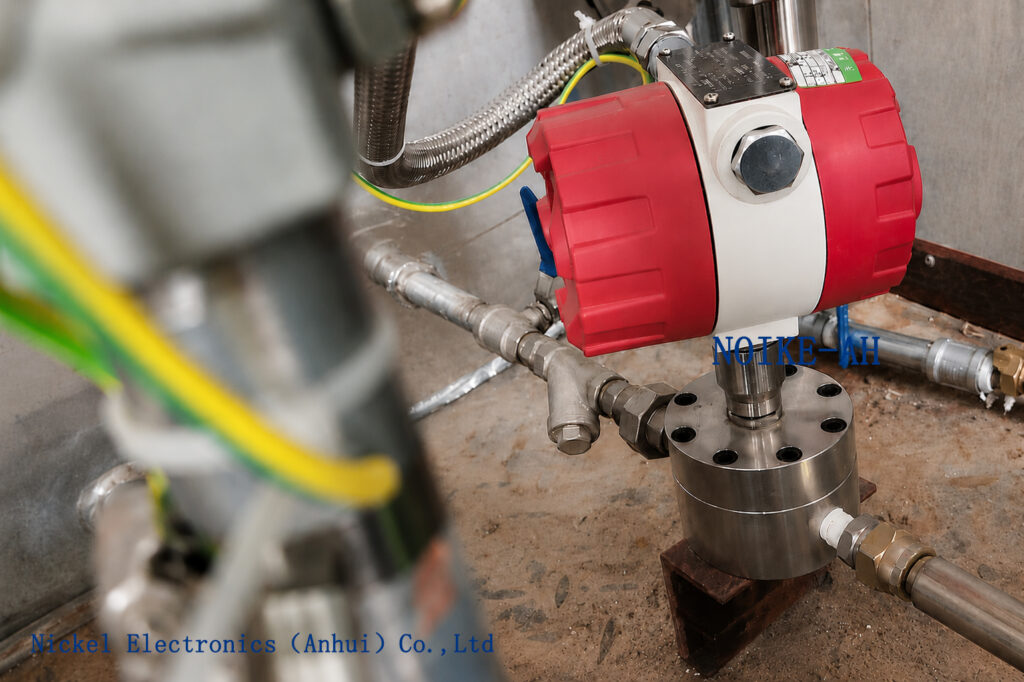
The NOIKE-AH Engineering Solution: The NOIKE-AH Oval Gear Flow Transmitter is specifically engineered for these brutal environments. Machined from high-grade stainless steel or robust cast iron, it seamlessly handles extreme viscosities and is rated for ultra-high-pressure conditions up to 70 MPa (700 bar). It provides unyielding precision for hydraulic test benches and industrial lubrication systems.
4. The Supply Chain Advantage with NOIKE-AH
Sourcing specialized high-pressure, high-viscosity instrumentation from Western conglomerates often involves navigating months-long lead times and rigid volume requirements, severely delaying skid manufacturing and prototyping.
NOIKE-AH redefines the B2B procurement experience by offering a highly flexible, direct-to-manufacturer supply chain:
- OEM/ODM Customization: Support for deep technical customization with a highly flexible 1-piece Minimum Order Quantity (MOQ).
- Agile Engineering Support: Time is money in system integration. We guarantee a 5-minute technical response time for all inquiries.
- Global Standards: Our gear flow meters are rigorously tested, CE-certified, and globally exported, delivering Tier-1 industrial performance at an aggressively optimized price point.



