
Electromagnetic vs. Gear Flow Meters
In the vast landscape of industrial fluid measurement, process engineers are frequently forced to choose between two dominant technologies: Electromagnetic Flow Meters (Magmeters) and Positive Displacement Gear Flow Meters. While both are highly accurate and reliable, they operate on fundamentally different physical principles.
Selecting the wrong technology will not just result in inaccurate readings; it can lead to complete sensor failure, severe pressure drops, or accelerated mechanical wear. As a specialist in precision fluid control, NOIKE-AH (臬克) breaks down the critical differences between these two heavyweights to help you optimize your process instrumentation.
1. Electromagnetic Flow Meters: The Champion of Conductive Fluids
How They Work
Electromagnetic flow meters operate on Faraday’s Law of Electromagnetic Induction. As a conductive fluid passes through a magnetic field generated by coils inside the meter, it induces a voltage. The equation is straightforward:
E = B × v × D
Where E is the induced voltage, B is the magnetic field strength, v is the fluid velocity, and D is the pipe diameter. Because the magnetic field and pipe diameter are constant, the induced voltage is directly proportional to the fluid velocity.
Key Advantages
- Zero Pressure Drop: Magmeters feature a completely unobstructed flow tube with no moving parts. This means they do not induce any pressure loss, making them highly energy-efficient for pumping systems.
- Slurry and Debris Handling: The unobstructed design is perfect for wastewater, chemical slurries, and liquids containing suspended solids.
- Low Maintenance: With no mechanical parts to wear out, they offer an exceptionally long lifespan.
The Catch: The Conductivity Constraint
The absolute prerequisite for a magmeter is that the fluid must be conductive—typically a minimum of 5 μS/cm. If you attempt to measure deionized water, hydrocarbons, oils, or solvents, the meter will read zero.
The NOIKE-AH Solution: For municipal water, wastewater, and conductive chemical applications, the NOIKE-AH NSC100 Electromagnetic Flowmeter is the industry standard. Offering ±0.5% precision and available in sizes from DN15 to DN600, it fully complies with ISO 4064 and OIML R49 standards, delivering rock-solid stability for bulk water management.
2. Gear Flow Meters: The Master of High Viscosity and Pressure
How They Work
Gear flow meters (specifically oval gear meters) are Positive Displacement (PD) devices. Inside the measuring chamber, two tightly meshed oval gears rotate as fluid forces its way through. Each rotation sweeps a precise, known volume of fluid from the inlet to the outlet. By simply counting the rotations using a magnetic sensor, the exact volumetric flow rate is calculated.
Key Advantages
- Viscosity Independence (and Preference): Unlike velocity-based meters, gear meters actually perform better as fluid viscosity increases. High-viscosity fluids seal the microscopic gaps between the gears and the chamber wall, preventing “slippage” and increasing accuracy.
- No Straight Pipe Requirements: Because they do not rely on a symmetrical flow velocity profile, gear meters can be installed immediately adjacent to valves, elbows, or pumps without sacrificing accuracy.
- Non-Conductive Fluids: They are entirely unaffected by the electrical properties of the fluid, making them the ultimate choice for hydrocarbons and oils.
The Catch: Pressure Drop and Cleanliness
Because the fluid must physically push the gears to pass through, these meters introduce a pressure drop into the system. Additionally, the fluid must be clean; abrasive particles or solid debris can jam the mechanical gears.
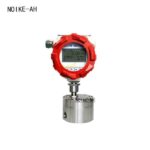
The NOIKE-AH Solution: For hydraulic test benches, fuel monitoring, and heavy oil transfer, the NOIKE-AH Oval Gear Flow Transmitter is unparalleled. Engineered to withstand extreme operating pressures up to 70 MPa, it provides pinpoint accuracy for highly viscous, non-conductive fluids where magmeters simply cannot operate.
3. Head-to-Head Comparison Matrix
| Specification/Feature | Electromagnetic Flow Meter | Oval Gear Flow Meter |
| Measurement Principle | Faraday’s Law of Induction | Positive Displacement (Volumetric) |
| Required Fluid Property | Must be conductive (≥ 5 μS/cm) | Highly suited for non-conductive fluids |
| Viscosity Handling | Unaffected by viscosity | Thrives on high viscosity |
| Pressure Drop | Zero (unobstructed pipe) | Moderate to High (mechanical operation) |
| Moving Parts | None | Yes (Meshing gears) |
| Straight Pipe Requirement | Yes (Typically 5D-10D upstream) | None (Can install anywhere) |
| Ideal Applications | Water, wastewater, chemical slurries | Oils, fuels, resins, high-pressure hydraulics |
4. How to Make the Final Decision
When choosing between these two, ask yourself the following diagnostic questions:
- Is the fluid water-based or oil-based? If it is oil, fuels, or lubricants (non-conductive), you must choose the Gear Flow Meter. If it is water or wastewater, the Magmeter is the default choice.
- How tight is the installation space? If you cannot guarantee sufficient straight pipe runs in a compact skid layout, a Gear Flow Meter will maintain its accuracy, whereas a Magmeter’s readings will fluctuate.
- What is the system pressure? For ultra-high-pressure hydraulic systems (e.g., 50-70 MPa), the heavy-duty mechanical casing of the NOIKE-AH Gear Flow Transmitter is mandatory.
Sourcing Your Sensors: The NOIKE-AH Advantage
Once the technical selection is made, procurement realities often slow down engineering projects. Western brands frequently impose rigid constraints on custom configurations.
NOIKE-AH (臬克) bridges this gap by functioning as a highly agile, professional OEM/ODM manufacturer in China. We offer:
- Unmatched Flexibility: 1-piece Minimum Order Quantity (MOQ) for custom configurations.
- Rapid Engineering Support: A strict 5-minute technical response time to keep your projects moving.
- Certified Quality: CE-certified sensors that deliver global competitiveness without compromising on precision or durability.



