
Direct Answer
Pump system vibration can cause pressure gauge pointer flutter, unstable readings and accelerated wear of the internal movement, gears, Bourdon tube and connections. Over time, a gauge installed in a vibrating location may show inaccurate readings, fail to return to zero, lose the pointer, suffer case damage, loosen at the connection or fail internally.
WIKA lists mechanical vibration, pulsation, extreme temperature, pressure spikes, overpressure, corrosion, clogging and mishandling as common causes of pressure gauge failure. Mechanical vibration can make the pointer erratic and damage internal components. Ashcroft also identifies excessive pulsation and vibration as leading causes of internal wear, pointer instability and premature gauge damage.
Why Pump Systems Create Vibration
Pump vibration can come from the motor, coupling, bearing, impeller, pipe support and fluid pulsation. If a gauge is mounted directly near the pump outlet, pump body, elbow, valve or vibrating pipe, the vibration is transmitted into the gauge movement.
| Source | Possible Cause | Effect on Gauge |
|---|---|---|
| Pump body vibration | Bearing wear, impeller imbalance, misalignment | Pointer flutter, loose connection |
| Pipe vibration | Poor support, high velocity, water hammer | Reading jump, mechanical fatigue |
| Motor vibration | Loose base or unstable installation | Case and movement shock |
| Pressure pulsation | Reciprocating, diaphragm or plunger pump | Fast pointer movement |
| Start-stop shock | Frequent pump cycling or valve action | Pointer shock, Bourdon tube fatigue |
Signs of Vibration-related Gauge Failure
Common signs include:
- pointer flutter;
- unstable or unreadable pressure;
- no zero return after shutdown;
- shifted or detached pointer;
- worn internal movement;
- Bourdon tube fatigue;
- loose or leaking connection;
- repeated failure after replacement.
If the pointer movement caused by vibration or pulsation reaches 5% or more of full scale, Ashcroft Europe recommends reducing the vibration source or reducing its effect on the instrument.
How to Fix the Problem
Reduce the vibration source
Check pump foundation, motor-pump alignment, bearing condition, impeller balance, pipe support, valve action and cavitation risk.
Improve installation position
Avoid mounting gauges directly on the pump body, short discharge pipe, elbows, valves, check valves or unsupported vibrating pipe. Use a more stable pressure tapping point when possible.
Use a liquid-filled or vibration-resistant gauge
For light to moderate vibration, a liquid-filled gauge or dampened movement gauge can improve readability and reduce pointer flutter. WIKA notes that matching gauge design to the application is critical, and vibration is one of the common reasons gauges fail in production facilities.
Add a snubber or dampener
If vibration is combined with pressure pulsation, install a pressure snubber, pulsation dampener or restrictor before the gauge, switch or transmitter.
Use a pressure transmitter for control
For pump control panels and automated systems, use a pressure transmitter to provide continuous feedback to PLC / VFD / control panel. The mechanical gauge can remain as a local indication device.
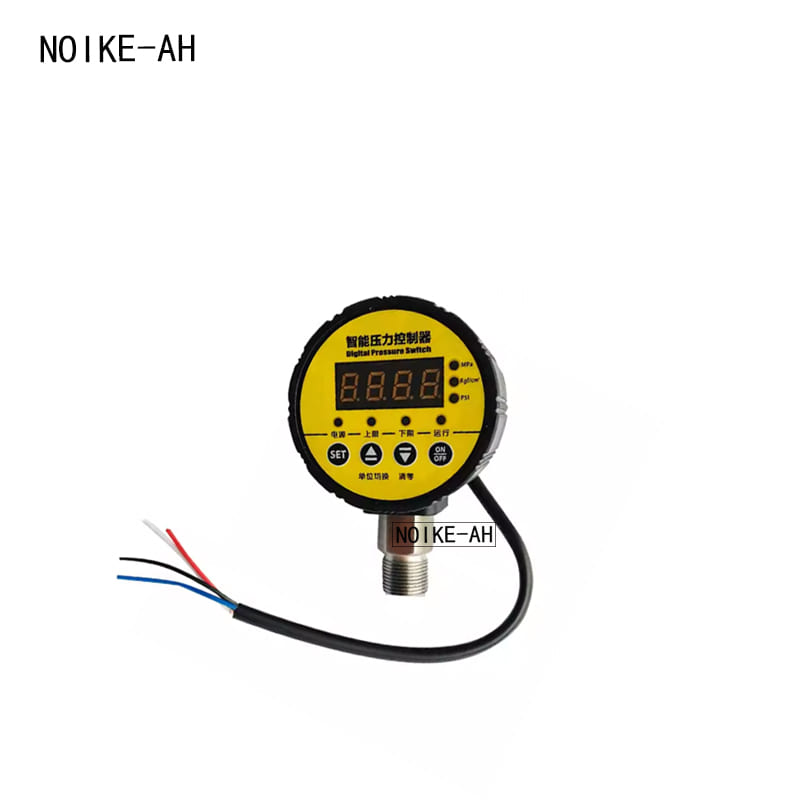
NOIKE-AH Application Solution
NOIKE-AH pressure products can be used for local indication, continuous monitoring and high / low pressure protection in vibrating pump systems. The NOIKE-AH product range covers flow, pressure, temperature, liquid level, position measurement and protection, including Pressure Series. (Noike-AH)
Recommended approach:
- use a digital pressure gauge for local display;
- use a pressure transmitter for continuous pressure feedback;
- use an intelligent pressure switch for alarm and protection;
- avoid direct installation at strong vibration points;
- add snubbers, dampeners or remote mounting when vibration or pulsation is severe.
Product Combination
| Application | Recommended Solution | Function |
|---|---|---|
| Gauge pointer flutter | Digital gauge / liquid-filled gauge | Improve readability |
| Strong pump outlet vibration | Gauge + remote mounting | Reduce vibration transfer |
| Vibration + pulsation | Gauge / transmitter + snubber | Protect instrument and stabilize reading |
| Control panel feedback | Pressure transmitter + PLC filtering | Continuous pressure signal |
| High / low pressure alarm | Intelligent pressure switch + delay | Reduce false action |
| High-reliability pump set | Transmitter + switch + digital gauge + dampener | Monitoring, alarm, display and protection |
Conclusion
When pump system vibration causes inaccurate pressure readings or gauge damage, replacing the gauge alone is usually not enough. The correct approach is to identify the vibration source, check the failure signs, improve installation, use vibration-resistant or digital indication, add damping protection when needed, and use pressure transmitters for control feedback.
NOIKE-AH recommends using digital pressure gauges for local display, pressure transmitters for continuous monitoring and intelligent pressure switches for alarm and protection. For high-vibration or pulsating points, damping, remote mounting or anti-vibration installation should be used to reduce gauge damage and after-sales misjudgment.



