
Pressure Gauges Direct Answer
In pump systems, chemical dosing, water treatment, wastewater, seawater, acids, alkalis and process pipelines, pressure instruments may fail early if the wetted parts are not compatible with the process media. Incorrect wetted material selection can cause diaphragm corrosion, connection leakage, signal drift, pressure gauge failure, transmitter output error or process fluid leakage.
Wetted material compatibility is as important as pressure range and output signal. Ashcroft states that both the diaphragm and lower housing of a diaphragm seal are wetted parts and must be compatible with the process media.
Why Material Compatibility Matters
The parts that contact the process fluid may include:
| Instrument | Wetted Parts |
|---|---|
| Mechanical pressure gauge | Connection, Bourdon tube, welds |
| Pressure sensor | Pressure port, diaphragm, seals |
| Pressure transmitter | Process connection, isolation diaphragm, gasket |
| Diaphragm seal gauge | Diaphragm, lower housing, flange or thread |
| Differential pressure transmitter | High/low side diaphragms, flanges, seals |
If the process media attacks these parts, the instrument may leak, drift, lose accuracy or fail completely.
Common Signs of Corrosion Damage
| Field Symptom | Possible Cause |
|---|---|
| Rust, discoloration or leakage at the connection | Wetted material is not compatible |
| Gauge does not return to zero | Bourdon tube corrosion or deformation |
| Transmitter zero drift | Diaphragm corrosion or stress change |
| 4–20mA output becomes unstable | Sensor diaphragm or internal structure damage |
| Crystals or deposits at the port | Crystallization, clogging and corrosion |
| O-ring swelling or cracking | Seal material incompatibility |
| Same point damages instruments repeatedly | Application and material selection problem |
Media That Need Special Attention
Special wetted material selection is often required for:
- acids and alkalis;
- chloride-containing liquids;
- seawater and brine;
- chemical dosing fluids;
- wastewater and sludge;
- electroplating solutions;
- cleaning fluids;
- high-temperature corrosive liquids;
- viscous or crystallizing fluids.
Yokogawa states that corrosion-resistant differential pressure and pressure transmitters use wetted materials such as Hastelloy C and tantalum for corrosive process media, and appropriate material selection allows these transmitters to be used across a wide range of processes.
How to Select the Right Wetted Material
Confirm process conditions
Before selecting a gauge or transmitter, confirm:
- media name;
- concentration;
- temperature;
- pressure range;
- chloride content;
- suspended solids or crystals;
- cleaning chemicals;
- high temperature, high pressure or vacuum conditions.
Select compatible materials
| Condition | Selection Direction |
|---|---|
| Water, air, oil | Stainless steel wetted parts are often suitable |
| Mild corrosive liquid | 316L or suitable stainless steel |
| Strong corrosive chemicals | Hastelloy, Tantalum, Monel or special coating |
| Viscous or crystallizing media | Diaphragm seal or flush diaphragm |
| High-temperature corrosive media | Diaphragm seal + capillary / cooling structure |
| Wastewater or slurry | Isolation ring, diaphragm seal or anti-clogging design |
WIKA notes that corrosive or extreme-temperature processes often require protective diaphragm seals, with materials such as 316 stainless steel, Hastelloy, Monel or tantalum.
Use diaphragm seals when needed
A diaphragm seal separates the pressure instrument from the process media. WIKA states that diaphragm seals can be used with pressure gauges, process transmitters and pressure switches for aggressive, corrosive, abrasive, highly viscous or toxic media.
NOIKE-AH Application Solution
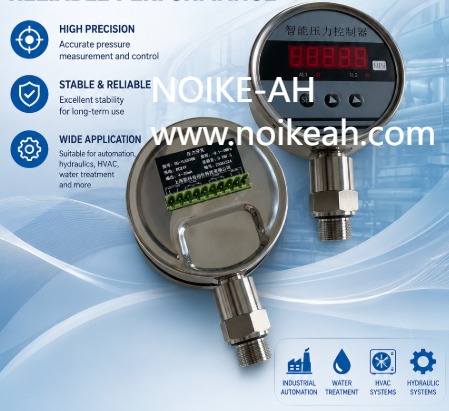
NOIKE-AH pressure products can be used for local indication, continuous pressure monitoring and high / low pressure protection in corrosive process applications.
NOIKE-AH pressure sensors and transmitters support output options such as 4–20mA / HART / Modbus, and the product range covers pressure gauges, pressure switches, pressure sensors and pressure transmitters. (Noike-AH)
Recommended approach:
- use a digital pressure gauge for local pressure display;
- use a pressure transmitter for continuous pressure feedback to PLC / VFD / control panel;
- use an intelligent pressure switch for high / low pressure alarm;
- select compatible wetted materials according to the process media;
- use a diaphragm seal when the media is corrosive, viscous, crystallizing or likely to clog the pressure port.
Product Combination
| Application | Recommended Solution | Function |
|---|---|---|
| Water, air, oil | Digital gauge / pressure transmitter | Local display or continuous signal |
| Mild corrosive media | 316L wetted parts | Better corrosion resistance |
| Strong corrosive liquid | Diaphragm seal + pressure transmitter | Isolate media and protect sensor |
| Viscous or crystallizing media | Flush diaphragm / diaphragm seal | Reduce clogging and corrosion |
| Chemical dosing system | Pressure transmitter + diaphragm seal | Continuous monitoring |
| Process alarm | Pressure switch + compatible wetted parts | High / low pressure protection |
Conclusion
When the process media is corrosive, incorrect wetted material selection can cause corrosion, leakage, drift, clogging, wrong readings and instrument failure. Correct selection requires more than pressure range and thread size. It must include media name, concentration, temperature, corrosion behavior, crystallization, solids content and compatibility of all wetted parts.
NOIKE-AH recommends selecting pressure gauges, pressure transmitters and pressure switches based on wetted material compatibility. For strong corrosive, viscous or crystallizing media, a diaphragm seal or other isolation structure should be considered to reduce instrument damage and after-sales misjudgment.



