
Noike-AH Electronic Flow Switches
Executive Summary In Singapore’s hot and humid tropical climate, cooling systems account for approximately 40% of a data center’s total energy consumption. With the rise of high-density computing, data centers are rapidly transitioning towards chilled water systems and Direct Liquid Cooling (DLC). However, incidents of server overheating and downtime caused by flow interruptions or pipeline leaks frequently occur.
Traditional mechanical paddle flow switches pose a critical “false security” risk due to their susceptibility to mechanical wear and jamming. To address this, Noike-AH leverages its thermal dispersion electronic flow switches, which contain no moving parts, providing Singapore data center operators with a highly reliable monitoring solution that eliminates mechanical fatigue, ensures minimal pressure drop, and perfectly aligns with the Singapore Standard for Tropical Data Centres (SS 697).
I. Deconstructing Physical Principles and Singapore On-Site Pain Points
1. System-Level Outage Risks Driven by Cooling Failures and Human Error Data centers must provide uninterrupted cooling capabilities. In October 2023, major banks in Singapore (DBS and Citibank) experienced severe service outages. The root cause was traced back to an underlying data center where a contractor mistakenly closed the valves of the chilled water buffer tanks during an upgrade, directly cutting off the chilled water flow and causing severe overheating in the data halls. This highlights the extreme importance of real-time, highly reliable flow monitoring in cooling loops to prevent catastrophic downtime.
2. Leakage Risks in High-Density Direct Liquid Cooling (DLC) As modern GPU servers increasingly adopt direct-to-chip liquid cooling, the risk of water leaks has become a critical concern. Recently, in a Southeast Asian data center, a ruptured overhead liquid cooling pipe flooded the aisle, destroying a GPU cluster worth millions of dollars. Complex liquid cooling systems require highly sensitive flow deviation detection to provide early leak warnings.
II. Industry Status Quo and Limitations of Traditional Mechanical Switches
Many existing HVAC and cooling water networks still heavily rely on traditional mechanical paddle flow switches. This technology exposes severe physical flaws in mission-critical environments:
- Mechanical Fatigue and “False Security”: Mechanical flow switches rely on fluid force to push a spring-loaded paddle to trigger physical contacts. Under the continuous 24/7 fluid impact in data centers, these mechanical components are highly prone to wear and tear. If debris in the cooling water causes the paddle to jam in the “flow present” position, the switch will fail to spring back and trigger an alarm during an actual flow loss, creating a dangerous monitoring blind spot.
- Increased Energy Consumption (Pressure Drop): Physical paddles protruding into the pipeline obstruct water flow, creating a noticeable pressure drop. This forces chilled water pumps to consume more electricity to maintain the required flow rate, directly contradicting the data center’s goal of lowering its Power Usage Effectiveness (PUE).
III. Noike-AH’s Electronic and Energy-Efficient Solutions
Noike-AH provides data centers with an advanced alternative that entirely discards mechanical structures:
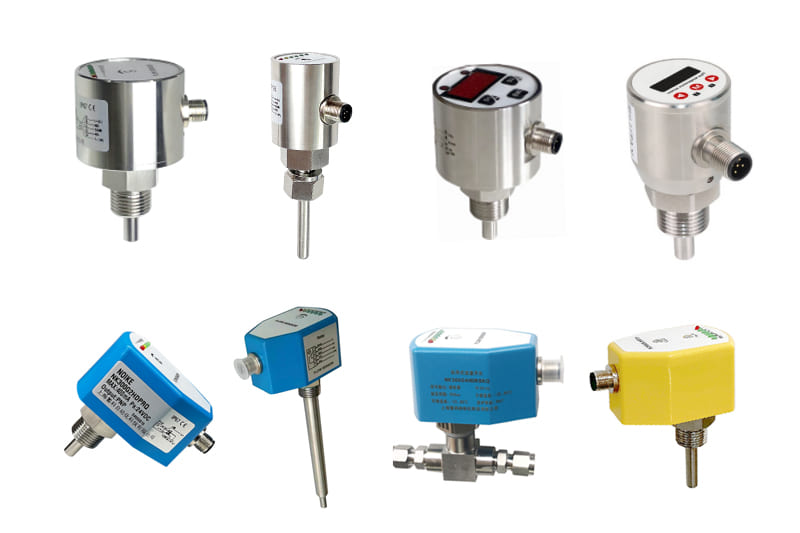
- 1. Thermal Dispersion Electronic Flow Switches: Noike-AH’s NK300B and NK600 series flow switches operate on the thermal dispersion principle. There are absolutely no mechanical moving parts between the probe and the fluid, completely eliminating failures caused by jamming or spring fatigue, thereby achieving maintenance-free operation and exceptional reliability.
- 2. Ultra-High Sensitivity and Early Leak Warning: Thermal dispersion sensors are highly sensitive to low flows and subtle velocity changes. Deploying them in the return or branch lines of liquid-cooled racks can provide early warnings in the event of minor leaks or partial blockages, allowing facility teams to intervene proactively before hardware damage occurs.
- 3. Alignment with SS 697 Tropical Standards and Minimal Pressure Drop: Singapore’s Tropical Data Centre Standard (SS 697:2023) guides operators to safely raise operating temperatures to 26°C and above, aiming for a 2% to 5% cooling energy saving per degree. Noike-AH’s electronic flow switch probes lack obstructing paddles, resulting in virtually zero pressure drop. This significantly reduces pump loads, directly assisting data centers in meeting the stringent PUE requirements of the BCA-IMDA Green Mark certification.



