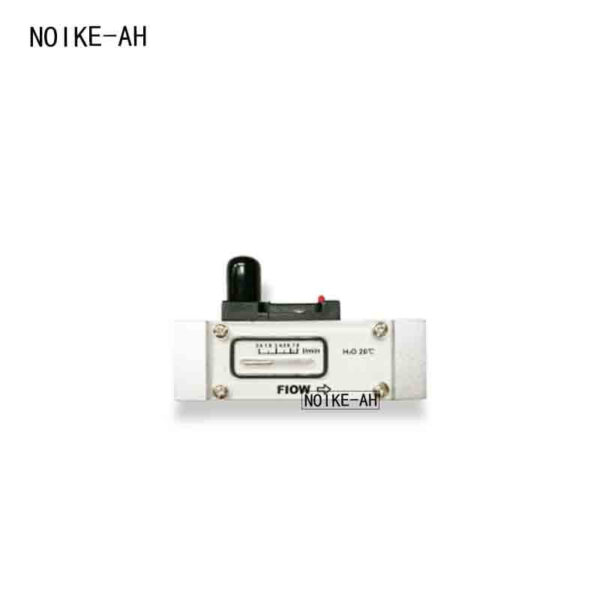
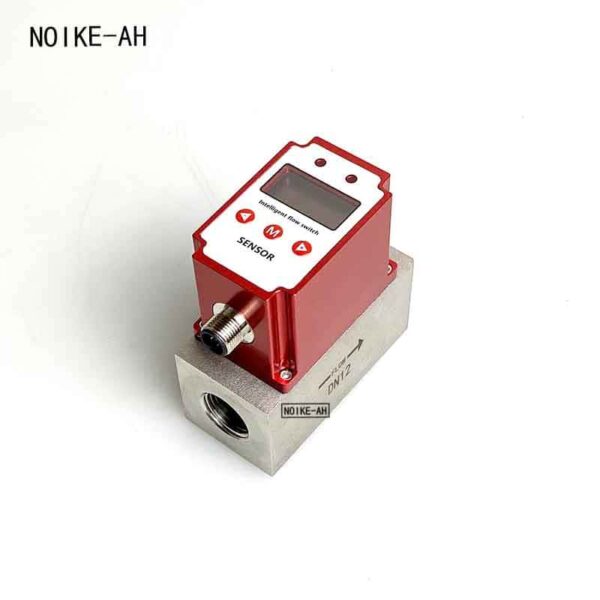
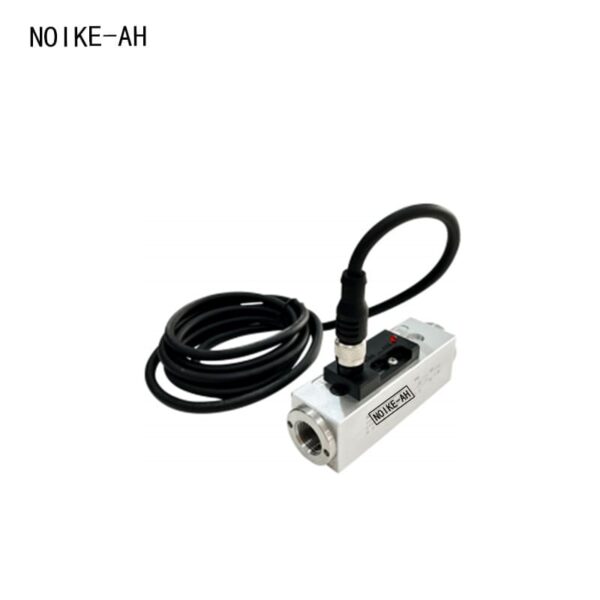
Product Overview
The Explosion-Proof Flow Sensor NKGF-90 operates based on the thermal dispersion principle. Inside the sealed sensing probe are two resistors: one functions as the heated sensing resistor, while the other serves as the unheated reference resistor.
When the process medium flows across the probe, heat generated by the sensing resistor is carried away by the moving medium. This changes the resistance value of the heated element. The instrument continuously compares the resistance difference between the sensing resistor and the reference resistor to determine the flow condition and generate a corresponding analog output signal.
Its integrated probe and electronic design provides stable operation, convenient installation, and reliable long-term flow monitoring for industrial applications.
Why Choose This Explosion-Proof Flow Sensor NKGF-90 ?
Selecting the right flow sensor is important for maintaining process safety and equipment protection in hazardous environments. This model offers several practical advantages:
- Thermal measurement technology with no moving mechanical parts
- Continuous 4–20mA analog output for PLC and DCS systems
- Integrated probe and signal processing circuit for easy installation
- Built-in temperature compensation for improved measurement stability
- Designed for hazardous industrial environments
- Long service life with minimal maintenance requirements
- Suitable for monitoring both liquid and gas flow
Working Principle
The sensor uses the thermal dispersion measurement principle.
Two resistors are enclosed inside the sensing probe:
- One resistor is continuously heated and serves as the sensing element.
- The other remains unheated and acts as the reference element.
As the medium flows past the probe, heat from the heated resistor is transferred into the moving fluid. The resulting resistance change is compared with the reference resistor. The resistance difference is used to determine the flow rate and generate a proportional 4–20mA analog output.
Product Features
- No moving mechanical parts for improved reliability
- Corrosion-resistant construction
- Stable performance and long service life
- Maintenance-free operation under normal conditions
- Integrated sensing probe and signal processing electronics
- Built-in temperature compensation minimizes measurement errors caused by changes in medium and ambient temperature
- Low power consumption with high-reliability electronic components
- Standard 4–20mA analog output
- Suitable for continuous industrial flow monitoring
Product Applications
The product carries the ExdIICT6 Gb explosion-proof certification and complies with the requirements of GB3836.1 and GB3836.2.
It is suitable for installation in:
- Zone 1 hazardous areas
- Zone 2 hazardous areas
- Class IIA explosive gas environments
- Class IIB explosive gas environments
- Class IIC explosive gas environments
It is designed for locations where flammable gases or vapors with ignition temperature groups T1–T6 may form explosive mixtures with air.
Typical applications include:
- Petrochemical plants
- Chemical processing
- Oil and gas facilities
- Industrial gas systems
- Hazardous process pipelines
- Flow monitoring systems
Note: The enclosure must not be opened while power is applied.
LED Setting Function (Switch Version)
After installation:
- Allow the medium to flow at the desired minimum monitoring flow rate.
- Adjust the lower-limit knob until the first green LED illuminates, corresponding to 4mA.
- Increase the medium flow to the required maximum monitoring flow rate.
- Adjust the upper-limit knob until the fifth green LED illuminates, corresponding to 20mA.
The sensor then outputs a linear analog signal proportional to the flow rate:
- 4mA → Lower flow limit
- 20mA → Upper flow limit
Technical Specifications
| Parameter | Specification |
|---|---|
| Measuring Principle | Thermal Dispersion |
| Setting Range | 1–300 cm/s (Water) 20–2000 cm/s (Air) |
| Output Signal | 4–20mA Analog |
| Supply Voltage | 24V ±20% DC |
| Pressure Rating | 100 bar |
| Medium Temperature Change | ≤4°C/s |
| Electrical Protection | Reverse polarity, short circuit, overload protection |
| Protection Class | IP65 |
| Medium Temperature | -20°C to 90°C |
| Ambient Temperature | -20°C to 80°C |
| Storage Temperature | -20°C to 100°C |
| Probe Material | Stainless Steel |
| Housing Material | Cast Aluminum |
Wiring Diagram
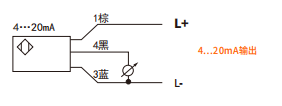
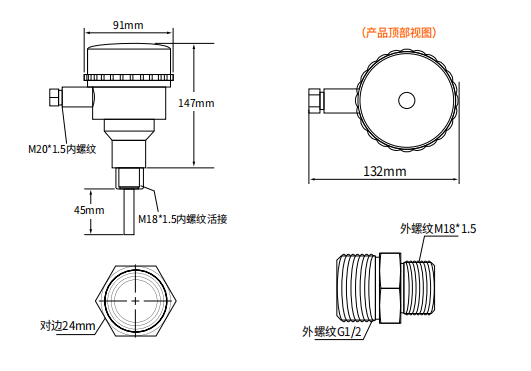
Dimensional drawing (mm)
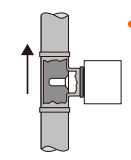
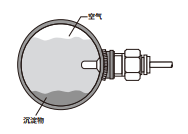
Installation direction
Typical Industrial Application
In hazardous industrial environments such as chemical plants and petrochemical facilities, continuous flow monitoring is essential for maintaining process safety.
The explosion-proof thermal flow sensor provides a continuous 4–20mA analog signal to PLC or DCS control systems, allowing operators to monitor flow conditions in real time. Because the sensor contains no moving mechanical parts, it offers stable performance with reduced maintenance requirements while meeting explosion-proof installation requirements in Zone 1 and Zone 2 hazardous areas.
Frequently Asked Questions (FAQ)
What is the measuring principle of this flow sensor?
It measures flow using the thermal dispersion principle by detecting the heat transfer difference between a heated resistor and a reference resistor.
What output signal does the sensor provide?
The standard output is 4–20mA analog.
Is it suitable for hazardous areas?
Yes. The sensor is certified ExdIICT6 Gb and is suitable for Zone 1 and Zone 2 hazardous locations.
Does the sensor require regular maintenance?
Under normal operating conditions, the sensor requires no special maintenance because it has no moving mechanical parts.
Can it monitor both gas and liquid flow?
Yes. It is suitable for monitoring both liquid and gas media within the specified measuring range.